


 Abstract
 HTML
HTML Reference
 Related
 PDF
PDF


-
The reaction of proton radiative capture by 7Be is the essential part of the pp-chain or more precisely – pp-III chain [1]. The radiative capture reaction 7Be(p, γ)8B played an important role in uncovering the apparent loss of solar neutrino flux. The flux of 8B neutrinos, detected by the Super-Kamiokande [2] and Sudbury Neutrino Observatory [3], contrasted with predictions from standard solar model(SSM), led to the discovery of the neutrino oscillations. For the current tasks of neutrino physics cross-section of 7Be(p, γ)8B reaction should be well studied around
$ \approx $ 20 keV incident proton energy, but experiments in the low-energy region are difficult and currently limited to energies above 100 keV. Thus, the required cross-section can come from low-energy extrapolations of data or from direct computations.For available energies this reaction is rather well studied – [4−10]. Data from these experiments agree well, so it looks optimal to compare the results of computations presented bellow with the latest known experimental data [9], as one of the most complete.
On the other hand, the results of the extrapolation procedures for the low energy region differ quite significantly [10, 11] - the S17(0) varies from 17.1
$ \mp $ 0.5 to 22.6$ \mp $ 0.2. eV·b. The most recent investigation of this kind [10], which thus takes into account the experience of previous studies, resulted in the value 20.9$ \mp $ 0.6 (exp)$ \mp $ 0.7(theor.) eV·b. The alternative way of obtaining S17(0) is by extracting asymptotic normalization coefficients (ANCs) from breakup reactions 10B(7Be, 8B)9Be, 14N(7Be, 8B)13C and 13C(7Li, 8Li)12C [12]. The extracted squared ANC is$ C_{\mathrm{tot}}^2=0.450\mp0.039 $ fm−1, that leads to the astrophysical factor$ S_{17} (0) = 17.6 \mp 1.7 $ eV·b.So, the discrepancy in the results of analysis of experimental data leads to necessity of the use of various theoretical approaches.
Modern high-precision methods for describing both light nuclei properties and characteristics of reactions induced by light nuclei collisions are advancing nowadays. An important role among the methods describing light nuclei structure belongs to various ab initio methods. These approaches are based on new possibilities provided by modern high-performance supercomputers and on the use of realistic nucleon-nucleon potentials. These potentials could be derived from Chiral Effective Field Theory [13−15] or from nucleon scattering data by the use of J-matrix inverse scattering method [16]. In the current work the Daejeon16 NN-potential [13] which is built using the N3LO limitation of Chiral Effective Field Theory is exploited.
The most popular among ab initio methods describing nuclear structure are various versions of No-Core Shell Model (NCSM) [17], Gamov Shell Model (GSM) [18], Green functions Monte Carlo method [19] and the Coupled Cluster Method [20].
NCSM model and methods similar to it are, however, not adapted to describe clustering effects and, consequently, wave functions of channels of nuclear reactions, as well as decay properties of resonances directly. For this purposes, different methods were developed. Among them there are methods which combine NCSM and RGM namely No-Core Shell Model/Resonating Group Model (NCSM/RGM) [21] and No-Core Shell Model with Continuum (NCSMC) [22] are considered the most developed. As the NCSMC the Fermionic Molecular Dynamics (FMD) [23] offers in fact an ab initio approach focused on the unified description of both bound states and continuum ones.
For theoretical studies of nuclear reactions on light nuclei many approaches which are not ab initio ones are used. The use of phenomenological potentials together with truncated bases leads to simplifying calculations and, in some cases, better description of long-range asymptotic. Among these approaches one can mention Generator Coordinate Method (GCM) [24], Microscopic Cluster Model [25], Antisymmetrized Molecular Dynamics (AMD) [26], Algebraic Version of the RGM [27], Coupled Cluster Method [20] and Coupled Cluster Gamov Shell Model - (GSM-CC) [28]. Hartree-Fock approach with the Skyrme forces is also used for studying the discussed reactions [29].
Both ab initio methods and methods using effective nucleon-nucleon potentials were used for studying 7Be(p, γ)8B reaction. Most of these calculations turn out to be in good agreement with the pattern of experimental values of radiative proton capture cross-sections in the energy area, available for the measurements. However, they show rather different values of astrophysical S-factor at zero energy
$ S_{17} (0) $ . Indeed, for Hartree-Fock approach with the Skyrme forces [29] this value is$ S_{17} (0) = 22.3 $ eV·b. In case of the use of coupled-channel formalism [30, 31]$ S_{17}(0) $ are 20.9 and 21.0 eV·b, respectively. The GSM-CC model was also used for 7Be(p, γ)8B process calculation with the use of an effective finite-range two-body interaction and inert 4He core –$ S_{17}(0) = 23.21 $ eV·b [28]. Among the approaches presented in the literature exploited to solve the problem under discussion, NCSMC appears to be the most theoretically justified. The results obtained by the use of NCSMC calculations [32] suggest the value for the 7Be(p, γ)8B S-factor at zero energy of 19.8$ \pm $ 0.3 eV·b for N4LO interaction and 21.0 eV·b for N3LO interaction.Thus, the above presented results of calculations demonstrate an essential scatter at low energies. Such a situation confirms the importance of further theoretical investigations, especially using well-founded ab initio methods. In the current work the results which have been obtained in the framework of approach of such a type, namely Cluster Channel Orthogonal Functions Method (CCOFM) are presented. We have previously demonstrated the high quality of the description by this method of the decay widths and ANCs of various nucleon and cluster channels [33], which gives hope for its successful application in both the discussed and many other problems of nuclear astrophysics. One of the basic advantages of this scheme is that, in contrast to the previously developed ones, it allows one to calculate not only total decay widths but the reduced partial width amplitudes (RPWAs) of resonance states into various cluster channels simultaneously. The method is based on the employment of NCSM computations. The possibility to calculate ANCs and RPWAs of decay channels within CCOFM makes it possible to develop the method of using ab initio calculated quantities in the theoretical studies of resonance nuclear reactions because the cross-sections of these reactions in the R-matrix theory are expressed in terms of ANCs and RPWAs.
Earlier this method was successfully used for studying elastic scattering of neutrons on 9Be [34] and for obtaining the cross-sections of resonance nuclear reactions going throw 8Be compound nucleus – [35, 36].
To study the proton radiative capture process, the CCOFM approach must be supplemented by NCSM calculations of the electromagnetic transition amplitudes. Methods allow one to increase the quality of calculations of such values are present in the present paper.
-
Let us briefly review the structure of the CCOFM algorithm. The first step of the algorithm is to construct translationally-invariant A-nucleon wave functions (WFs) for an arbitrary two-fragment decay channel. The oscillator-basis terms of the cluster channel
$ c_\kappa $ are expressed in the following form:$ \Psi^{c_\kappa} _{{A\,},nlm} = \hat A\{\Psi^{\{k_1\}}_{A\,_1 } \Psi^{\{k_2\}}_{A\,_2 } \varphi _{nlm} (\boldsymbol \rho )\}_{J_cJM_JT} , $
(1) where
$ \hat A $ is the antisymmetrization operator,$ \Psi^{\{k_i\}}_{A\,_i} $ is a translationally-invariant WF of the cluster labelled by a set of quantum numbers$ \{k_i\} $ ;$ \varphi _{nlm} (\boldsymbol \rho) $ is the function of the relative motion. The CCOFM cluster wave function component is labelled by the set of quantum numbers$ c_\kappa $ which includes$ \{k_1\},\{k_2\},n,l,J_c,J,M_J,T $ , where J is the total momentum and$ J_c $ is the channel spin.The presented WFs are used in CCOFM together with the NCSM functions written in the M-scheme. Therefore, the main objective of the method is to represent them in as superpositions of Slater determinants (SDs). To do that we exploited the technique of so-called cluster coefficients (CCs). In this approach each function (1) is multiplied by the function of the center of mass (CM) zero vibrations
$ \Phi _{000} (\boldsymbol R) $ . Then the transformation of WFs caused by changing from relative coordinates -$ \boldsymbol R,\boldsymbol \rho $ to cluster centres$ \boldsymbol R_1,\boldsymbol R_2 $ coordinates is performed by the use of Talmi-Moshinsky-Smirnov transformation [37]. After that WF (1) takes the form$ \begin{aligned}[b]&\Phi _{000} (\boldsymbol R)\Psi^{c_\kappa} _{{A\,},nlm} = \sum\limits_{N_i ,L_i ,M_i} \left\langle {\begin{array}{*{20}{c}} {\begin{array}{*{20}{c}} {000}\\ {nlm} \end{array}}&{\left| {\begin{array}{*{20}{c}} {{N_1},{L_1},{M_1}}\\ {{N_2},{L_2},{M_2}} \end{array}} \right.} \end{array}} \right\rangle \\& \hat A\{ \Phi _{N_1 ,L_1 ,M_1 }^{A_1 } (\boldsymbol R_1 ) \Psi^{\{k_1\}}_{A\,_1 } \Phi _{N_2 ,L_2 ,M_2 }^{A_2 } (\boldsymbol R_2 )\Psi^{\{k_2\}} _{A\,_2 } \} _{J_c,M_{J_c},M_JT} . \end{aligned}$
(2) Further, each of the two products of the internal WF of the fragment with its function of non-zero center-of-mass oscillations is expanded onto a superposition of Slater determinants (SDs). The overlap of such a product with SD or a more complicated shell-model
$ A_i $ function is called cluster coefficient (CC). As a result of these transformations, cluster channel WF (1) turns out to be a superposition of SDs. The methods of calculations of CCs explained in detail in [38, 39]. An alternative is to directly use the methods of the translation-invariant shell model (see, for example [21, 22]).It should be noted that WFs (1) of the same channel
$ c_\kappa $ are non-normalized and non-orthogonal due to the properties of the antisymmetrizator. Creation of orthonormalized basis is performed by the diagonalization of the overlap kernel$ \begin{aligned}[b] &||N_{nn'} || \equiv \langle \Psi^{c_\kappa} _{{A\,},n'}|\Psi^{c_\kappa} _{{A\,},n} \rangle = \\& \langle \Psi^{\{k_1\}} _{A_1} \,\Psi^{\{k_2\}} _{A_2} \,\varphi _{nl} (\rho ) |\hat A^2 |\Psi^{\{k_1\}} _{A_1} \,\Psi^{\{k_2\}} _{A_2} \,\varphi _{n'l} (\rho )\Phi _{00}(\boldsymbol R) \rangle . \end{aligned} $
(3) The eigenvalues -
$ \varepsilon _{\kappa,k} $ and eigenvectors –$ f_l^k (\rho) $ of the overlap kernel matrix are the result of this diagonalization.Thus, the wave functions of the orthonormalized channel basis
$ c_\kappa $ turn out to be represented in the form of the superposition of the SDs.The basis of such functions is complete in the sense that a function of this channel including arbitrary function of relative motion
$ \Phi(\rho) $ can be represented as a superposition of such WFs, i.e. as a linear combination of SDs.The cluster form factor (CFF)
$ \Phi^{c_\kappa}_A(\rho) $ describes the relative motion of subsystems of discussed channel$ c_\kappa $ in A-nucleon configuration space. It is defined by the following overlap$ \begin{array}{c} \Phi^{c_\kappa}_A(\rho)= \langle \Psi _{A}|\hat N^{-1/2}\hat A\{\Psi^{\{k_1\}} _{A\,_1} \Psi^{\{k_2\}} _{A\,_2}\dfrac{\delta(\rho-\rho')}{\rho'^2}Y_{l} (\Omega)\} _{J_c,M_JT}\rangle , \end{array} $
(4) where
$ \Psi _{A} $ is the WF of the initial nucleus calculated by the use of NCSM and$ \hat N $ is the exchange kernel operator. The exchange kernel can be represented as the overlap kernel matrix (3). This makes it possible to rewrite the CFF in the form$ \Phi^{c_\kappa}_A(\rho)=\sum\limits_k \varepsilon^{-1/2} _{\kappa,k} \langle \Psi _{A}|\hat A\{ \Psi^{\{k_1\}} _{A_1} \,\Psi^{\{k_2\}}_{A_2} \,f_l^k (\rho') \} \rangle f_l^k (\rho ). $
(5) In this way, the CFF of an arbitrary two-body channel
$ c_\kappa $ can be obtained throw a successive overlapping of the WF of a nucleus$ \Psi _{A} $ with functions of orthonormalized cluster channel basis.The spectroscopic factor (SF) is defined as the norm of CFF. Both SFs and CFFs are the objects used in theoretical studies on nuclear decays and reactions.
It is important to emphasize that the definitions of CFF and SF we use have a long history of refinement and confirmation. The matter is that the initial definition of the SF of alpha decay channels was given in [40], and the nucleon channel – in [41]. They were included in textbooks and were used for a long time (and is still sometimes used) in various scientific publications. Modified definitions of the CFF and SF were proposed in [42] (in this work they were called "new" spectroscopic factor and "new" CFF as opposed to "old" ones). In contrast to the traditional definition, the new CFF and SF characterize the total contribution of orthonormalized cluster components to the solution of the Schrödinger equation describing an A-nucleon system. Despite the obvious shortcomings of the primary version, sometimes leads to SF values greater than unity, which results in a violation of the unitarity of the theory of nuclear processes, discussions regarding the correctness of both approaches continued for a very long time. The decisive arguments in favour of the necessity of its use for the description of nuclear decay and reactions can be found in publications [43, 44]. In [45, 46], it was shown that the correct definition eliminates a sharp contradiction between theoretically calculated values of the cross sections for reactions of knock-out and transfer of α clusters and the experimental data. For example the use of the "old" definition of the SF, that is, the loss of normalization of the asymptotic wave function, leads to an underestimation of the cross section of knock-out reaction 40Ca(p, p'α)36Ar by more than 20 times, while using the "new" definition gives a result close to the measured one. Using this fact, one can talk about "experimental" confirmation of validity of the latter definition.
A detailed description of the problem under discussion as a whole is presented in our paper [47].
In CCOFM the CFFs are used for computing the widths of resonances. While, the norms of these values – SFs – are used to distinguish the main channels against the background of a multitude of other ones. Although, in simplified calculations, partial widths can be obtained with the use of SF.
For calculation of asymptotic properties of open and closed decay channels we use the procedure of logarithmic matching of the CFF with the asymptotic WF of the corresponding channel.
The partial decay channel width is obtained within the expression relative to one used in traditional R-matrix theory:
$ \Gamma = \frac{\hbar^2}{\mu k_0} \Xi_l ( \rho_{m})^{-2}(\Phi _A^{c_\kappa} (\rho_{m} ))^2, $
(6) where
$ \Xi_l ( \rho) = (F^2_l ( \rho) + G^2_l ( \rho))^{1/2}, $
(7) $ F_l (\rho) $ and$ G_l (\rho) $ are regular and irregular Coulomb functions,$ \rho_m $ is the point of exact matching of the logarithmic derivatives of functions$ \Phi^{c_\kappa}_A(\rho) $ and$ \Xi_l (\rho) $ . The position of the matching point and the size of the stability region of the results of its search depend, naturally, on the parameters$ \hbar\omega $ and$ N* $ characterizing the NCSM basis. For open p-wave channels of proton decays of 8B, values of the matching radius appear to be 3.6$ \pm $ 0.3 fm.The reduced partial width amplitude (RPWA) is expressed throw the value of CFF as
$ \gamma_{c_{\kappa}} = (\frac{\hbar^2 \rho_m}{2 \mu_c})^{1/2} \Phi_A^{c_{\kappa}}(\rho_m). $
(8) In R-matrix calculations the sign of partial decay width amplitude is needed. It is determined by sign of CFF at the matching point.
For closed decay channels the asymptotic normalization coefficient (ANC) –
$ A^{c_\kappa} $ is determined by the way:$ A^{c_\kappa}= \rho_{m} \Phi _A^{c_\kappa} (\rho_{m} )/W_{-\eta,l+1/2}(2k \rho_{m}), $
(9) where
$ W_{-\eta,l+1/2}(2k \rho) $ is the Whittaker function. For closed nucleon channels of 8B, the values of the matching radius are found to be 4.0$ \pm $ 0.4 fm.The real possibility to calculate asymptotic properties of arbitrary two-body decay channels within the CCOFM makes it possible to develop the method of using ab initio calculated quantities in the theory of nuclear reactions.
There are many computer implementations of R-matrix theory, we use the AZURE2 R-matrix code [48]. In AZURE2 the input parameters include an analogue of the matching radius in addition to the asymptotic properties listed in (8, 9). However, in AZURE2 the matching radius is determined as one and the same value for each pair of colliding and scattered particles. In [34] it was showed that the calculated cross sections for resonant reactions very weakly depend on the variation of this parameter in a wide range of distances. For proton direct capture the cross section also weakly depends on the value of the matching radius - in our case the value of S17(0) changes by less that 0.05% when the matching radius is varied by 0.5 fm.
In the current work, the WFs of 7Be and 8B nuclei are calculated in standard M-scheme of the NCSM on the complete basis of SDs with the cut-off parameter
$ \rm{\mathit{N}}_{\mathrm{max}}^* $ in the space of total number of excitation quanta. NCSM calculations are carried out with the use of shell-model code Bigstick [49].But for nuclei around A
$ \approx $ 8 NCSM calculations are not fully converged even for maximum allowed cut-off parameter. The only way out of this situation is the use of one of the extrapolation procedures. We use the well-known five-parameter "Extrapolation A5" method [50] when needed.In our previous paper [34] it was shown that for deeply sub-barrier resonances, even a moderate deviation of the calculation resonance energy from the experimental one often leads to a dramatic, sometimes by several orders of magnitude, changes in the calculated values of cross-sections of resonance nuclear reactions. On the other hand, the accuracy of NCSM calculations is limited even after the use of an extrapolation procedure. This reason necessitates to introduce the experimental values of resonance energies to the computation of decay widths. Note that the theoretical groups performing similar ab initio studies of the decay processes also use the same procedure in certain situations. It has become known as NCSMC-pheno in the literature [51].
The electromagnetic decay widths could be calculated with the use of NCSM model [52]. The possibility of both EJ and MJ transitions are expressed throw reduced transition probabilities:
$ P(EJ, MJ) = 8 \pi \frac{e^2}{\hbar} \frac{J+1}{J[(2J+1)!!]^2} k^{2J+1} B(EJ, MJ). $
(10) The reduced transition probabilities B(EJ, MJ) is defined in terms of reduced matrix elements of a one-body operators by:
$ B(i \rightarrow f) = \frac{|\langle J_f || O(\lambda) || J_i \rangle|^2}{(2J_i + 1)}. $
(11) The one-body operators
$ O(\lambda) $ represent a sum over the operators for the individual nucleon degrees of freedom i$ O(\lambda) = \sum\limits_{i} O(\lambda, i). $
(12) For electric transition one-body operator is defined as
$ O(E\lambda) = r^{\lambda} Y^{\lambda}_{\mu} (\hat r) e_q e, $
(13) and for magnetic transitions operator is defined as
$ O(M\lambda) = \left[ \boldsymbol l \frac{2g_q^l}{\lambda + 1} + \boldsymbol s g^s_q \right] \boldsymbol \nabla \left[ r^{\lambda} Y^{\lambda}_{\mu} (\hat r) \right] \mu_{N}. $
(14) Using the Bigstick shell model code one can calculate the reduced matrix elements as a sum over one-body transition densities times single-particle matrix elements:
$ \langle f || O(\lambda) || i \rangle = \sum\limits_{k_{\alpha}, k_{\beta}} OBTD(fik_{\alpha}k_{\beta}\lambda) \langle k_{\alpha} || O(\lambda) || k_{\beta} \rangle $
(15) where OBTD is given by
$ OBTD(fik_{\alpha}k_{\beta}\lambda) = \frac{\langle f || \left[ a^+_{k_{\alpha}} \cdot \tilde a_{k_{\beta}} \right] ||i \rangle}{\sqrt(2\lambda + 1)}. $
(16) Similarly to partial decay widths for resonances located deep below the barrier electromagnetic transitions probabilities depend strongly on resonance energies. On the other hand, the accuracy of NCSM calculations is limited to
$ \approx $ 100 keV even for ground states. So, one should also introduce the experimental values of resonance energies (if they are known) to the computation of electromagnetic transitions. -
First of all, let us consider the properties of nuclear states that can affect the astrophysical S-factor of reaction 7Be(p, γ)8B at low energies.
The NCSM computations of the total binding energies (TBEs) and WFs of 7Be and 8B nuclei were carried out in wide range of oscillator parameter
$ \hbar \omega $ = 10$ \div $ 25 MeV and the basis cut-off parameter${{N}} ^*_{\rm max} $ = 4$ \div $ 12. The maximal basis for 7Be contain 2.52$ \cdot 10^{8} $ SDs and for 8B – 9.46$ \cdot 10^{8} $ SDs. Table 1 demonstrates the pattern of convergence of NCSM calculation results for ground state of 8B. As can be seen from these calculations, the TBE values converge within the basis growth for all values of$ \hbar \omega $ parameter. Extrapolation procedure A5 [50] results in the TBE value -38.116$ \pm $ 0.118 MeV, i.e. the accuracy of the NCSM computations even on the great basis is about 100 keV. It should be stressed that this inaccuracy does not include possible shortcomings of the using NN-potential.$ \hbar\omega/N_{\mathrm{max}}^* $ 4 6 8 10 12 10.0 −29.02 −33.02 −35.43 −36.78 −37.50 12.5 −32.89 −35.70 −37.06 −37.67 −37.95 15.0 −34.44 −36.45 −37.34 −37.75 −37.95 17.5 −34.57 −36.35 −37.17 −37.59 −37.82 20.0 −33.88 −35.81 −36.76 −37.29 −37.59 Table 1. TBEs [MeV] of ground state 2+ of 8B for various values of
$ \hbar \omega $ and cut-off parameter$ N_{\mathrm{max}}^* $ and extrapolated ones.In total the TBEs were computed for the ground state of 7Be –
$3/2 ^-_1 $ and five lowest states of 8B properties of which may have a significant impact on the process under study:$2_1^+ $ ,$ 1_1^+ $ ,$ 3_1^+ $ ,$ 0_1^+ $ and$ 1_2^+ $ . The results of calculations and the corresponding experimental data are demonstrated in Table 2. Computations of 7Be ground state and lowest states of 8B show overestimation in TBE in comparison with experimental data which is approximately 300 keV. The proton channel energies, being differential quantities, are reproduced with the accuracy about few tens keV. An exception is observed for$ 1_1^+ $ resonance. No doubt that this difference is a consequence of the imperfection of Daejeon16 potential. But although this potential is not ideal, for other nuclei with A = 7−8 [33, 47, 53] the calculations of TBEs of ground and excited states show good agreement with known experimental data.${{J}}^{\pi} $ ${{TBE}} _{\rm th.} $ ${{TBE}} _{\rm exp.} $ ${{E}}_{p}^{\rm th.} $ ${{E}}_{p}^{\rm exp.} $ Ground state of 7Be. $ {3/2}^-_1 $ −37.965 −37.600 — —- Lowest states of 8B. $2 _1^{+} $ −38.116 −37.737 −0.151 −0.1375 $1 _1^+ $ −36.875 −36.968 1.090 0.632 $3 _1^+ $ −35.799 −35.417 2.165 2.182 $ 0_1^+ $ −35.381 — 2.583 — $1 _2^+ $ −34.663 — 3.301 — Table 2. Computed TBEs [MeV] of 7Be and 8B states, decay energies, and their experimental values.
The ANCs, widths and transition probabilities are very sensitive to the energy of a process therefore the use of well-measured level energies is preferable in the computations of the cross-sections of resonance reactions. So, we use them in 7Be(p, γ)8B reaction cross-section calculation.
Since we calculate the cross-section of proton radiative capture only up to the proton energy of 2.5 MeV, the impact of
$1 _2^+ $ state obtained in the performed studies can be neglected. Furthermore, the$ 0_1^+ $ resonance also practically does not contribute to this reaction cross-section, since only a low-intensity E2 transition to the$ 2_1^+ $ ground state is allowed for it.The impact of
$1 _1^+ $ and$3 _1^+ $ resonances on the cross-section of 7Be(p, γ)8B process is determined mainly by width of M1 transitions. It is clear a priory and has been confirmed (see bellow), that the impact of E2 transitions can be neglected. The values of reduced transition probabilities B($ i \rightarrow f $ ) and electromagnetic widths for$ 3_1^{+} \rightarrow 2_1^+ $ and$ 1_1^{+} \rightarrow 2_1^+ $ M1 transitions for experimental resonance energies are shown in Table 3.$ \hbar \omega / N^*_{\rm max} $ 4 6 8 10 12 Reduced probabilities of $ B(1_1^{+} \rightarrow 2_1^+) $ .10.0 3.609 3.678 3.731 3.751 3.765 15.0 3.902 3.813 3.791 3.772 3.770 20.0 3.971 3.869 3.821 3.793 3.779 Width of electromagnetic transition $ 1_1^{+} \rightarrow 2_1^+ $ .10.0 0.0274 0.0280 0.0284 0.0285 0.0286 15.0 0.0296 0.0290 0.0288 0.0287 0.0286 20.0 0.0302 0.0294 0.0291 0.0288 0.0287 Width of electromagnetic transition $ 3_1^{+} \rightarrow 2_1^+ $ .10.0 0.090 0.0929 0.0954 0.0965 0.0966 15.0 0.136 0.1223 0.1140 0.1080 0.1039 20.0 0.156 0.1380 0.1263 0.1183 0.1126 Table 3. The reduced probabilities
$ B(i \rightarrow f) $ [$ \mu_N^2 $ ] and widths [eV] of$ 3_1^{+} \rightarrow 2_1^+ $ and$ 1_1^{+} \rightarrow 2_1^+ $ M1 transitions.As it can be seen in Table 3 the reduced probability of
$ B(1_1^{+} \rightarrow 2_1^+) $ process converges well – its computed value lies within the range$ 3.7675 \pm 0.0025 $ $ \mu_N^2 $ . Thus, the width of electromagnetic transition$ 1_1^{+} \rightarrow 2_1^+ $ is (2.86$ \pm $ 0.006)· 10-2 eV. This result is in very good agreement with experimental data from [54] –$ (2.52 \pm 0.11) \cdot 10^{-2} $ eV.The computation of electromagnetic transition widths
$ 3_1^{+} \rightarrow 2_1^+ $ show it is$ 0.10 \pm 0.0036 $ eV. It is also in rather good agreement with experimental value$ 0.1 \pm 0.05 $ eV presented in [54].The convergence of calculations of E2 transitions is much worse. Nevertheless, there is no obstacle to obtain more or less actual estimate of the widths of
$ 1_1^{+} \rightarrow 2_1^+ $ and$ 3_1^{+} \rightarrow 2_1^+ $ E2 transitions. For$ 1_1^{+} \rightarrow 2_1^+ $ E2 transition the result is (3.485$ \pm $ 0.437) · 10-6 eV and for$ 3_1^{+} \rightarrow 2_1^+ $ the width is (7.637$ \pm $ 0.257) · 10-4 eV. These estimates reliably confirm the priory assumption that the contribution of E2 transitions amplitudes to the cross-section of 7Be(p, γ)8B reaction can be neglected.So, the convergence of the results of calculating the total widths of the electromagnetic transitions is beyond doubt.
The asymptotic properties of 8B nucleus states were calculated for experimental values of proton channel threshold energies for a variety oscillator parameter
$ \hbar \omega $ values: 10.0, 12.5, 15.0, 17.5 and 20.0 MeV. The calculated partial decay widths, ANCs and SFs for$ \hbar \omega $ = 15.0 MeV and${{N}} ^*_{\rm max} $ = 12 are presented in Table 4. Known experimental data are included for comparison.${{J}} ^{\pi} $ ${{E}} ^{*}_{\rm theor.} $
/MeV$ {E}_p^{\rm theor.} $
/MeV$ {{E}}_p^{\rm exp.} $
/MeVl( $ J_c $ )$ \Gamma_{\rm th} $
($ A_{\rm th} $ )$ \Gamma_{\rm tot}^{\rm exp} $
($ A^{2}_{\rm exp} $ )$ 2_1^+ $ 0.0 −0.151 −0.137 1(1) 0.463 fm−1/2 0.452 fm−1 [55] 1(2) 0.623 fm−1/2 0.711 $ \pm $ 0.092 fm−1 [54]3(1) 1.74·10−4 fm−1/2 3(1) 7.0·10−4 fm−1/2 $1 _1^+ $ 1.24 1.09 0.632 1(1) 15.6 keV 35.6 $ \pm $ 0.6 keV [54]1(2) 28.0 keV 3(2) 0.327 eV $3 _1^+ $ 2.316 2.165 2.182 1(2) 850 keV 350 $ \pm $ 30 keV [54]3(1) 25.0 eV 3(2) 173 eV Table 4. The theoretical values of ANCs
$ A_{\rm th}^{l,J_c} $ and partial decay widths$ \Gamma_{\rm th}^{l,J_c} $ of 8B states for 7Be + p channels obtained for$ \hbar \omega $ = 15 MeV and${N} ^*_{\rm max} $ = 12 input parameters.The convergence of the calculations of the asymptotic properties will be discussed below, and the convergence of the calculations of the SFs for p-shell nuclei on 7Li example was discussed in [33].
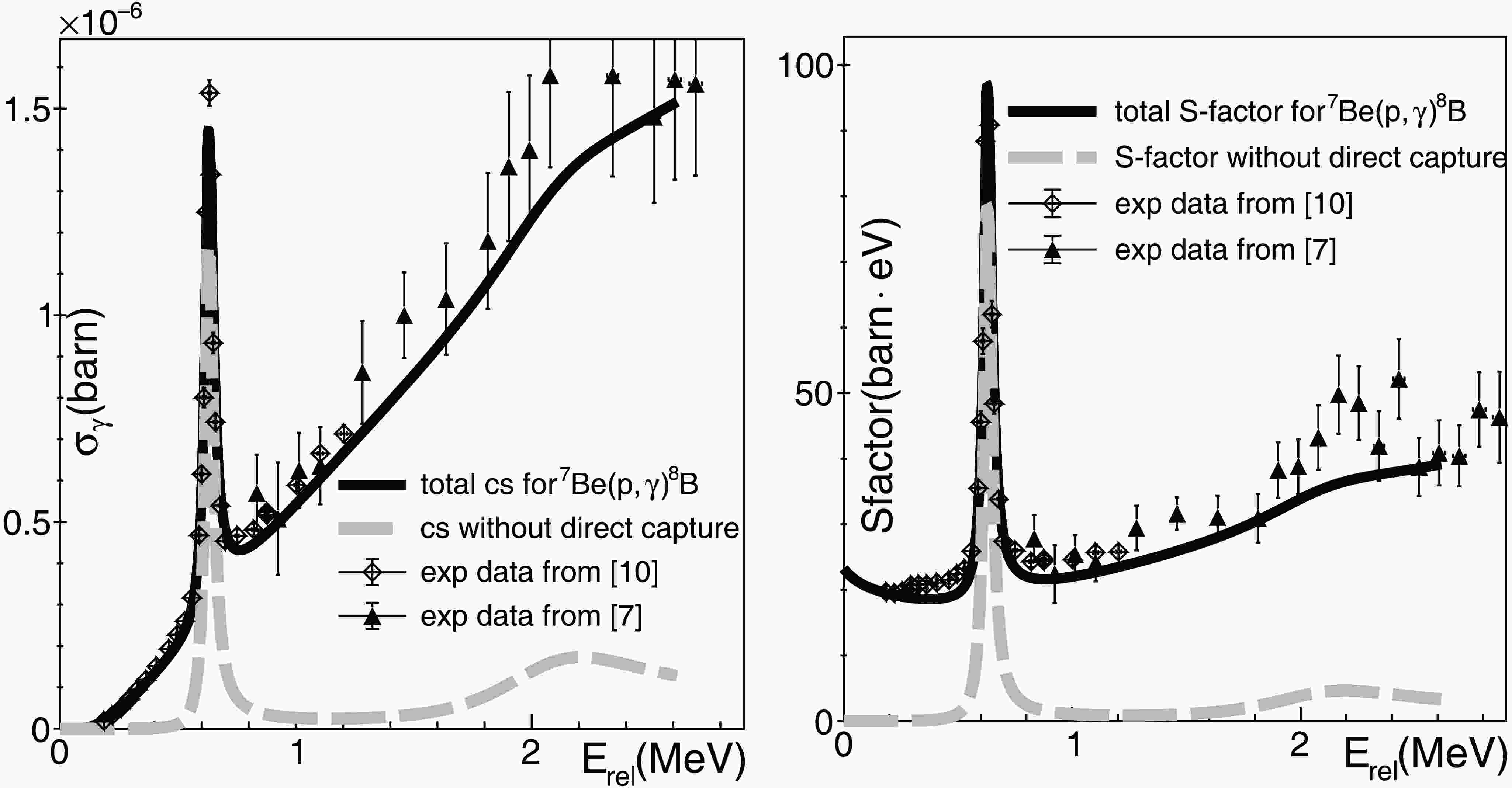
These results together with electromagnetic transitions widths were used for calculation of 7Be(p, γ)8B reaction cross-section, presented in Fig. 1.
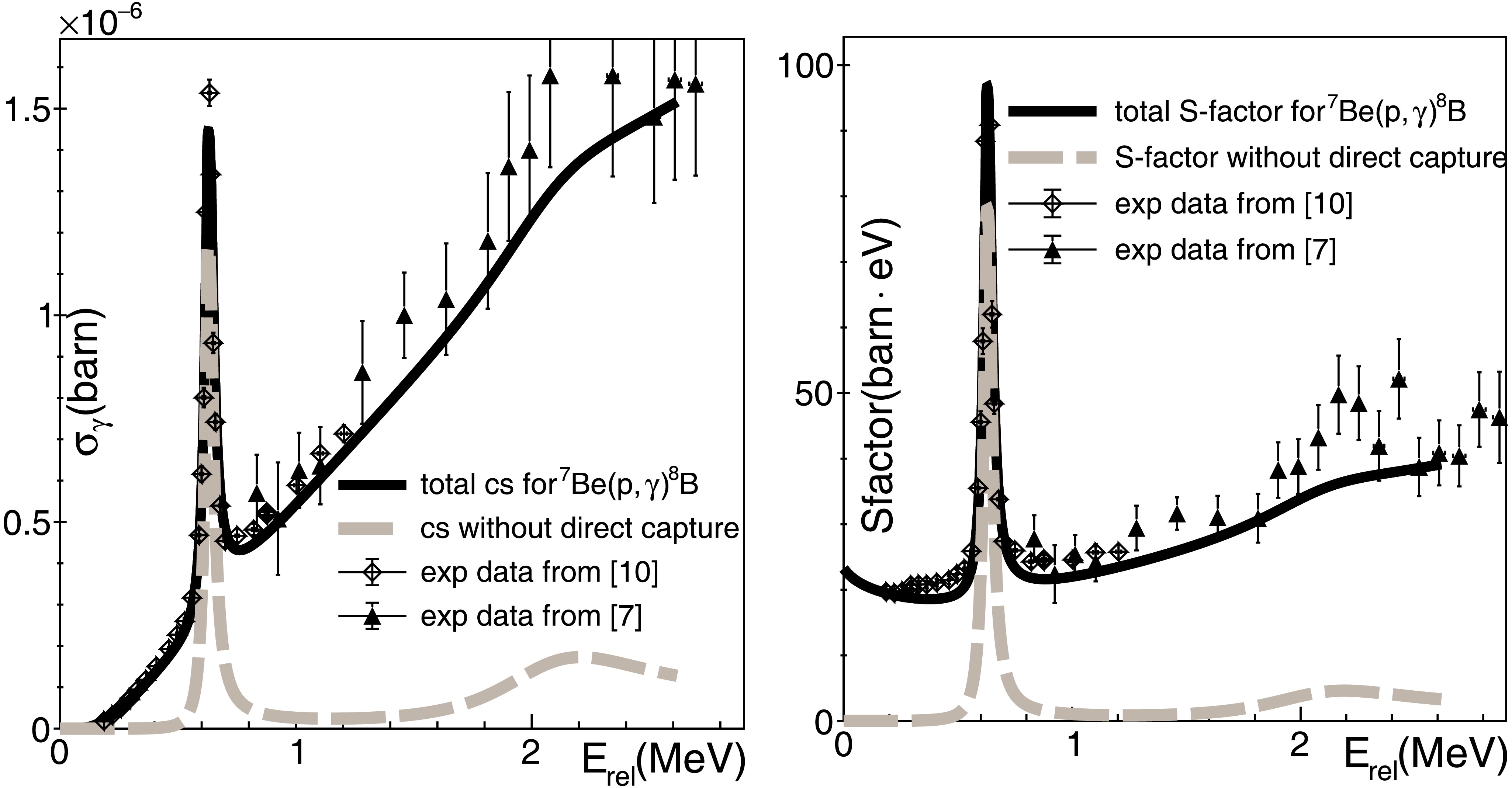
Figure 1. (color online) The cross-section and S-factor of radiative proton capture by 7Be nucleus for
$\hbar \omega$ = 15 MeV and${{N}} ^*_{\rm max} $ = 12.As it could be seen from Fig. 1 calculations show good agreement with experimental data for both low energies [10] and higher energies [7]. This good agreement allows us to claim a well-founded derivation of the astrophysical S-factor in energy regions inaccessible to experiment, i. e. energies below 180 keV. Figure 2 shows the result of partial analysis of the impact of 8B resonances on the values of the cross-section and S-factor in the same energy region.
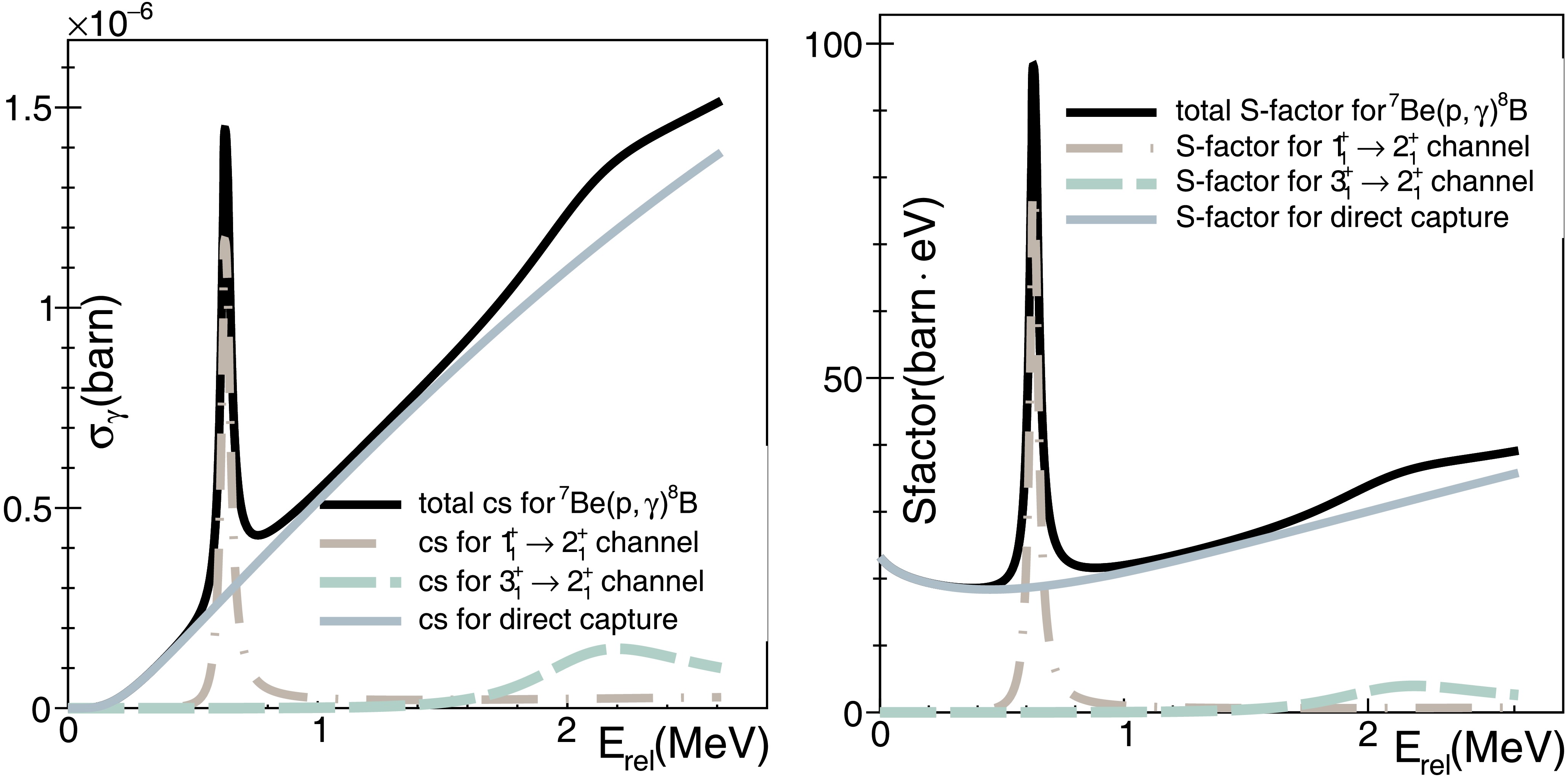
Figure 2. (color online) The contribution of 8B resonances to cross-section and S-factor of radiative proton capture by 7Be.
As it follows from the analysis of Fig. 1, in the energy range up to 2.5 MeV, with the exception of the narrow peak of
$1 _1^+ $ , the cross-section is determined mainly by direct (external) capture to ground$ 2_1^+ $ state and, consequently, depends, first of all, on ANCs of the decay channels of this state.Thus, the total squared value of
$ 2_1^+ $ ANC calculated in this paper is 0.602 fm−1. This value is between the value presented in the tables of [54], which is 0.711$ \pm $ 0.092 fm−1, and the compiled result of 0.452 fm−1 contained in [55]. Anyway, the cross-section obtained using the discussed ANC values turn out to be in good agreement with the measured ones. The results of testing the quality of the performed computations of ANCs are presented below.It could be seen from Table 4, the total width of the
$1 _1^+ $ is also in a good agreement with the measured one: 43.6 keV vs 35.6$ \pm $ 0.6 keV. The calculated width of$3 _1^+ $ – 850 keV is overestimated compare to known data – 350$ \pm $ 30 keV, which were obtained from the cross-section of the 7Be(p, γ)8B reaction in the energy region of about 2 MeV [54] and confirmed in the experiment [56] devoted to the study of 7Be + p backward elastic scattering. The measured cross-section of the first process in the discussed energy region is characterized by rather large error bars [7] – see Fig. 1, as well as by the dominating contribution of direct capture amplitude – see Fig. 2. The statistics collected during the measurement of elastic scattering of 7Be from proton also seem to be insufficient for an accurate measurement of the decay width of the$ 3^{+}_{1} $ state against the background of wide neighbouring levels. The contribution of$3 _1^+ $ resonance to the total cross-section of radiative proton capture does not exceed 13% in its maximum, which is comparable to the measurement accuracy of about 11% in this energy area. Thus, an experimental estimate of the$3 _1^+ $ resonance width can hardly be called reliable. So that, the values of the width of$3 _1^+ $ state obtained in this work can be considered as quite reasonable. A procedure of testing the quality of computations of the decay widths was also carried out (see bellow).It is important to emphasize that the goal of the study we present in this paper was not only to obtain, on the basis of ab initio calculations, the cross section and the astrophysical S-factor of reaction 7Be(p, γ)8B in the measured and unmeasured energy regions, but also, to no lesser extent, to test the presented method as a whole using an example that has been well studied experimentally with a view to its widespread use.
The most important methodical element of the studies using NCSM, CCOFM, and R-matrix calculations is the analysis of reliability of the results obtained by use of them. Fast convergence of the widths of M1 transitions are demonstrated by Table 3, which allows to get accurate results for these values in NCSM calculations. More difficult question of nuclear size parameters convergence has also been satisfactorily resolved in several ways. In particular, the authors had developed twisted tape extrapolation method - TTE for these purposes [57, 58]. These methods look the most effective for estimating the probabilities of E2-transitions, but, as shown above, within the framework of the problem under study, any precise calculation of these values is not required to solve the problem under discussion.
The problem of convergence of asymptotic characteristics of closed and open decay channels has not been reliably resolved yet. So, of great interest is the evolution of the ANCs and RPWAs with increasing
${{N}} ^*_{\rm max} $ in a wide range of$ \hbar \omega $ values. In Table 5 the convergence pattern of the results of CCOFM calculations of ANCs and partial widths for basic proton decay channels of 8B nucleus is shown.$ \hbar \omega $ /${{N}} ^*_{\rm max} $ $ A_{2_{1}^+}^{l=1, J_c=1} $ /fm−1/2$ A_{2_{1}^+}^{l=1, J_c=2} $ /fm−1/2$ \Gamma_{1_{1}^+}^{l=1, J_c=1} $ /keV8 10 12 extrap. 8 10 12 extrap. 8 10 12 extrap. 10.0 0.489 0.476 0.468 0.467 0.653 0.639 0.629 0.627 16.30 15.69 15.30 15.07 12.5 0.482 0.471 0.464 0.464 0.624 0.625 0.626 0.626 16.51 15.93 15.57 15.00 15.0 0.481 0.471 0.463 0.463 0.612 0.619 0.623 0.625 16.64 16.08 15.60 15.03 17.5 0.483 0.473 0.463 0.462 0.601 0.611 0.616 0.618 16.78 16.28 15.70 15.04 20.0 0.476 0.476 0.467 0.467 0.587 0.593 0.612 0.624 16.11 16.58 16.33 15.81 $ \hbar \omega $ /${{N}} ^*_{\rm max} $ $ \Gamma_{1_{1}^+}^{l=1, J_c=2} $ /keV$ \Gamma_{3_{1}^+}^{l=1, J_c=2} $ /keV8 10 12 extrap. 8 10 12 extrap. 10.0 32.20 30.45 29.30 27.08 909.3 869.0 829.0 815.6 12.5 29.90 29.10 28.41 27.21 883.8 860.2 842.0 815.4 15.0 29.30 28.79 28.00 27.04 887.3 863.5 850.0 821.1 17.5 28.76 28.58 27.70 26.17 904.2 878.4 862.0 833.7 20.0 26.90 27.97 28.00 28.50 899.8 914.0 870.0 876.7 Table 5. The results of the CCOFM calculations of ANCs and partial widths for dominating proton capture channels of 8B nucleus states.
A visual analysis of the data presented in the table creates a contradictory impression. On the one hand, the columns containing the calculation results on the maximum available basis, characterized by the boundary value of
${{N}} ^*_{\rm max} $ = 12, in all cases show lines of very high stability for a fairly wide range of$ \hbar \omega $ values. On the other hand, the change in the investigated decay widths in the rows of the Table 5 in the range of values of${{N}} ^*_{\rm max} $ = 8$ \div $ 12 is not small.To resolve the discussed contradiction, the following extrapolation procedure was used. First, for each value of the oscillator parameter the set of computed values of
$ \Gamma^{c_\kappa}_J $ was extrapolated by use of simple two-parameter exponential formula$ \Gamma(N^*_{\rm max})=\Gamma(\infty)\cdot (1 - \alpha \cdot {\mathrm{e}}^{-\beta N^*_{\rm max}}), $
(17) where α, β are the fitting parameters. In spite of good convergence of ANCs values, the same extrapolation procedure was carried out for them for reliability. The results of the extrapolation are also shown in the table. Taking into account the task of checking the computational accuracy, some of these results contain four significant digits.
Let us consider the ANC of
$ 2_1^+ $ state decaying to l=1,$ J_c $ =1 virtual channel$ A_{2_{1}^+}^{l=1, J_c=1} $ . The set of results of its calculation is a smooth and almost flat horizontal surface above plane$ \hbar \omega \times $ ${{N}} ^*_{\rm max} $ for all studied values of$ \hbar \omega $ in the range${{N}} ^*_{\rm max} $ = 12$ \div $ extrap. The results of the extrapolation procedure confirm with very good accuracy the results obtained for${{N}} ^*_{\rm max} $ = 12. By averaging the extrapolated values, one can obtain its mean value and standard deviation equal to 0.464$ \pm $ 0.002.Not taking into account the slightest discrepancy in the last line, ANC
$ A_{2_{1}^+}^{l=1, J_c=2} $ demonstrates completely analogous behaviour. Its mean value and standard deviation are equal to 0.624$ \pm $ 0.003. As a result, the accuracy of calculating the asymptotic normalization coefficients turns out to be close to 0.5%.The convergence of the
$ \Gamma_{1_{1}^+}^{l=1, J_c=1} $ value is slower than that characteristic of ANCs – a tendency toward its decrease for${{N}} ^*_{\rm max} \gt $ 12 is clearly visible. Moreover, the values presented in the last row of the table sharply deviate from the smooth systematic pattern of its change. This last circumstance is not difficult to understand, given that with increasing$ \hbar \omega $ , the size of the region in which the CFF (4) is correctly described decreases. However, extrapolation in a narrower range of$ \hbar \omega $ =10.0$ \div $ 17.5 MeV leads to results that differ by no more than a few units of the fourth significant digit for different$ \hbar \omega $ . The final mean value and standard deviation are equal to 15.03$ \pm $ 0.03 keV. As a result, using the extrapolation procedure, a uniquely small for nuclear physics calculations standard deviation of 0.2% was achieved. The average extrapolated value of$ \Gamma_{1_{1}^+}^{l=1, J_c=1} $ differs significantly from that obtained in calculations on a limited basis, but in the discussed particular case this does not actually affect the behaviour of the astrophysical S-factor curve due to the dominance of the amplitude of the direct process.The properties of the data arrays
$ \Gamma_{1_{1}^+}^{l=1, J_c=2} $ and$ \Gamma_{3_{1}^+}^{l=1, J_c=2} $ differ little from those just described. The only difference is that the smooth systematic of the values is violated in the last two rows of the table. Despite this, the accuracy of the results obtained on the narrower space$ \hbar \omega \times $ ${{N}} ^*_{\rm max} $ remains just as uniquely high. Their values are:$ \Gamma_{1_{1}^+}^{l=1, J_c=2} $ = 27.11$ \pm 0.09 $ keV;$ \Gamma_{3_{1}^+}^{l=1, J_c=1} $ = 817.3$ \pm 3.3 $ keV.Thus, the conducted tests demonstrate that calculations of ANCs and partial widths of single-nucleon decay channels of light nuclei using basis sets accessible to modern computers, supplemented by appropriate extrapolation procedures, provide high numerical accuracy. The origins of discrepancies between these results and reliably measured ones may be conceptual shortcomings of NCSM, CCOFM, and R-matrix theory.
Naturally, the most important thing for astrophysical research is to obtain reliable values of the S-factor of 7Be(p, γ)8B process at energies inaccessible to measurements. In this regard, we conducted a test of the accuracy of the calculation results, similar to the one presented above. The calculated S17(0)-factors of the process for
${{N}} ^*_{\rm max} $ =8, 10, 12 and oscillator parameter range$ \hbar \omega $ = 10$ \div $ 20 MeV and the extrapolated ones are presented in Table 6. Extrapolation formula (17) was used for these purposes.$ \hbar \omega $ /${{N}} ^*_{\rm max} $ 8 10 12 extrap. 10.0 25.68 24.49 23.66 23.16 12.5 23.94 23.62 23.41 22.94 15.0 23.37 23.36 23.24 22.97 17.5 22.94 23.09 22.97 22.94 20.0 22.040 22.3 22.86 23.95 Table 6. The results of the calculations of the astrophysical S-factor S17(0) [eV·b] of 7Be(p, γ)8B reaction.
Convergence of the S-factor is not achieved in the
${{N}} ^*_{\rm max} \leqslant $ 12 range. Besides that, the values presented in the last row of the table sharply deviate from the systematic pattern of its change. At the same time, the extrapolated S-factor values lie with high accuracy on a horizontal line within the range of$ \hbar \omega = 10\div $ 17.5 MeV variation. This allows, within the framework of the averaging procedure analogous to that used above, to obtain the value of S17(0) and its standard deviation. Finally, the optimal value of the S-factor turned out to be 23.00$ \pm 0.10 $ [eV·b].Of interest is also the behaviour of the astrophysical S-factor at proton energies close to zero point. This behaviour is illustrated by Fig. 3. As can be seen from this graph, the S-factor decreases rather quickly with the grows of proton energy. For low energies, close to zero point it can be obviously assumed that the standard deviation of S-factor is the same as the standard deviation of S17(0).
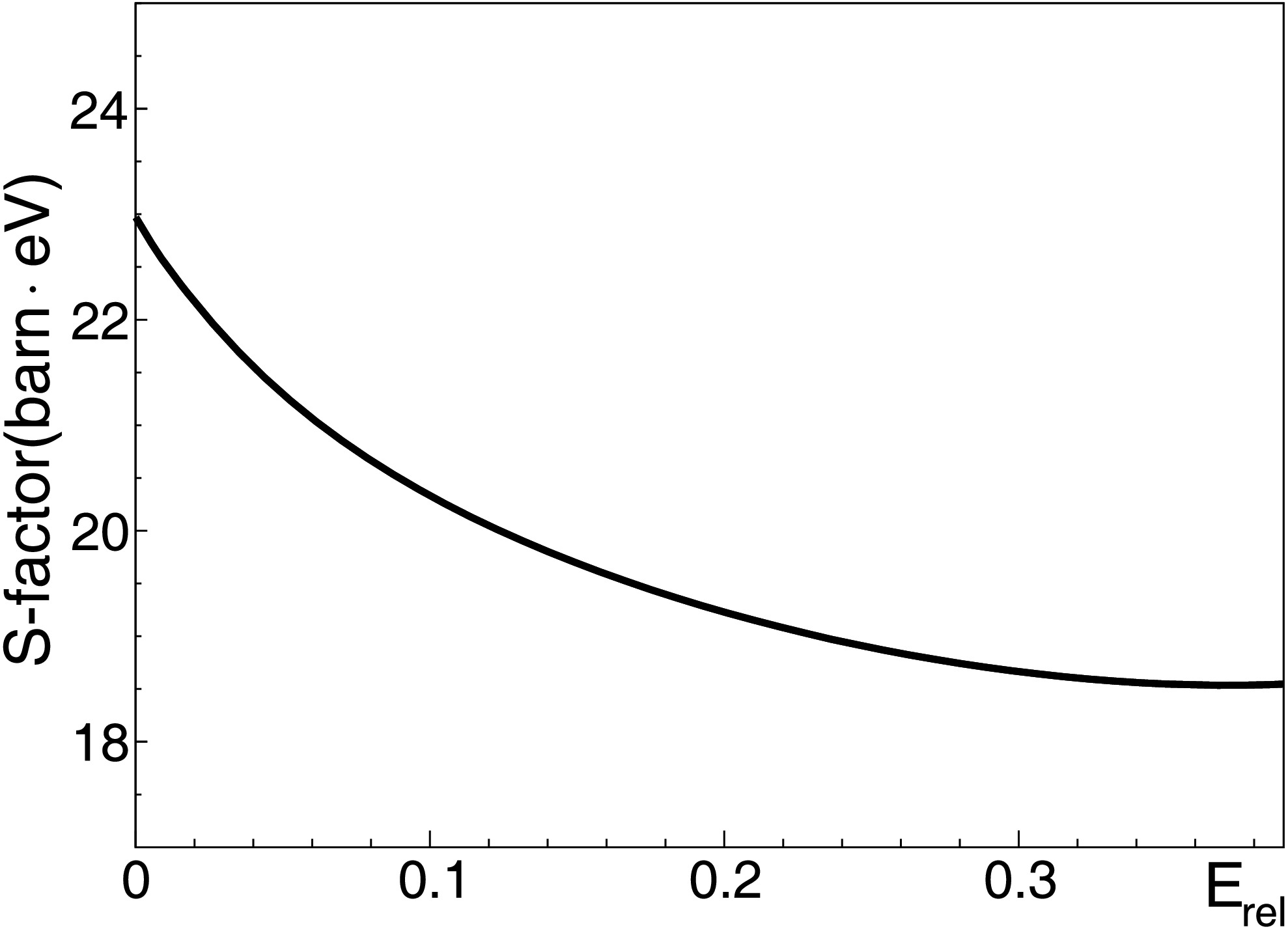
Figure 3. Behaviour of S-factor at low energies.
-
In conclusion let us list the basic points of the performed investigation.
1. With the use of new approach, based on Cluster Channel Orthogonal Functions Method together with NCSM calculations of the wave functions of 7Be and 8B states and probabilities of electromagnetic transition between them, ab initio calculations of the astrophysical S-factor of proton radiative capture by 7Be nucleus were carried out.
2. The NCSM calculations were carried out with the use of Daejeon16 potential the high efficiency of which has been demonstrated in a large number of studies. The size of the NCSM basis used is almost 109 SD. Because of the high sensitivity of the results of calculating the asymptotic properties and transition probabilities to the process energy, the measured values of the energy levels and the proton decay threshold were used. The remaining values were calculated ab initio with subsequent use of an extrapolation procedure.
3. In this work, for the first time in scientific literature, the question of convergence of NCSM+CCOFM computations of asymptotic properties was raised and resolved. The study of convergence and extrapolation for infinite oscillator basis of
${S}_{17}(0) $ factor was carried out. Due to that, capabilities of the developed approach turned out to be not limited to the direct calculation of the astrophysical S-factor. The scheme as a whole allows, to perform qualitative analysis of resonance energies, the widths of the electromagnetic transitions and the asymptotic properties of nuclear states in order to identify the amplitudes of various transitions that are significant and, conversely, have little effect on the results of calculations of the astrophysical S-factor at low energies. Moreover, the approach makes it possible to conduct the quantitative analysis of accuracy of the obtained values of electromagnetic transition probabilities, asymptotic normalization coefficients and decay widths of proton channels and astrophysical S-factor itself.4. Almost all theoretically obtained characteristics of the states of the nuclei participating in the reaction under study are in good agreement with known experimental data. The exception are the value of the energy of level
$1 _1^+ $ and the decay width of state$3 _1^+ $ . This difference between the calculated and measured energies is within the limits of typical NCSM calculation results. The fact that the value of the width of state$3 _1^+ $ is evaluated mainly on the basis of measurements of the cross-section of reaction 7Be(p, γ)8B, which do not have high accuracy and theoretically obtained cross-section of this reaction show good agreement with experimental data for both low energies [10] and higher energies [7] gives the opportunity to assume that for the width of$3 _1^+ $ our results can be considered as more reasonable than the ones tabulated in [54]. The obtained value of astrophysical S-factor${S}_{17}(0) $ is also in rather good agreement with earlier theoretical and experimental works.5. Finally, basing on the obtained results of studying the astrophysical S-factor of 7Be(p, γ)8B reaction and taking into account the high versatility and reliability of the Cluster Channels Orthogonal Functions Method in solving problems of computing asymptotic normalization coefficients and decay widths of nuclear states into various channels (including cluster ones), one can with full justification hope that the approach as a whole, developed in this work, will find wide application in studies of problems of nuclear astrophysics.
Study of radiative proton capture by the 7Be nucleus with the use of ab initio approaches
- Received Date: 2026-03-05
- Available Online: 2026-11-15
Abstract: A theoretical study of the 7Be(p, γ)8B reaction in the "astrophysical" energy range with the use of ab initio methods is presented. The used approaches are No-Core Shell Model and Cluster Channels Orthogonal Functions Method. The scheme also contains elements of R-matrix theory and procedures for extrapolating various data obtained in ab initio computations. The developed approach as a whole allows one not only to calculate the astrophysical S-factor and all nuclear characteristics that determine its value, but also to evaluate the reliability of the obtained results and to identify the dominant reaction mechanisms against a background of insignificant ones. The high accuracy of the obtained results and has been demonstrated.



 DownLoad: