


 Abstract
 HTML
 Reference
 Related
 PDF



-
$ X(2370) $ was first observed by the BESIII Collaboration (BESIII) in the$ \pi^+\pi^-\eta' $ invariant mass spectrum in the$ J/\psi\to \gamma \pi^+\pi^- \eta' $ decay process in 2011 [1] and confirmed by BESIII in the same process in 2016 [2].$ X(2370) $ was also observed in$ J/\psi\to \gamma K\bar{K}\eta' $ by BESIII in 2019 [3]. Recently, BESIII performed a partial-wave analysis of$ J/\psi\to \gamma K_S^0K_S^0 \eta' $ and determined the quantum numbers of$ X(2370) $ to be$ J^{PC} = 0^{-+} $ [4]. Reference [5] also reported preliminary BESIII results showing the possible signals of$ X(2370) $ in the$ K_S^0K_S^0\eta $ ,$ K_S^0 K_S^0\pi^0 $ , and$ \pi^0\pi^0\eta $ systems in$ J/\psi $ radiative decays. These observations indicate that$ X(2370) $ has a decay pattern similar to that of$ \eta_c $ . The decays of$ \eta_c $ into light hadrons proceed through the annihilation of the charm quark and antiquark ($ c\bar{c} $ ) into multiple (at least two) gluons; therefore,$ X(2370) $ is also expected to decay through gluonic intermediate states. Lattice QCD studies, either in the quenched approximation [6−9] or with dynamical quarks [10−12], predict that the lowest pseudoscalar glueball ($ G_{0^-} $ ) has a mass ranging from 2.3 to 2.7 GeV. The mass of$ X(2370) $ lies in this region, suggesting that$ X(2370) $ could be a candidate for the pseudoscalar glueball.According to BESIII's observations, both
$ X(2370) $ and$ \eta_c $ appear in the five three-pseudoscalar-meson systems mentioned above, and$ X(2370) $ is an isolated structure in the energy region between 2.2 GeV and$ m_{\eta_c} $ (except for the$ \pi^+\pi^-\eta' $ spectrum, which may accommodate an$ X(2600) $ state [2, 13]).$ X(2370) $ has a mass close to$ m_{\eta_c} $ and exhibits a decay pattern similar to that of$ \eta_c $ ; therefore,$ \eta_c $ and$ X(2370) $ could be the mixed mass eigenstates of the lowest pure pseudoscalar$ c\bar{c} $ state$ (c\bar{c}(0^-)) $ and pseudoscalar glueball$ G_{0^-} $ . The$ \eta-\eta'-\eta_c-G_{0^-} $ mixing was explored in phenomenological studies [14, 15] that favored a mixing angle of approximately$ 11^\circ $ . Furthermore, the$ c\bar{c}(0^-)-G_{0^-} $ mixing was calculated in a lattice QCD study with$ N_f=2 $ dynamical charm quarks [16]. In this unitary lattice setup for charm quarks, the mixing energy was determined to be$ x=\langle (c\bar{c}(0^-))|H_I|G_{0^-}\rangle = 49(6) $ MeV. With approximations$ m_{c\bar{c}(0^-)}\approx m_{\eta_c} $ and$ m_{G(0^-)}\approx m_X $ , the mixing angle satisfied$ \sin\theta = 0.08(1) $ . This implies that$ \eta_c $ has a 99%$ c\bar{c}(0^-) $ component while$ X(2370) $ has a 99% pseudoscalar glueball component. This mixing increases the total width$ \Gamma_{\eta_c} $ of$ \eta_c $ by roughly 7 MeV (using the total width$ \Gamma_X\approx 100 $ MeV of$ X(2370) $ ) with respect to that of$ c\bar{c}(0^-) $ and explains the relatively large$ \Gamma_{\eta_c}=30.5(5) $ MeV [17] to some extent. Thus, a small mixing angle can have sizable effects when$ \Gamma_X\gg \Gamma_{\eta_c} $ . A similar effect of this mixing is expected in the production rates of$ \eta_c $ and$ X(2370) $ in$ J/\psi $ radiative decay because$ {\rm{Br}}(J/\psi\to \gamma \eta_c)=1.41(14) $ % [17] is considerably larger than the lattice QCD prediction$ {\rm{Br}}(J/\psi\to \gamma G_{0^-})= 2.3(8)\times 10^{-4} $ obtained using$ m_{G_{0^-}}\approx m_{X(2370)} $ [8]. In this letter, we explore the production rate of$ X(2370) $ in$ J/\psi $ radiative decay based on$ c\bar{c}(0^-)-G_{0^-} $ mixing. -
For a pseudoscalar P, the partial decay width of
$ J/\psi\to \gamma P $ is related to the on-shell form factor$ M^{(P)}(Q^2=0) $ as$ \begin{aligned} \Gamma(J/\psi\to \gamma P)=\frac{4\alpha}{27}|\vec{k}|^3 M^2(0), \end{aligned} $
(1) where the electric charge of the charm quark,
$ Q_c=2e/3 $ , is incorporated, α is the fine-structure constant, and$ |\vec{k}|=(m_{J/\psi}^2-m_P^2)/(2m_{J/\psi}) $ is the magnitude of the spatial momentum of the final-state photon. The form factor$ M(Q^2) $ is defined through the electromagnetic multipole decomposition [18] of the transition matrix element$ \begin{aligned} \langle P(k)|j \,^\mu(0)|J/\psi(p, \lambda)\rangle = M^{(P)}(Q^2) \epsilon \,^{\mu\nu\rho\sigma}p_{\nu}k_{\rho}\epsilon_\sigma ^\lambda(p), \end{aligned} $
(2) where
$ Q^2=-(p-k)^2 $ is the virtuality of the photon,$ \epsilon_\sigma^\lambda(p) $ is the polarization vector of$ J/\psi $ , and$ j^\mu=\bar{c}\gamma^\mu c $ is the electromagnetic current involving only the charm quark because P is either a$ c\bar{c} $ state or a glueball.The mixing of the
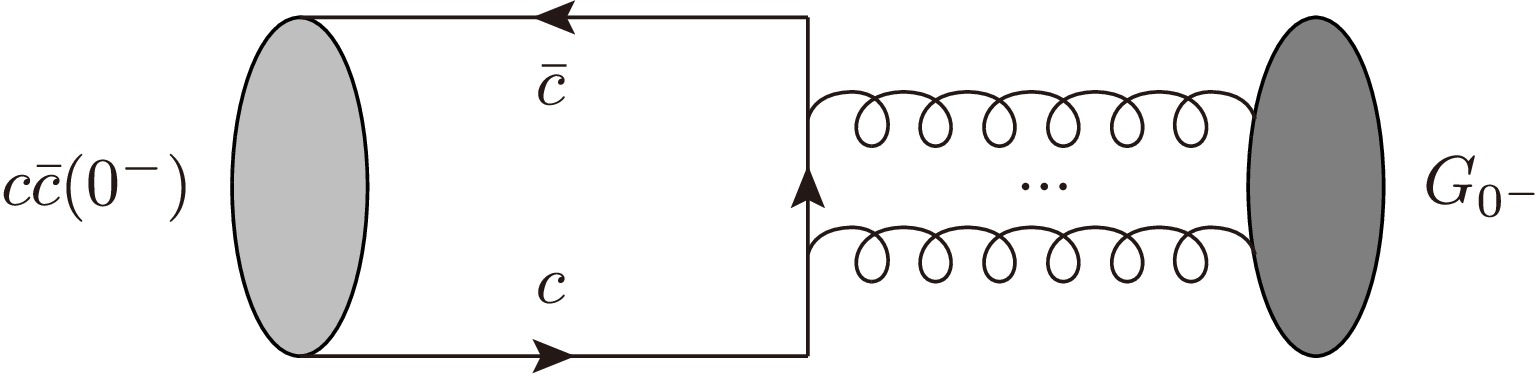
$ c\bar{c}(0^-) $ state ($ |c\bar{c}\rangle $ ) and pure glueball$ G_{0^-} $ state ($ |G\rangle $ ) occurs through the$ c\bar{c}-gg(\cdots) $ dynamics (Fig. 1), where$ gg(\cdots) $ denotes intermediate multi-gluon states containing at least two gluons. If$ X(2370) $ ($ |X\rangle $ ) and$ \eta_c $ ($ |\eta_c\rangle $ ) are the corresponding two mass eigenstates after mixing, one has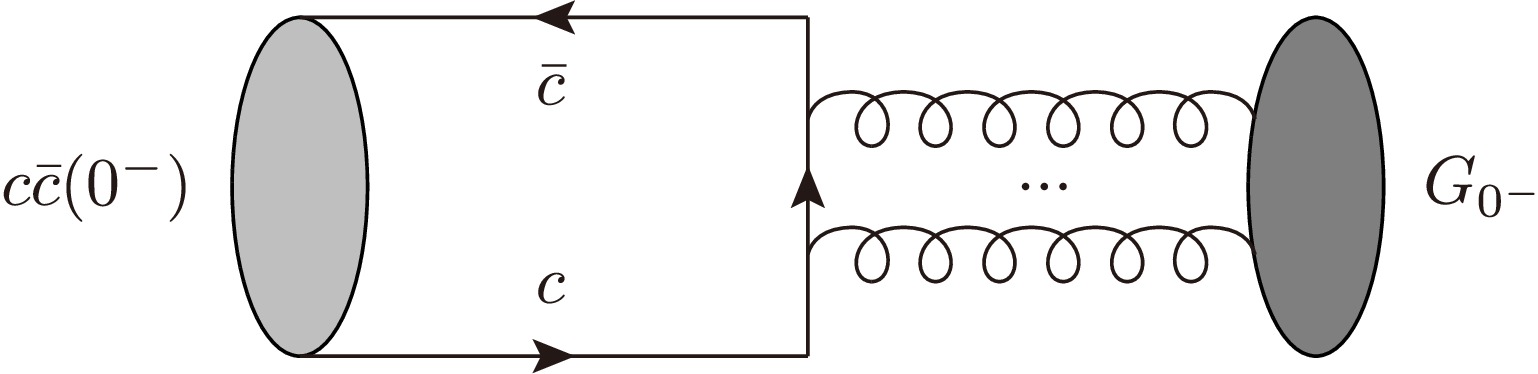
Figure 1. Schematic of
$ c\bar{c}(0^-) $ –$ G_{0^-} $ mixing.$ \begin{aligned} \left(\begin{array}{c} |X\rangle \\ |\eta_c\rangle \end{array} \right)= \left(\begin{array}{lr} \cos\theta &-\sin\theta \\ \sin\theta & \cos\theta \end{array} \right) \left( \begin{array}{c} |G\rangle \\ |c\bar{c}\rangle \end{array} \right), \end{aligned} $
(3) where θ is the mixing angle. The on-shell form factors
$ M^{(P)}(0) $ for the$ J/\psi\to \gamma X(\eta_c) $ processes can be expressed as$ \begin{aligned}[b] M^{(X)}(0) &= M^{(G)}(0) \cos\theta-M^{(c\bar{c})}(0)\sin\theta, \\ M^{(\eta_c)}(0) &= M^{(G)}(0) \sin\theta+M^{(c\bar{c})}(0)\cos\theta. \end{aligned} $
(4) The on-shell form factors
$ M^{(c\bar{c})}(0) $ and$ M^{(G)}(0) $ have been derived directly from lattice QCD calculations. The lattice QCD calculations of$ M^{(P)}(0) $ for$ J/\psi\to \gamma \eta_c $ consider only the connected diagram shown in Fig. 2(a), and therefore, the resulting$ M^{(P)}(0) $ is$ M^{(c\bar{c})}(0) $ . The schematic for$ J/\psi\to \gamma G_{0^-} $ is shown in Fig. 2(b).$ M^{(P)}(0) $ is often expressed in terms of a dimensionless form factor$ V^{(P)}(0) $ as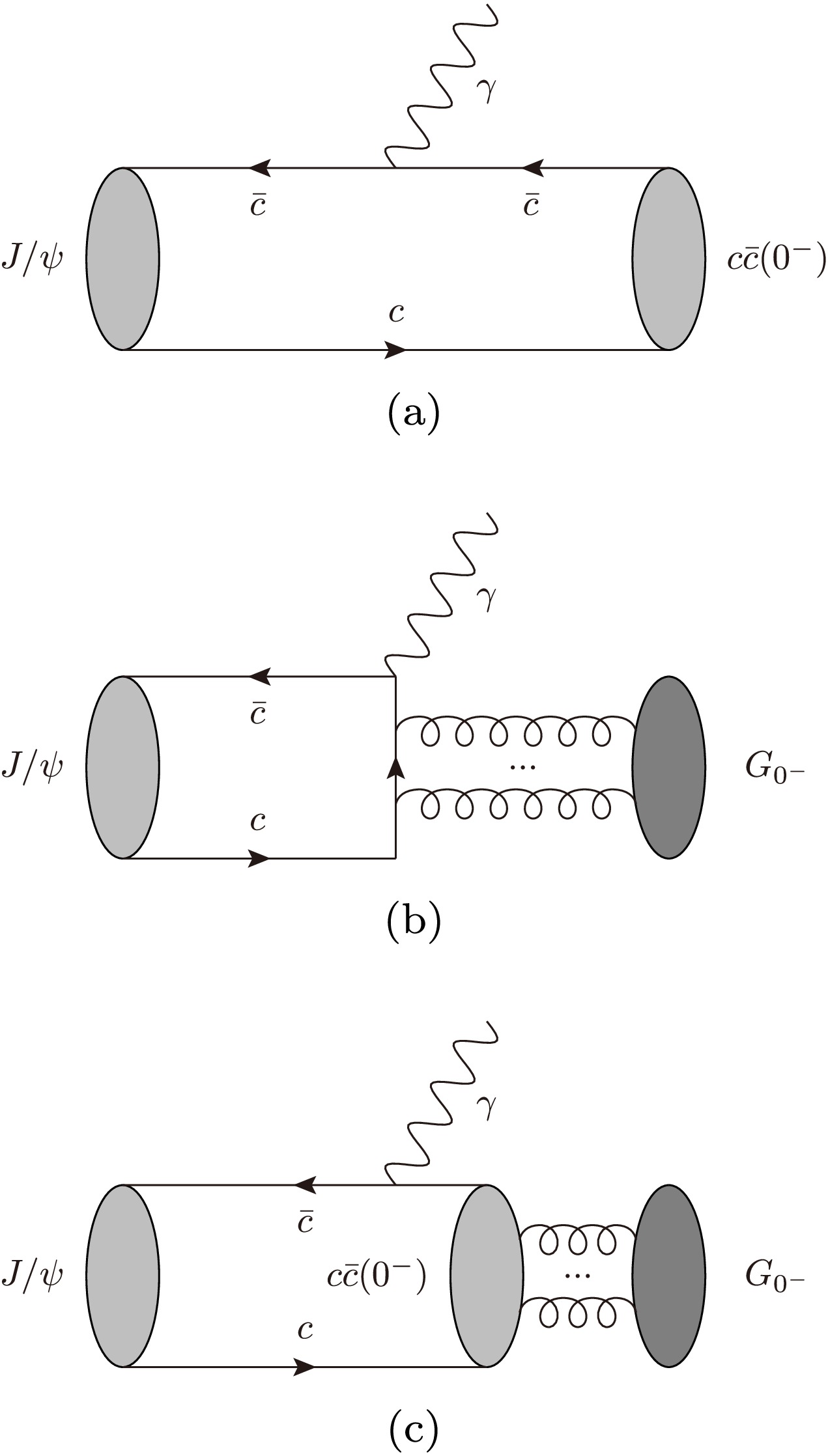
Figure 2. Schematics for (a)
$ J/\psi\to \gamma c\bar{c}(0^-) $ and (b)$ J/\psi\to $ $ \gamma G_{0^{-}} $ . (c) Mechanism in which$ J/\psi $ undergoes a radiative transition to$ c\bar{c}(0^-) $ , which then mixes with$ G_{0^-} $ .$ \begin{aligned} M^{(P)}(0)=\frac{2\omega_P V^{(P)}(0)}{m_{J/\psi}+m_P}. \end{aligned} $
(5) For
$ c\bar{c}(0^-) $ ,$ \omega_P=2 $ account for photon emission from either the charm quark or the antiquark. For$ G_{0^-} $ , we take$ \omega_P=1 $ since the$ c\bar{c} $ annihilation produces a photon and gluons almost simultaneously, with the gluons coupling to$ G_{0^-} $ . In practical lattice QCD calculations, the gluon lines in Fig. 2(b) are accounted for by averaging over gauge configurations, while the photon is emitted from the charm quark loop. Therefore, all possible orderings of the photon and gluon vertices are included implicitly, and there is no need to consider the position of the photon emission separately.Table 1 summarizes the lattice QCD results for
$ V^{(c\bar{c})}(0) $ obtained either in the quenched approximation or with dynamical quarks. These results are consistent with one another. The result from the HPQCD collaboration [19] is obtained in$ N_f=2+1+1 $ QCD (including the dynamical$ u,d,s,c $ quark flavors), with better control of systematic uncertainties after the continuum and chiral extrapolations. Therefore, we use the value$ V^{(c\bar{c})}(0)= 1.865(7)(8) $ in the following discussion.Table 1. Values of the dimensionless form factor
$ V^{(c\bar{c})}(0) $ determined by lattice QCD calculations in the quenched approximation (QA) and with dynamical quarks.There is only one lattice QCD calculation of
$ V^{(G)}(0) $ in the quenched approximation, which yields$ V^{(G)}(0)= 0.0246(43) $ and$ m_{G_{0^-}}=2.395(14)\; {\rm{GeV}} $ after continuum extrapolation [8]. Using the experimental mass values$ m_{J/\psi}=3.0969(0) $ GeV and$ m_{\eta_c}=2.9841(4) $ GeV [17], as well as the value of$ m_{G_{0^-}} $ mentioned above, Eq. (5) yields$ \begin{aligned}[b] M^{(c\bar{c})}(0)&=1.227(7)\,{\rm{GeV}}^{-1},\\ M^{(G)}(0)&=0.0090(16)\; \rm{GeV}^{-1}.\end{aligned} $
(6) The effect of the
$ c\bar{c}(0^-)-G_{0^-} $ mixing on the decays$ J/\psi\to \gamma \eta_c(X) $ is illustrated in Fig. 2(c). We omit the other diagram describing the mixing of the final-state$ G_{0^-} $ produced in$ J/\psi\to\gamma G_{0^-} $ with$ c\bar{c}(0^-) $ because$ M^{(G)}(0)\ll M^{(c\bar{c})}(0) $ . The difference between Fig. 2(b) and Fig. 2(c) is interpreted theoretically as follows: the former describes the$ c\bar{c} $ pair in$ J/\psi $ annihilating into a photon and gluons that couple to$ G_{0^-} $ , whereas the latter describes the$ c\bar{c} $ pair propagating as a$ c\bar{c}(0^-) $ state after photon emission and subsequently mixing with$ G_{0^-} $ . The mechanism in Fig. 2(c) has not been investigated using lattice QCD because this would require the numerically challenging calculation of four-point functions such as$ \langle {\cal{O}}_{J/\psi}(t)j^\mu(t_1){\cal{O}}_{c\bar{c}(0^-)}(t_2){\cal{O}}_{G^{0^-}}(0)\rangle $ , where$ {\cal{O}}_Y $ denotes the lattice interpolating field for$ Y=J/\psi, c\bar{c}(0^-), G_{0^-} $ . Fortunately, the parts of Figs. 2(a), 2(b), and 2(c) to the right of the photon emission vertex can be well described by$ c\bar{c}(0^-)-G_{0^-} $ mixing. It is commonly believed that$ \eta_c $ is predominantly the lowest pseudoscalar charmonium state, which requires$ |\sin\theta|\ll 1 $ . Here, we consider some subtleties concerning Eq. (4), which is approximately valid when$ m_{G_{0^-}}\approx m_{c\bar{c}(0^-)} $ and$ |\sin\theta| $ is small. Given the non-negligible mass difference between$ G_{0^-} $ and$ c\bar{c}(0^-) $ , the kinematics corresponding to an on-shell photon differ for the two states. This difference is particularly relevant for the estimate of$ M^{(X)}(0) $ because$ M^{(c\bar{c})}(0)\gg M^{(G)}(0) $ . We do not know the value of$ M^{(c\bar{c})}(0) $ when$ \eta_c $ is off shell; therefore, we introduce a scaling parameter$ \kappa_c $ to account for the effect of the mass shift of$ c\bar{c}(0^-) $ , namely,$ M^{(c\bar{c})}(0,m_X)=\kappa_c M^{(c\bar{c})}(0) $ . Furthermore,$ M^{(G)}(0) $ and$ M^{(c\bar{c})}(0) $ are derived from independent lattice QCD calculations with independent phase conventions for the interpolating field operators. Therefore, we introduce another parameter s to describe the relative phase between$ M^{(G)}(0) $ and$ M^{(c\bar{c})}(0) $ . Using these prescriptions and combining Eqs. (1), (4), and (6) with the experimental total width$ \Gamma_{J/\psi}=92.6(1.4)\; {\rm{keV}} $ of$ J/\psi $ [17], we obtain$ \begin{aligned}[b] {\rm{Br}}(J/\psi\to\gamma\eta_c)=\;& (2.44(5)\times 10^{-2})\cos^2\theta,\\ {\rm{Br}}(J/\psi\to\gamma X) =\;& 2.88(4)\times 10^{-4} \\ & \times \left(122.7(7)\kappa_c \sin\theta-0.90(16) s\cos\theta\right)^2, \end{aligned} $
(7) where the contribution of the
$ M^{(G)}\sin\theta $ term to$ \Gamma(J/\psi\to \gamma\eta_c) $ is neglected because it is very small. When$ \cos\theta=1 $ (no mixing), one approximately recovers the lattice predictions in Ref. [19] for$ \Gamma(J/\psi\to \gamma\eta_c) $ (Ref. [19] uses the fine-structure constant$ \alpha=1/137 $ at the energy scale$ \mu\sim 0 $ , whereas we use$ 1/134 $ at the charmonium energy scale) and in Ref. [8] for$ \Gamma(J/\psi\to \gamma G_{0^-}) $ ). The effect of mixing with$ c\bar{c}(0^-) $ on$ {\rm{Br}}(J/\psi\to \gamma X(2370)) $ can be enhanced by two factors. Equation (6) indicates that$ M^{(c\bar{c})}(0)\gg M^{(G)}(0) $ , and the partial decay width is proportional to$ |\vec{k}|^3 $ , where$ \vec{k} $ is the photon momentum. Using the experimental mass values, one has$ \begin{aligned} \frac{|\vec{k}(J/\psi\to \gamma X)|^3}{|\vec{k}(J/\psi\to \gamma \eta_c)|^3}=\left(\frac{m_{J/\psi}^2-m_{X}^2}{m_{J/\psi}^2-m_{\eta_c}^2}\right)^3\approx 177.5. \end{aligned} $
(8) Consequently, in contrast to
$ \Gamma(J/\psi\to \gamma\eta_c) $ , which is insensitive to small values of$ \sin\theta $ ,$ \Gamma(J/\psi\to\gamma X(2370)) $ depends strongly on$ \sin\theta $ even when it is small, as illustrated in Fig. 3. We use the scaling factors$ \kappa_c=0.5, 1, 1.5 $ (green, red, and purple curves, respectively) to account for the effect of the$ G_{0^-}-c\bar{c}(0^-) $ mass difference, considering both destructive ($ s=1 $ , solid curves) and constructive ($ s=-1 $ , dashed curves) interference. In all cases,$ {\rm{Br}}(J/\psi\to \gamma X(2370)) $ exceeds$ 10^{-3} $ when$ \sin\theta\gtrsim 0.05 $ .
Figure 3. (color online) Branching fractions of
$ J/\psi\to\gamma\eta_c $ and$ J/\psi\to\gamma X(2370) $ as functions of$ \sin\theta $ . The blue curve denotes$ {\rm{Br}}(J/\psi\to\gamma\eta_c) $ . The green, red, and purple curves correspond to$ \kappa_c=0.5 $ ,$ 1.0 $ , and$ 1.5 $ , respectively, where$ \kappa_c\equiv {\cal{M}}^{(c\bar c)}(0,m_X)/ $ $ {\cal{M}}^{(c\bar c)}(0,m_{\eta_c}) $ . The solid and dashed curves represent the interference phases$ s=+1 $ and$ s=-1 $ , respectively. The shaded bands show the uncertainties propagated from the input radiative-transition amplitudes and the total$ J/\psi $ width.A previous lattice QCD study explored
$ c\bar{c}(0^-)-G_{0^-} $ mixing using gauge ensembles with$ N_f=2 $ degenerate charm sea quarks [16]. In this unitary lattice setup for charm quarks, mixing was clearly observed, and$ \sin\theta $ was determined directly. At two$ J/\psi $ masses, namely,$ m_{J/\psi} = 2.743(1) $ GeV and 3.068(1) GeV, the mixing angle was determined to be$ \theta = 6.6(9)^\circ $ and$ 4.3(4)^\circ $ , respectively. Based on the effective Hamiltonian$ \begin{aligned} H=\left( \begin{array}{cc} m_{G} & x\\ x &m_{c\bar{c}} \end{array} \right), \end{aligned} $
(9) the mixing energy was estimated to be
$ x= 49(6) $ MeV and found to be insensitive to the charm quark mass. This mixing energy may shift the masses$ m_{G} $ and$ m_{c\bar{c}} $ by only a few million electronvolts. Therefore, we estimate$ \begin{aligned} \sin\theta\approx \frac{x}{m_{\eta_c}-m_X}= 0.083_{-0.017}^{+0.011}, \; \theta\approx (4.8_{-1.0}^{+0.6})^\circ, \end{aligned} $
(10) using the experimental values of
$ m_{\eta_c} $ and$ m_X=2.395\pm 0.011_{-0.094}^{+0.026} $ GeV [4]. Substituting this value into Eq. (7), one obtains$ \begin{aligned}[b] \Gamma(J/\psi\to\gamma X(2370))&\approx 2.3_{-1.0}^{+0.7}\; {\rm{keV}},\\ {\rm{Br}}(J/\psi\to \gamma X(2370))&\approx 2.5_{-1.1}^{+0.7}\times 10^{-2}, \end{aligned} $
(11) for
$ \kappa_c=1 $ and$ s=1 $ . This large branching fraction is primarily attributed to the non-negligible mixing angle.We note that the estimate
$ \sin\theta\approx 0.08(1) $ was obtained in an unphysical lattice setup with two flavors of charm sea quarks and no light sea quarks. In this lattice setup, the flavor-singlet pseudoscalar charmonium state$ (c\bar{c}(0^-)) $ has the quark configuration$ (c_1\bar{c}_1+c_2\bar{c}_2)/\sqrt{2} $ , where$ c_{1,2} $ represents the two degenerate charm quark flavors.$ c_1\bar{c}_1 $ and$ c_2\bar{c}_2 $ couple to gluons through the same mechanism, as illustrated in Fig. 1, and therefore, the value of$ \sin\theta $ mentioned above can be matched qualitatively to the case with one charm quark flavor by multiplying it by$ 1/\sqrt{2} $ . When light sea quarks are present, they should contribute to the$ c\bar{c}(0^-)-G_{0^-} $ mixing through light quark loops, as indicated in Fig. 4. In the flavor-singlet pseudoscalar channel, the coupling of a quark–antiquark pair to gluons can be nonperturbative and enhanced by the QCD$ {\rm{U}}_A(1) $ anomaly, which introduces a topological$ q\bar{q}-gg(\cdots) $ coupling [25]. This argument is supported by experimental observations showing that light pseudoscalars (such as$ \eta' $ and$ \eta(1405) $ ) have large production rates in$ J/\psi $ radiative decay [17]. Based on the$ U_A(1) $ anomaly, an$ N_f=2 $ lattice QCD study yields a value of$ {\rm{Br}}(J/\psi\to \gamma \eta') $ consistent with the experimental value [26]. Thus, the light quark loop contribution can evade the OZI suppression that typically applies to other channels and can have a sizable effect on the$ c\bar{c}(0^-)-G_{0^-} $ mixing. Compared with Fig. 1, Fig. 4 has an additional (light) quark loop that introduces a relative minus sign. Therefore, to some extent, the light quark contribution reduces the$ c\bar{c}(0^-)-G_{0^-} $ mixing arising from the dynamics shown in Fig. 1. This minus sign is also observed in the lattice QCD calculation of the form factors for the$ D_s\to \eta(\eta') $ semileptonic decay [27]. Based on the discussion above, the branching fraction of$ J/\psi\to \gamma X(2370) $ in the real world is likely smaller than the value in Eq. (11).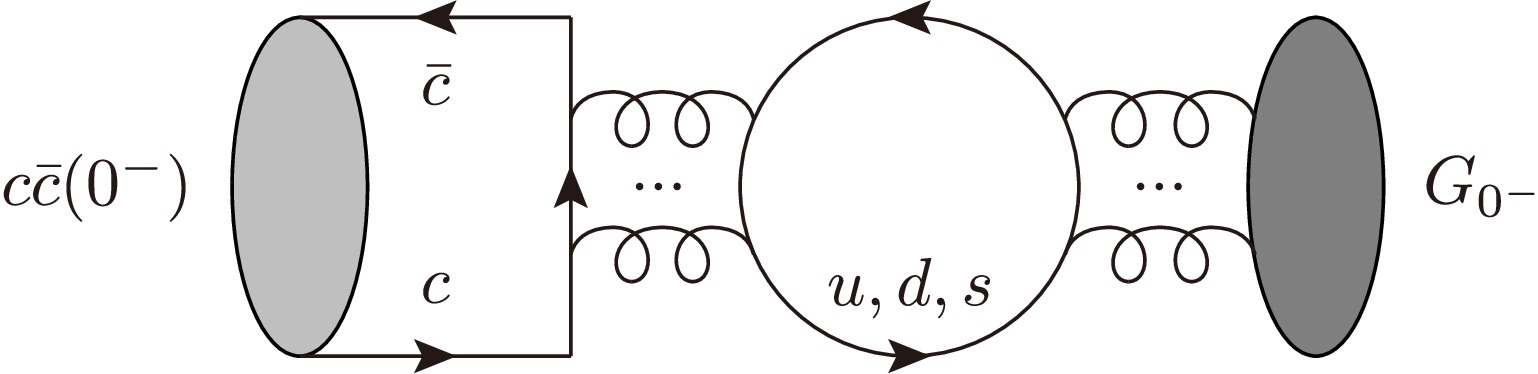
Figure 4. Schematic of the contribution of light quarks to the
$ c\bar{c}(0^-) $ –$ G_{0^-} $ mixing.Although the study in Ref. [16] yields strong evidence from first principles that
$ c\bar{c}(0^-) $ and$ G_{0^-} $ do mix, the derived mixing angle has uncontrolled systematic uncertainties. Thus, the result in Eq. (7) is robust, and mixing can provide a mechanism for enhancing the production rate of$ X(2370) $ in$ J/\psi $ radiative decay. -
For a pseudoscalar P, the partial decay width of
$ J/\psi\to \gamma P $ is related to the on-shell form factor$ M^{(P)}(Q^2=0) $ as$ \begin{aligned} \Gamma(J/\psi\to \gamma P)=\frac{4\alpha}{27}|\vec{k}|^3 M^2(0), \end{aligned} $
(1) where the electric charge of the charm quark,
$ Q_c=2e/3 $ , is incorporated, α is the fine-structure constant, and$ |\vec{k}|=(m_{J/\psi}^2-m_P^2)/(2m_{J/\psi}) $ is the magnitude of the spatial momentum of the final-state photon. The form factor$ M(Q^2) $ is defined through the electromagnetic multipole decomposition [18] of the transition matrix element$ \begin{aligned} \langle P(k)|j \,^\mu(0)|J/\psi(p, \lambda)\rangle = M^{(P)}(Q^2) \epsilon \,^{\mu\nu\rho\sigma}p_{\nu}k_{\rho}\epsilon_\sigma ^\lambda(p), \end{aligned} $
(2) where
$ Q^2=-(p-k)^2 $ is the virtuality of the photon,$ \epsilon_\sigma^\lambda(p) $ is the polarization vector of$ J/\psi $ , and$ j^\mu=\bar{c}\gamma^\mu c $ is the electromagnetic current involving only the charm quark because P is either a$ c\bar{c} $ state or a glueball.The mixing of the
$ c\bar{c}(0^-) $ state ($ |c\bar{c}\rangle $ ) and pure glueball$ G_{0^-} $ state ($ |G\rangle $ ) occurs through the$ c\bar{c}-gg(\cdots) $ dynamics (Fig. 1), where$ gg(\cdots) $ denotes intermediate multi-gluon states containing at least two gluons. If$ X(2370) $ ($ |X\rangle $ ) and$ \eta_c $ ($ |\eta_c\rangle $ ) are the corresponding two mass eigenstates after mixing, one has
Figure 1. Schematic of
$ c\bar{c}(0^-) $ –$ G_{0^-} $ mixing.$ \begin{aligned} \left(\begin{array}{c} |X\rangle \\ |\eta_c\rangle \end{array} \right)= \left(\begin{array}{lr} \cos\theta &-\sin\theta \\ \sin\theta & \cos\theta \end{array} \right) \left( \begin{array}{c} |G\rangle \\ |c\bar{c}\rangle \end{array} \right), \end{aligned} $
(3) where θ is the mixing angle. The on-shell form factors
$ M^{(P)}(0) $ for the$ J/\psi\to \gamma X(\eta_c) $ processes can be expressed as$ \begin{aligned}[b] M^{(X)}(0) &= M^{(G)}(0) \cos\theta-M^{(c\bar{c})}(0)\sin\theta, \\ M^{(\eta_c)}(0) &= M^{(G)}(0) \sin\theta+M^{(c\bar{c})}(0)\cos\theta. \end{aligned} $
(4) The on-shell form factors
$ M^{(c\bar{c})}(0) $ and$ M^{(G)}(0) $ have been derived directly from lattice QCD calculations. The lattice QCD calculations of$ M^{(P)}(0) $ for$ J/\psi\to \gamma \eta_c $ consider only the connected diagram shown in Fig. 2(a), and therefore, the resulting$ M^{(P)}(0) $ is$ M^{(c\bar{c})}(0) $ . The schematic for$ J/\psi\to \gamma G_{0^-} $ is shown in Fig. 2(b).$ M^{(P)}(0) $ is often expressed in terms of a dimensionless form factor$ V^{(P)}(0) $ as
Figure 2. Schematics for (a)
$ J/\psi\to \gamma c\bar{c}(0^-) $ and (b)$ J/\psi\to $ $ \gamma G_{0^{-}} $ . (c) Mechanism in which$ J/\psi $ undergoes a radiative transition to$ c\bar{c}(0^-) $ , which then mixes with$ G_{0^-} $ .$ \begin{aligned} M^{(P)}(0)=\frac{2\omega_P V^{(P)}(0)}{m_{J/\psi}+m_P}. \end{aligned} $
(5) For
$ c\bar{c}(0^-) $ ,$ \omega_P=2 $ account for photon emission from either the charm quark or the antiquark. For$ G_{0^-} $ , we take$ \omega_P=1 $ since the$ c\bar{c} $ annihilation produces a photon and gluons almost simultaneously, with the gluons coupling to$ G_{0^-} $ . In practical lattice QCD calculations, the gluon lines in Fig. 2(b) are accounted for by averaging over gauge configurations, while the photon is emitted from the charm quark loop. Therefore, all possible orderings of the photon and gluon vertices are included implicitly, and there is no need to consider the position of the photon emission separately.Table 1 summarizes the lattice QCD results for
$ V^{(c\bar{c})}(0) $ obtained either in the quenched approximation or with dynamical quarks. These results are consistent with one another. The result from the HPQCD collaboration [19] is obtained in$ N_f=2+1+1 $ QCD (including the dynamical$ u,d,s,c $ quark flavors), with better control of systematic uncertainties after the continuum and chiral extrapolations. Therefore, we use the value$ V^{(c\bar{c})}(0)= 1.865(7)(8) $ in the following discussion.Table 1. Values of the dimensionless form factor
$ V^{(c\bar{c})}(0) $ determined by lattice QCD calculations in the quenched approximation (QA) and with dynamical quarks.There is only one lattice QCD calculation of
$ V^{(G)}(0) $ in the quenched approximation, which yields$ V^{(G)}(0)= 0.0246(43) $ and$ m_{G_{0^-}}=2.395(14)\; {\rm{GeV}} $ after continuum extrapolation [8]. Using the experimental mass values$ m_{J/\psi}=3.0969(0) $ GeV and$ m_{\eta_c}=2.9841(4) $ GeV [17], as well as the value of$ m_{G_{0^-}} $ mentioned above, Eq. (5) yields$ \begin{aligned}[b] M^{(c\bar{c})}(0)&=1.227(7)\,{\rm{GeV}}^{-1},\\ M^{(G)}(0)&=0.0090(16)\; \rm{GeV}^{-1}.\end{aligned} $
(6) The effect of the
$ c\bar{c}(0^-)-G_{0^-} $ mixing on the decays$ J/\psi\to \gamma \eta_c(X) $ is illustrated in Fig. 2(c). We omit the other diagram describing the mixing of the final-state$ G_{0^-} $ produced in$ J/\psi\to\gamma G_{0^-} $ with$ c\bar{c}(0^-) $ because$ M^{(G)}(0)\ll M^{(c\bar{c})}(0) $ . The difference between Fig. 2(b) and Fig. 2(c) is interpreted theoretically as follows: the former describes the$ c\bar{c} $ pair in$ J/\psi $ annihilating into a photon and gluons that couple to$ G_{0^-} $ , whereas the latter describes the$ c\bar{c} $ pair propagating as a$ c\bar{c}(0^-) $ state after photon emission and subsequently mixing with$ G_{0^-} $ . The mechanism in Fig. 2(c) has not been investigated using lattice QCD because this would require the numerically challenging calculation of four-point functions such as$ \langle {\cal{O}}_{J/\psi}(t)j^\mu(t_1){\cal{O}}_{c\bar{c}(0^-)}(t_2){\cal{O}}_{G^{0^-}}(0)\rangle $ , where$ {\cal{O}}_Y $ denotes the lattice interpolating field for$ Y=J/\psi, c\bar{c}(0^-), G_{0^-} $ . Fortunately, the parts of Figs. 2(a), 2(b), and 2(c) to the right of the photon emission vertex can be well described by$ c\bar{c}(0^-)-G_{0^-} $ mixing. It is commonly believed that$ \eta_c $ is predominantly the lowest pseudoscalar charmonium state, which requires$ |\sin\theta|\ll 1 $ . Here, we consider some subtleties concerning Eq. (4), which is approximately valid when$ m_{G_{0^-}}\approx m_{c\bar{c}(0^-)} $ and$ |\sin\theta| $ is small. Given the non-negligible mass difference between$ G_{0^-} $ and$ c\bar{c}(0^-) $ , the kinematics corresponding to an on-shell photon differ for the two states. This difference is particularly relevant for the estimate of$ M^{(X)}(0) $ because$ M^{(c\bar{c})}(0)\gg M^{(G)}(0) $ . We do not know the value of$ M^{(c\bar{c})}(0) $ when$ \eta_c $ is off shell; therefore, we introduce a scaling parameter$ \kappa_c $ to account for the effect of the mass shift of$ c\bar{c}(0^-) $ , namely,$ M^{(c\bar{c})}(0,m_X)=\kappa_c M^{(c\bar{c})}(0) $ . Furthermore,$ M^{(G)}(0) $ and$ M^{(c\bar{c})}(0) $ are derived from independent lattice QCD calculations with independent phase conventions for the interpolating field operators. Therefore, we introduce another parameter s to describe the relative phase between$ M^{(G)}(0) $ and$ M^{(c\bar{c})}(0) $ . Using these prescriptions and combining Eqs. (1), (4), and (6) with the experimental total width$ \Gamma_{J/\psi}=92.6(1.4)\; {\rm{keV}} $ of$ J/\psi $ [17], we obtain$ \begin{aligned}[b] {\rm{Br}}(J/\psi\to\gamma\eta_c)=\;& (2.44(5)\times 10^{-2})\cos^2\theta,\\ {\rm{Br}}(J/\psi\to\gamma X) =\;& 2.88(4)\times 10^{-4} \\ & \times \left(122.7(7)\kappa_c \sin\theta-0.90(16) s\cos\theta\right)^2, \end{aligned} $
(7) where the contribution of the
$ M^{(G)}\sin\theta $ term to$ \Gamma(J/\psi\to \gamma\eta_c) $ is neglected because it is very small. When$ \cos\theta=1 $ (no mixing), one approximately recovers the lattice predictions in Ref. [19] for$ \Gamma(J/\psi\to \gamma\eta_c) $ (Ref. [19] uses the fine-structure constant$ \alpha=1/137 $ at the energy scale$ \mu\sim 0 $ , whereas we use$ 1/134 $ at the charmonium energy scale) and in Ref. [8] for$ \Gamma(J/\psi\to \gamma G_{0^-}) $ ). The effect of mixing with$ c\bar{c}(0^-) $ on$ {\rm{Br}}(J/\psi\to \gamma X(2370)) $ can be enhanced by two factors. Equation (6) indicates that$ M^{(c\bar{c})}(0)\gg M^{(G)}(0) $ , and the partial decay width is proportional to$ |\vec{k}|^3 $ , where$ \vec{k} $ is the photon momentum. Using the experimental mass values, one has$ \begin{aligned} \frac{|\vec{k}(J/\psi\to \gamma X)|^3}{|\vec{k}(J/\psi\to \gamma \eta_c)|^3}=\left(\frac{m_{J/\psi}^2-m_{X}^2}{m_{J/\psi}^2-m_{\eta_c}^2}\right)^3\approx 177.5. \end{aligned} $
(8) Consequently, in contrast to
$ \Gamma(J/\psi\to \gamma\eta_c) $ , which is insensitive to small values of$ \sin\theta $ ,$ \Gamma(J/\psi\to\gamma X(2370)) $ depends strongly on$ \sin\theta $ even when it is small, as illustrated in Fig. 3. We use the scaling factors$ \kappa_c=0.5, 1, 1.5 $ (green, red, and purple curves, respectively) to account for the effect of the$ G_{0^-}-c\bar{c}(0^-) $ mass difference, considering both destructive ($ s=1 $ , solid curves) and constructive ($ s=-1 $ , dashed curves) interference. In all cases,$ {\rm{Br}}(J/\psi\to \gamma X(2370)) $ exceeds$ 10^{-3} $ when$ \sin\theta\gtrsim 0.05 $ .
Figure 3. (color online) Branching fractions of
$ J/\psi\to\gamma\eta_c $ and$ J/\psi\to\gamma X(2370) $ as functions of$ \sin\theta $ . The blue curve denotes$ {\rm{Br}}(J/\psi\to\gamma\eta_c) $ . The green, red, and purple curves correspond to$ \kappa_c=0.5 $ ,$ 1.0 $ , and$ 1.5 $ , respectively, where$ \kappa_c\equiv {\cal{M}}^{(c\bar c)}(0,m_X)/ $ $ {\cal{M}}^{(c\bar c)}(0,m_{\eta_c}) $ . The solid and dashed curves represent the interference phases$ s=+1 $ and$ s=-1 $ , respectively. The shaded bands show the uncertainties propagated from the input radiative-transition amplitudes and the total$ J/\psi $ width.A previous lattice QCD study explored
$ c\bar{c}(0^-)-G_{0^-} $ mixing using gauge ensembles with$ N_f=2 $ degenerate charm sea quarks [16]. In this unitary lattice setup for charm quarks, mixing was clearly observed, and$ \sin\theta $ was determined directly. At two$ J/\psi $ masses, namely,$ m_{J/\psi} = 2.743(1) $ GeV and 3.068(1) GeV, the mixing angle was determined to be$ \theta = 6.6(9)^\circ $ and$ 4.3(4)^\circ $ , respectively. Based on the effective Hamiltonian$ \begin{aligned} H=\left( \begin{array}{cc} m_{G} & x\\ x &m_{c\bar{c}} \end{array} \right), \end{aligned} $
(9) the mixing energy was estimated to be
$ x= 49(6) $ MeV and found to be insensitive to the charm quark mass. This mixing energy may shift the masses$ m_{G} $ and$ m_{c\bar{c}} $ by only a few million electronvolts. Therefore, we estimate$ \begin{aligned} \sin\theta\approx \frac{x}{m_{\eta_c}-m_X}= 0.083_{-0.017}^{+0.011}, \; \theta\approx (4.8_{-1.0}^{+0.6})^\circ, \end{aligned} $
(10) using the experimental values of
$ m_{\eta_c} $ and$ m_X=2.395\pm 0.011_{-0.094}^{+0.026} $ GeV [4]. Substituting this value into Eq. (7), one obtains$ \begin{aligned}[b] \Gamma(J/\psi\to\gamma X(2370))&\approx 2.3_{-1.0}^{+0.7}\; {\rm{keV}},\\ {\rm{Br}}(J/\psi\to \gamma X(2370))&\approx 2.5_{-1.1}^{+0.7}\times 10^{-2}, \end{aligned} $
(11) for
$ \kappa_c=1 $ and$ s=1 $ . This large branching fraction is primarily attributed to the non-negligible mixing angle.We note that the estimate
$ \sin\theta\approx 0.08(1) $ was obtained in an unphysical lattice setup with two flavors of charm sea quarks and no light sea quarks. In this lattice setup, the flavor-singlet pseudoscalar charmonium state$ (c\bar{c}(0^-)) $ has the quark configuration$ (c_1\bar{c}_1+c_2\bar{c}_2)/\sqrt{2} $ , where$ c_{1,2} $ represents the two degenerate charm quark flavors.$ c_1\bar{c}_1 $ and$ c_2\bar{c}_2 $ couple to gluons through the same mechanism, as illustrated in Fig. 1, and therefore, the value of$ \sin\theta $ mentioned above can be matched qualitatively to the case with one charm quark flavor by multiplying it by$ 1/\sqrt{2} $ . When light sea quarks are present, they should contribute to the$ c\bar{c}(0^-)-G_{0^-} $ mixing through light quark loops, as indicated in Fig. 4. In the flavor-singlet pseudoscalar channel, the coupling of a quark–antiquark pair to gluons can be nonperturbative and enhanced by the QCD$ {\rm{U}}_A(1) $ anomaly, which introduces a topological$ q\bar{q}-gg(\cdots) $ coupling [25]. This argument is supported by experimental observations showing that light pseudoscalars (such as$ \eta' $ and$ \eta(1405) $ ) have large production rates in$ J/\psi $ radiative decay [17]. Based on the$ U_A(1) $ anomaly, an$ N_f=2 $ lattice QCD study yields a value of$ {\rm{Br}}(J/\psi\to \gamma \eta') $ consistent with the experimental value [26]. Thus, the light quark loop contribution can evade the OZI suppression that typically applies to other channels and can have a sizable effect on the$ c\bar{c}(0^-)-G_{0^-} $ mixing. Compared with Fig. 1, Fig. 4 has an additional (light) quark loop that introduces a relative minus sign. Therefore, to some extent, the light quark contribution reduces the$ c\bar{c}(0^-)-G_{0^-} $ mixing arising from the dynamics shown in Fig. 1. This minus sign is also observed in the lattice QCD calculation of the form factors for the$ D_s\to \eta(\eta') $ semileptonic decay [27]. Based on the discussion above, the branching fraction of$ J/\psi\to \gamma X(2370) $ in the real world is likely smaller than the value in Eq. (11).
Figure 4. Schematic of the contribution of light quarks to the
$ c\bar{c}(0^-) $ –$ G_{0^-} $ mixing.Although the study in Ref. [16] yields strong evidence from first principles that
$ c\bar{c}(0^-) $ and$ G_{0^-} $ do mix, the derived mixing angle has uncontrolled systematic uncertainties. Thus, the result in Eq. (7) is robust, and mixing can provide a mechanism for enhancing the production rate of$ X(2370) $ in$ J/\psi $ radiative decay. -
First, we discuss the experimental results for
$ {\rm{Br}}(J/\psi\to\gamma\eta_c) $ . The world-average value reported in PDG 2024 [17] is 1.41(14)%, which is in tension with the lattice result of 2.44(5)% (see Eq. (7) for$ \cos\theta=1 $ ). Recently, BESIII reported an experimental result of$ (2.29\pm0.01_{\rm{stat}}\pm 0.04_{\rm{syst}}\pm 0.18_{\rm{opbf}}) $ % from the process$ (J/\psi\to \gamma\eta_c, \eta_c\to p\bar{p}) $ [28], where "opbf" represents the uncertainty from other product branching fractions. This result is consistent with the lattice QCD result. This value favors$ \cos\theta\approx 1 $ and supports the interpretation of$ \eta_c $ as a predominantly pure charmonium state if the$ c\bar{c}(0^-)-G_{0^-} $ mixing picture applies here.We now turn to the production rate of
$ X(2370) $ in$ J/\psi $ radiative decay. When this paper was completed, BESIII had reported three product branching fractions, as listed in Table 2 [30]. Based on these branching fractions, SU(3) flavor symmetry implies$ {\rm{Br}}(J/\psi\to\gamma X(2370)\to \gamma K\bar{K}\eta')\sim 4\times 10^{-5} $ . If$ X(2370) $ is a pure pseudoscalar glueball, the quenched lattice QCD study predicts$ {\rm{Br}}(J/\psi\to \gamma X(2370))=2.3(8)\times 10^{-4} $ [8]. This would imply that$ K\bar{K}\eta' $ is a major decay mode with a branching fraction of approximately 20%. However, if$ X(2370) $ is a glueball state, its decays into light hadrons should follow a pattern similar to that of$ \eta_c $ [31, 32]. These decays proceed through intermediate gluons. The branching fraction of$ \eta_c\to K\bar{K}\eta' $ is only 1.73(35)%, and therefore,$ {\rm{Br}}(X(2370)\to K\bar{K}\eta')\sim 20 $ % is implausibly large. The most probable reason for this inconsistency is that the production rate of$ X(2370) $ in$ J/\psi $ radiative decay is considerably larger than that of a pure pseudoscalar glueball (this issue was addressed in a phenomenological study [33]). Very recently, BESIII estimated that$ {\rm{Br}}(J/\psi\to \gamma X(2370))> 1\times 10^{-3} $ [29].Decay process Product branching fraction $ J/\psi\to \gamma X(2370)\to \gamma K^+K^-\eta' $ $ (1.79\pm 0.23\pm 0.65)\times 10^{-5} $ [3]$ J/\psi\to \gamma X(2370)\to \gamma K_S^0K_S^0\eta' $ $ (1.18\pm 0.32\pm 0.39)\times 10^{-5} $ [3]$ (J/\psi\to \gamma X(2370), X(2370)\to $ $f_0(980)\eta', $ $f_0(980)\to K_S^0K_S^0) $ $ (1.31\pm 0.22_{-0.84}^{+2.85})\times 10^{-5} $ [4]$ J/\psi\to \gamma X(2370)\to \gamma K\bar{K}\eta' $ $ (3.9\pm 0.5\pm 1.0)\times 10^{-5} $ [29]$ J/\psi\to \gamma X(2370)\to \gamma K\bar{K}\pi $ $ (3.25\pm 0.25_{-0.75}^{+0.73})\times 10^{-4} $ [29]$ J/\psi\to \gamma X(2370)\to \gamma \pi\pi\eta $ $ (3.2\pm 0.1_{-1.0}^{+0.9})\times 10^{-4} $ [29]$ J/\psi\to \gamma X(2370)\to \gamma \pi\pi\eta' $ $ (1.94\pm 0.04_{-0.88}^{+0.33})\times 10^{-4} $ [29]Table 2. Product branching fractions for
$ J/\psi\to \gamma X(2370) $ followed by$ X\to PPP $ , measured by BESIII. Here,$ PPP $ denotes three-pseudoscalar final states.The
$ c\bar{c}(0^-)-G_{0^-} $ mixing helps explain the large production rate of$ X(2370) $ , as shown in Eq. (7) and Fig. 3. In other words, a small mixing angle θ can lead to a large production rate. The BESIII results [5, 34] indicate that$ X(2370) $ and$ \eta_c $ appear simultaneously in five three-pseudoscalar systems in$ J/\psi $ radiative decay, namely,$ K_S^0K_S^0\eta $ ,$ K_S^0K_S^0\pi^0 $ , and$ \pi^0\pi^0\eta $ , as well as$ \pi^+\pi^-\eta' $ and$ K_S^0K_S^0\eta' $ . A single clear structure (likely$ X(2370) $ ) appears in the energy region from 2.2 GeV to$ m_{\eta_c} $ [3, 5], except in the$ \pi^+\pi^-\eta' $ system [1, 2, 13], where an additional structure$ X(2600) $ was observed. This indicates the similarity between the decays of$ X(2370) $ and$ \eta_c $ and is consistent with the mixing mechanism. If the branching fraction$ {\rm{Br}}(X(2370)\to K\bar{K}\eta') $ is also roughly 2%, similar to that of$ \eta_c $ ($ {\rm{Br}}(\eta_c\to K\bar{K}\eta')= 1.73(35) $ % [17]), the estimate$ {\rm{Br}}(J/\psi\to\gamma X(2370)\to \gamma K\bar{K}\eta')\sim 4\times 10^{-5} $ from Table 2 yields$ {\rm{Br}}(J/\psi\to \gamma X(2370))\sim 2\times 10^{-3} $ , which is compatible with the latest BESIII estimate,$ {\rm{Br}}(J/\psi\to \gamma X(2370))> 1\times 10^{-3} $ [29]. The estimated mixing angle θ depends on the correction factor$ \kappa_c $ and interference parameter s in Eq. (7). For$ (\kappa_c=0.5, s=1) $ , using$ {\rm{Br}}(J/\psi\to\gamma X(2370))> 1\times 10^{-3} $ yields$ \theta>2.6^\circ $ . In the other cases, the lower bound on the mixing angle can be even smaller. This small mixing angle indicates that, in the$ c\bar{c}(0^-)-G_{0^-} $ mixing picture,$ \eta_c $ is predominantly a pure pseudoscalar charmonium state and$ X(2370) $ is almost a pure pseudoscalar glueball, while the latter is produced in$ J/\psi $ radiative decay through its tiny$ c\bar{c}(0^-) $ component. -
The BESIII collaboration observed the simultaneous appearance of
$ \eta_c $ and the pseudoscalar meson$ X(2370) $ in the three-pseudoscalar systems$ \pi^+\pi^-\eta' $ [1, 2] and$ K\bar{K}\eta' $ [3, 4] (and likely$ K_S^0K_S^0\eta $ ,$ K_S^0K_S^0\pi^0 $ , and$ \pi^0\pi^0\eta $ [5]) in$ J/\psi $ radiative decay.$ X(2370) $ appears to be the only structure in the energy region from 2.2 GeV to$ m_{\eta_c} $ , which includes the mass range of the pseudoscalar glueball predicted by lattice QCD studies. A previous lattice QCD study found that the pseudoscalar glueball ($ G_{0^-} $ ) and lowest pseudoscalar charmonium state ($ c\bar{c}(0^-) $ ) can mix with a small mixing angle θ. Therefore, it is possible that$ X(2370) $ and$ \eta_c $ are admixtures of$ G_{0^-} $ and$ c\bar{c}(0^-) $ . Within the mixing picture, we discuss the production rate of$ X(2370) $ in the$ J/\psi $ radiative decay. Although$ {\rm{Br}}(J/\psi\to\gamma\eta_c) $ is insensitive to small values of$ \sin\theta $ ,$ {\rm{Br}}(J/\psi\to \gamma X(2370)) $ can be greatly enhanced by mixing because of the considerably larger kinematic factor for$ J/\psi\to \gamma X(2370) $ and the substantially larger transition form factor for$ J/\psi\to \gamma (c\bar{c}(0^{-})) $ . In other words, depending on the value of$ \sin\theta $ ,$ X(2370) $ can be produced in$ J/\psi $ radiative decay through its tiny$ c\bar{c}(0^-) $ component, with a branching fraction considerably larger than the value of$ 2.3(8)\times 10^{-4} $ for a pure pseudoscalar glueball. The BESIII results favor a small mixing angle of$ {\cal{O}}(1^\circ) $ . This implies that, in the$ c\bar{c}(0^-)-G_{0^-} $ mixing picture,$ \eta_c $ is predominantly a pure pseudoscalar charmonium state and$ X(2370) $ is almost a pure pseudoscalar glueball. Further experimental measurements of the decay modes of$ X(2370) $ are required to constrain the mixing angle. -
The BESIII collaboration observed the simultaneous appearance of
$ \eta_c $ and the pseudoscalar meson$ X(2370) $ in the three-pseudoscalar systems$ \pi^+\pi^-\eta' $ [1, 2] and$ K\bar{K}\eta' $ [3, 4] (and likely$ K_S^0K_S^0\eta $ ,$ K_S^0K_S^0\pi^0 $ , and$ \pi^0\pi^0\eta $ [5]) in$ J/\psi $ radiative decay.$ X(2370) $ appears to be the only structure in the energy region from 2.2 GeV to$ m_{\eta_c} $ , which includes the mass range of the pseudoscalar glueball predicted by lattice QCD studies. A previous lattice QCD study found that the pseudoscalar glueball ($ G_{0^-} $ ) and lowest pseudoscalar charmonium state ($ c\bar{c}(0^-) $ ) can mix with a small mixing angle θ. Therefore, it is possible that$ X(2370) $ and$ \eta_c $ are admixtures of$ G_{0^-} $ and$ c\bar{c}(0^-) $ . Within the mixing picture, we discuss the production rate of$ X(2370) $ in the$ J/\psi $ radiative decay. Although$ {\rm{Br}}(J/\psi\to\gamma\eta_c) $ is insensitive to small values of$ \sin\theta $ ,$ {\rm{Br}}(J/\psi\to \gamma X(2370)) $ can be greatly enhanced by mixing because of the considerably larger kinematic factor for$ J/\psi\to \gamma X(2370) $ and the substantially larger transition form factor for$ J/\psi\to \gamma (c\bar{c}(0^{-})) $ . In other words, depending on the value of$ \sin\theta $ ,$ X(2370) $ can be produced in$ J/\psi $ radiative decay through its tiny$ c\bar{c}(0^-) $ component, with a branching fraction considerably larger than the value of$ 2.3(8)\times 10^{-4} $ for a pure pseudoscalar glueball. The BESIII results favor a small mixing angle of$ {\cal{O}}(1^\circ) $ . This implies that, in the$ c\bar{c}(0^-)-G_{0^-} $ mixing picture,$ \eta_c $ is predominantly a pure pseudoscalar charmonium state and$ X(2370) $ is almost a pure pseudoscalar glueball. Further experimental measurements of the decay modes of$ X(2370) $ are required to constrain the mixing angle.
Production rate of the glueball-like X(2370) in J/ψ radiative decay
- Received Date: 2026-09-17
- Available Online: 2027-01-15
Abstract: $ X(2370) $ lies in the mass region of the lowest pseudoscalar glueball predicted by lattice quantum chromodynamics (QCD) studies, and its decay properties are similar to those of $ \eta_c $. A previous lattice QCD study clearly shows that the pseudoscalar glueball ($ G_{0^-} $) and lowest pseudoscalar charmonium state ($ c\bar{c}(0^-) $) can mix with a small mixing angle θ. Therefore, $ X(2370) $ and $ \eta_c $ could be admixtures of $ G_{0^-} $ and $ c\bar{c}(0^-) $. Although $ {\rm{Br}}(J/\psi\to\gamma\eta_c) $ is insensitive to small values of $ \sin\theta $, $ {\rm{Br}}(J/\psi\to \gamma X(2370)) $ can be greatly enhanced by mixing because of the considerably larger kinematic factor for $ J/\psi\to \gamma X(2370) $ and the substantially larger transition form factor for $ J/\psi\to \gamma (c\bar{c}(0^{-})) $. Based on the value of $ \sin\theta $, $ {\rm{Br}}(J/\psi\to \gamma X(2370)) $ can be considerably larger than the branching fraction for a pure pseudoscalar glueball, namely, $ 2.3(8)\times 10^{-4} $, as predicted by a quenched lattice QCD calculation. This amplification mechanism helps explain the large production rate of $ X(2370) $ in $ J/\psi $ radiative decay, and the BESIII Collaboration results favor a small mixing angle of $ {\cal{O}}(1^\circ) $ if the mixing picture applies here.



 DownLoad: