


 Abstract
 HTML
 Reference
 Related
 PDF



-
In the past several decades, the synthesis of superheavy nuclei (SHNs) in terrestrial laboratories via fusion-evaporation reactions has made substantial progress, reaching the element oganesson (
$ Z=118 $ ). Up to now, the seventh period of the periodic table has been completely filled. Extending the periodic table is important not only for basic science, but also for applications in chemistry, materials science, biology, interdisciplinary science, etc. The synthesis of new superheavy elements or SHNs is complicated by the quasifission mechanism that occurs before compound-nucleus formation in fusion reactions. Shell effects bind nucleons and enable the existence of SHNs, thereby motivating predictions of the “island of stability”. Low-energy fusion reactions are multidimensional quantum-tunneling processes, in which collective excitation, dynamical deformation, nucleon or cluster transfer, etc., are coupled to compound-nucleus formation through overcoming the Coulomb barrier [1]. Up to now, fusion reactions in low-energy heavy-ion collisions have been extensively investigated, including weakly bound nucleus-induced reactions [2], nuclear fusion at deep sub-barrier energies for astrophysical interest [3], and the synthesis of superheavy nuclei (SHNs) [4, 5]. Roughly one third of the nuclides on the nuclear chart have been synthesized in laboratories via fusion reactions [6]. With the establishment of radioactive beam facilities worldwide, such as RIBF at RIKEN (Japan) [7], SPIRAL2 at GANIL (France) [8], FRIB at MSU (USA) [9], and HIAF at IMP (China) [10], the synthesis of new SHNs on the “island of stability” via fusion reactions induced by neutron-rich radioactive beams or via multinucleon transfer (MNT) reactions may become possible in future experiments. Accurate estimation of SHN production cross sections is particularly important for experimental synthesis, including the optimal choice of reaction system, beam energy, evaporation channel, and so on.The nucleus-nucleus (NN) potential influences fusion dynamics. A key quantity is the Coulomb barrier, which determines the capture and fusion of two colliding partners and is mainly composed of the nuclear, centrifugal, and repulsive Coulomb potentials. Usually, the NN potential is used to calculate the fusion cross section within a quantum-penetration or coupled-channel approach. The fusion probability rapidly decreases as the incident energy is reduced below the Coulomb barrier. Bass proposed an empirical formula for estimating the Coulomb barrier and fusion cross section [11]. In light and medium reaction systems, the compound nucleus is formed after overcoming the Coulomb barrier, and this process has been extensively investigated in studies of stellar fusion and nuclear structure. However, in heavy projectile-target combinations for SHN formation, quasifission proceeds before compound-nucleus formation; in this process, the disintegration of the colliding system after a few nucleon transfers hinders compound-nucleus formation. Neck dynamics, shape evolution, collective excitation, nucleon (cluster) transfer, etc., influence fusion dynamics and compound-nucleus formation. It is well known from transport models, e.g., the time-dependent Hartree-Fock (TDHF) approach [12] and the quantum molecular dynamics (QMD) model [13], that the NN potential in fusion reactions is associated with shape evolution and beam energy. There are mainly two types of NN potentials, namely, the adiabatic potential [14] and phenomenological potentials within the prompt approximation, such as the Woods-Saxon potential [15], proximity potential [16], and double-folding potentials with Yukawa-plus-exponential, density-dependent M3Y force, Migdal force, etc. [17–20]. The NN potential can also be calculated within the energy-density functional approach based on effective nucleon-nucleon interactions, i.e., the Skyrme force [21, 22], the finite-range Gogny interaction [23], etc. An advantage of the energy-density functional approach is that it provides a unified description of nuclear structure, nuclear dynamics, and nuclear matter based on effective nucleon-nucleon interactions.
In this work, the NN potential is calculated within the Skyrme energy-density functional framework. The potential energy surface is obtained with this approach, and SHN production is discussed by implementing it into the dinuclear system (DNS) model. The article is organized as follows. In Section 2, we briefly describe Skyrme energy-density functional theory and the potential energy surface in the DNS model. The fusion-evaporation excitation functions for SHN production in the 48Ca-, 50Ti-, 51V-, and 54Cr-induced reactions on actinide nuclei are systematically investigated in Section 3. A summary and perspective on new SHN production are presented in Section 4.
-
The DNS model has been extensively applied to quasi-fission dynamics, multinucleon transfer reactions, pre-equilibrium cluster emission, and deep-inelastic collisions, among others, in which the dissipation of the relative motion energy and rotational energy of the colliding system into internal degrees of freedom such as excitation energy is assumed to occur at the touching configuration. The evolution of the DNS system toward the formation of a compound nucleus mainly proceeds along two degrees of freedom, namely, the radial motion via the decay of the DNS and the nucleon (cluster) transfer via the mass asymmetry
$ \eta=(A_{1}-A_{2})/(A_{1}+A_{2}) $ or the charge asymmetry$ \eta_{Z}=(Z_{1}-Z_{2})/(Z_{1}+Z_{2}) $ [24–27]. In accordance with the temporal evolution of the system, projectile-target capture by overcoming the Coulomb barrier, the competition between quasi-fission and complete fusion through nucleon transfer to form the compound nucleus, and the de-excitation of the thermal compound nucleus proceed to form the SHN. The production cross section in the fusion-evaporation reaction is calculated by summing over the partial waves J at an incident center-of-mass energy$ E_{c.m.} $ as$ \begin{aligned}[b] \sigma_{ER}(E_{c.m.}) = \;& \frac{\pi\hbar^{2}}{2\mu E_{c.m.}}\sum^{J_{max}}_{J=0}(2J+1)T(E_{c.m.},J) \\ & \times P_{CN}(E_{c.m.},J)W_{sur}(E_{c.m.},J) \end{aligned} $
(1) Here,
$ T(E_{c.m.},J) $ is the transmission probability for overcoming the Coulomb barrier, and it is given by the Hill–Wheeler formula with a Gaussian-type barrier distribution, as described in [25].$ \begin{aligned}[b] & T(E_{{\rm{c}}.m.},J)= \int f(B) \\& \frac{1}{1+\exp\left \{ -\dfrac{2\pi }{\hbar \omega (J)}\left [ E_{{\rm{c}}.m.} - B - \dfrac{J(J+1)\hbar^2}{2\mu R_B^2 (J) } \right ] \right \} } dB, \end{aligned} $
(2) with
$ \hbar \omega (J) $ denoting the width of the parabolic barrier at the barrier radius$ R_{B} (J) $ , where$ R_{B} = r_{0b}*(A_{P}^{1/3} + A_{T}^{1/3}) $ and$ r_{0b} = 1.4\sim1.5 $ fm. The distribution function is assumed to have the Gaussian form$ f(B) = \frac{1}{N} \exp[-((B-B_{m})/\Delta)^{2}] $ , where the normalization constant satisfies the condition$ \int f(B)dB=1 $ . The quantities$ B_{m} $ and Δ are evaluated as$ B_{m}=(B_{C} + B_{S})/2 $ and$ \Delta = (B_{C} - B_{S})/2 $ , respectively. Here,$ B_{C} $ and$ B_{S} $ denote the Coulomb barrier for the waist-to-waist orientation in nuclear collisions and the barrier height at the saddle point with varying quadrupole deformation, respectively.In the DNS model, accurate estimation of the NN potential is important for calculating the transmission and formation probabilities, which affect the production cross section of SHN and the structural distribution of the fusion-evaporation excitation function. The NN potential consists of nuclear, Coulomb, and centrifugal contributions, as follows [25, 28]
$ \begin{aligned}[b] V(R, {\alpha}_{P}, {\alpha}_{T}, J) =\;&V_{nucl}(R, {\alpha}_{P}, {\alpha}_{T}) + V_{Coul}(R, {\alpha}_{P}, {\alpha}_{T}) \\ & + \frac{\hbar^{2}}{2\xi_{rel}}J(J+1). \end{aligned} $
(3) Here, the Coulomb potential including quadrupole deformation is calculated using the well-known Wong formula [29]. The
$ {\alpha}_{i} $ denote the nuclear radius$ R_{i} $ , quadrupole deformation$ \beta_{i} $ , the polar angle$ \theta_{i} $ between the collision direction and the symmetry axis of the deformed nucleus, with$ i=P, T $ denoting the projectile and target nuclei, and the relative moment of inertia$ \xi_{rel} $ . The center-of-mass distance R between the projectile and target nuclei is correlated with the quadrupole deformation parameter. The deformation effect is included in both the nuclear and Coulomb potentials, resulting in the orientation dependence of the Coulomb barrier and influencing the quasifission dynamics in fusion-evaporation reactions.In the DNS model, the nuclear potential was initially calculated using the Morse potential [30], the Woods-Saxon potential [25], and the double-folding approach with Migdal force [31]. In this work, the nuclear potential is calculated using the Skyrme energy-density functional (EDF) in spherical coordinates (r, θ, and ϕ), as in [32, 33]
$ \begin{aligned}[b] V_{nucl}(R, \{\alpha\}_{P}, \{\alpha\}_{T}) =\;& E_{sys}(R, \{\alpha\}_{P}, \{\alpha\}_{T}) \\ & - E_{P}(\{\alpha\}_{P}) - E_{T}(\{\alpha\}_{T}). \end{aligned} $
(4) The
$ E_{sys} $ ,$ E_{P} $ , and$ E_{T} $ are the total binding energies arising from the nucleon-nucleon interaction for the colliding system, projectile, and target nuclei, respectively, calculated by multiple integration as$ E=\int \int\int \varepsilon[\rho_{p}({\boldsymbol{r}}), \rho_{n}({\boldsymbol{r}})] r^{2}\sin(\theta) drd\theta d\phi $ . The total energies of the colliding system, projectile, and target nuclei are calculated using the EDF method as$ \begin{aligned}[b] E_{sys}({\boldsymbol{R}}, \{\alpha\}_{P}, \{\alpha\}_{T}) =\;& \int\varepsilon[\rho_{1p}({\boldsymbol{r}})+\rho_{2p}({\boldsymbol{R}}-{\boldsymbol{r}}), \\ &\rho_{1n}({\boldsymbol{r}})+\rho_{2n}({\boldsymbol{R}}-{\boldsymbol{r}}) ] d{\boldsymbol{r}}, \end{aligned} $
(5) $ E_{P}(\{\alpha\}_{P})=\int\varepsilon[\rho_{1p}({\boldsymbol{r}}), \rho_{1n}({\boldsymbol{r}}) ] d{\boldsymbol{r}} $
(6) and
$ E_{T}(\{\alpha\}_{T})=\int\varepsilon[\rho_{2p}({\boldsymbol{R}}-{\boldsymbol{r}}), \rho_{2n}({\boldsymbol{R}}-{\boldsymbol{r}}) ] d{\boldsymbol{r}}, $
(7) respectively. The density profiles of the proton and neutron distributions for the projectile and target nuclides are assumed under the sudden approximation. For example, the Woods-Saxon form for the projectile nuclide is given as
$ \rho_{1i}({\boldsymbol{r}})=\frac{\rho_{1i_{0}}}{1+\exp[{\boldsymbol{r}}-R_{1}/a_{i}]}, i=\{n,p\} $
(8) with the diffuseness coefficient
$ a_{i} $ in the range 0.55–0.65 fm. The parameters$ \rho_{1i_{0}} $ and$ a_{i} $ are obtained by fitting the results of the Skyrme-Hartree-Fock method. The projectile radius with quadrupole deformation is given by$ R_{1}=R_{01}\left( 1+\sqrt{\frac{5}{4\pi}}\beta_{2}\frac{3\cos^{2}\theta-1}{2}\right) $
(9) with
$ R_{01}=1.28A_{P}^{1/3}-0.76+0.8A_{P}^{-1/3} $ fm, where$ A_{P} $ is the mass number of the projectile nucleus. A similar method is used to calculate the system energy and the target energy. Details can be found in Ref. [34].Based on the well-known extended Thomas-Fermi (ETF) approximation, the kinetic-energy term, with protons and neutrons distinguished, is calculated up to the second-order correction. The energy-density functional is expressed as follows [22]
$ \varepsilon_{kin}[\rho_{p}({\boldsymbol{r}}),\rho_{n}({\boldsymbol{r}})] = \frac{\hbar^{2}}{2m} [\varepsilon_{kin}^{p}({\boldsymbol{r}}) + \varepsilon_{kin}^{n}({\boldsymbol{r}})] + \varepsilon_{pot}({\boldsymbol{r}}). $
(10) The kinetic-energy density functional is given by
$ \begin{aligned}[b] \varepsilon_{kin}^{i}({\boldsymbol{r}})=\;&\frac{3}{5}(3\pi^{2})^{2/3}\rho_{i}^{5/3}+\frac{1}{36}\frac{(\bigtriangledown\rho_{i})^{2}}{\rho_{i}}+\frac{1}{3}\bigtriangleup\rho_{i} \\ &+\frac{1}{6}\frac{\bigtriangledown\rho_{i}\bigtriangledown f_{i}+\rho_{i}\bigtriangleup f_{i}}{f_{i}}-\frac{1}{12}\rho_{i} \left(\frac{\bigtriangledown f_{i}}{f_{i}} \right)^{2} \\ &+\frac{1}{2}\rho_{i} \left( \frac{2m}{\hbar^{2}}\frac{W_{0}}{2}\frac{\bigtriangledown(\rho+\rho_{i})}{f_{i}} \right)^{2} \end{aligned} $
(11) with the factor
$ f_{i}=1+\frac{2m}{\hbar^{2}}\left(\frac{3t_{1}+5t_{2}}{16}+\frac{t_{2}x_{2}}{4}\right)\rho_{i}({\boldsymbol{r}}). $
(12) Here, the local densities of protons and neutrons are denoted by
$ \rho_{i} $ with$ i=n, p $ , the total density is$ \rho = \rho_{n}+\rho_{p} $ , and the kinetic energy density is$ \varepsilon_{kin} = \varepsilon_{kin}^{n} + \varepsilon_{kin}^{p} $ . These quantities are specified separately for the colliding system, the projectile, and the target nuclei. The potential-energy density functional is evaluated by$ \begin{aligned}[b] \varepsilon_{pot}({\boldsymbol{r}})=\;&\frac{t_{0}}{2}[(1+\frac{1}{2}x_{0})\rho^{2}-(x_{0}+\frac{1}{2})(\rho_{p}^{2}+\rho_{n}^{2})] \\ &+\frac{1}{12}t_{3}\rho^{\alpha}[(1+\frac{1}{2}x_{3})\rho^{2}-(x_{3}+\frac{1}{2})(\rho_{p}^{2}+\rho_{n}^{2})]\end{aligned} $
$ \begin{aligned}[b] \quad &+\frac{1}{4}[t_{1}(1+\frac{1}{2}x_{1})+t_{2}(1+\frac{1}{2}x_{2})]\tau\rho \\ &+\frac{1}{4}[t_{2}(x_{2}+\frac{1}{2})-t_{1}(x_{1}+\frac{1}{2})](\tau_{p}\rho_{p}+\tau_{n}\rho_{n}) \\ &+\frac{1}{16}[3t_{1}(1+\frac{1}{2}x_{1})-t_{2}(1+\frac{1}{2}x_{2})](\bigtriangledown\rho)^{2} \\ &-\frac{1}{16}[3t_{1}(x_{1}+\frac{1}{2})+t_{2}(x_{2}+\frac{1}{2})]((\bigtriangledown\rho_{n})^{2}+(\bigtriangledown\rho_{p})^{2}) \\ & - \frac{mW_{0}^{2}}{2\hbar^{2}} \left[\frac{\rho_{p}}{f_{p}}(2\bigtriangledown\rho_{p}+\bigtriangledown\rho_{n})^{2}+ \frac{\rho_{n}}{f_{n}} (2\bigtriangledown\rho_{n}+\bigtriangledown\rho_{p})^{2} \right]. \end{aligned} $
(13) The parameters
$ t_{0} $ ,$ t_{1} $ ,$ t_{2} $ ,$ t_{3} $ ,$ x_{0} $ ,$ x_{1} $ ,$ x_{2} $ ,$ x_{3} $ , the density-dependent stiffness α, the spin-orbit strength$ W_{0} $ , the symmetry energy coefficient$ a_{s} $ , the nucleon effective mass$ m^{\ast}_{\infty} $ , and the incompressibility modulus$ K_{\infty} $ are listed in Table 1. Five sets of Skyrme parameters, SkM, SkM* [35], Z [36], SKa [37], and SLy4 [38], are compared in the calculations. The selected forces self-consistently describe the ground-state binding energies, root-mean-square radii of finite nuclei around the magic numbers, and nuclear matter properties (symmetry energy, saturation density, etc.).Parameter SkM SkM* SLy4 SKa Z $ t_{0} $ (MeV fm3)−2645 −2645 −2488.9 −1602.8 −1140.3 $ t_{1} $ (MeV fm5)385 410 486.8 570.9 309.6 $ t_{2} $ (MeV fm5)−120 −135 −546.4 −67.7 −122.2 $ t_{3} $ (MeV${\rm{fm}} ^{3+3\alpha} $ )15595 15595 13777 8000 11608 $ x_{0} $ 0.09 0.09 0.834 −0.02 0.798 $ x_{1} $ 0 0 −0.344 0 0 $ x_{2} $ 0 0 −1.0 0 0 $ x_{3} $ 0 0 1.354 −0.286 1.632 W0 (MeV fm5) 130 130 123 125 120 α 1/6 1/6 1/6 1/3 0.8 $ a_{s} $ (MeV)30.8 30.1 32.0 33.0 26.9 $ m^{\ast}_{\infty}/m $ 0.79 0.79 0.70 0.61 0.84 $ K_{\infty} $ (MeV)217 217 230 261 330 Table 1. The Skyrme parameters used in the calculations.
The nucleus-nucleus (NN) potential is important for describing nuclear dynamics, i.e., α decay, low-energy heavy-ion collisions, quasi-fission processes, fusion-evaporation reactions, etc. [39, 40]. The quasifission yields, fusion-fission products, fusion cross sections, fusion-evaporation excitation functions, isotopic distributions, and angular and kinetic energy spectra in deep-inelastic collisions or multinucleon transfer reactions are associated with the NN potential. Dynamical deformation, collective excitation, shape evolution, initial orientation, etc. are correlated with the nucleus-nucleus potential and influence fusion dynamics [41–43]. In low-energy nuclear collisions, the nucleon density profiles of the reaction system vary with time and lead to very complicated NN potentials and potential energy surfaces. Two typical approximations are usually used in reaction models, i.e., the sudden approximation and the adiabatic approach. In the calculations, the sudden approximation with frozen nuclear density is used for the potential energy surface and for estimating SHN production, i.e., in the DNS model. As a typical reaction type, the 48Ca-induced fusion reactions on actinide nuclides were chosen because they were successfully used to synthesize SHNs with charge numbers Z=112–118 at Dubna. The Skyrme forces SKM, SKM*, SKa, Z, and SLy4, corresponding to different incompressibility moduli of nuclear matter at normal density, are selected in the calculation. Shown in Fig. 1 is a comparison of the NN potentials obtained with different Skyrme forces in the collisions of 48Ca+243Am and 48Ca+248Cm, respectively. The difference among the NN potentials from the Skyrme forces is pronounced, which is mainly caused by the difference in the incompressibility modulus of nuclear matter. It is well known that the DNS is assumed to be formed at the bottom of the potential pocket. A broader and deeper potential pocket is favorable for compound nucleus formation against quasifission reactions.
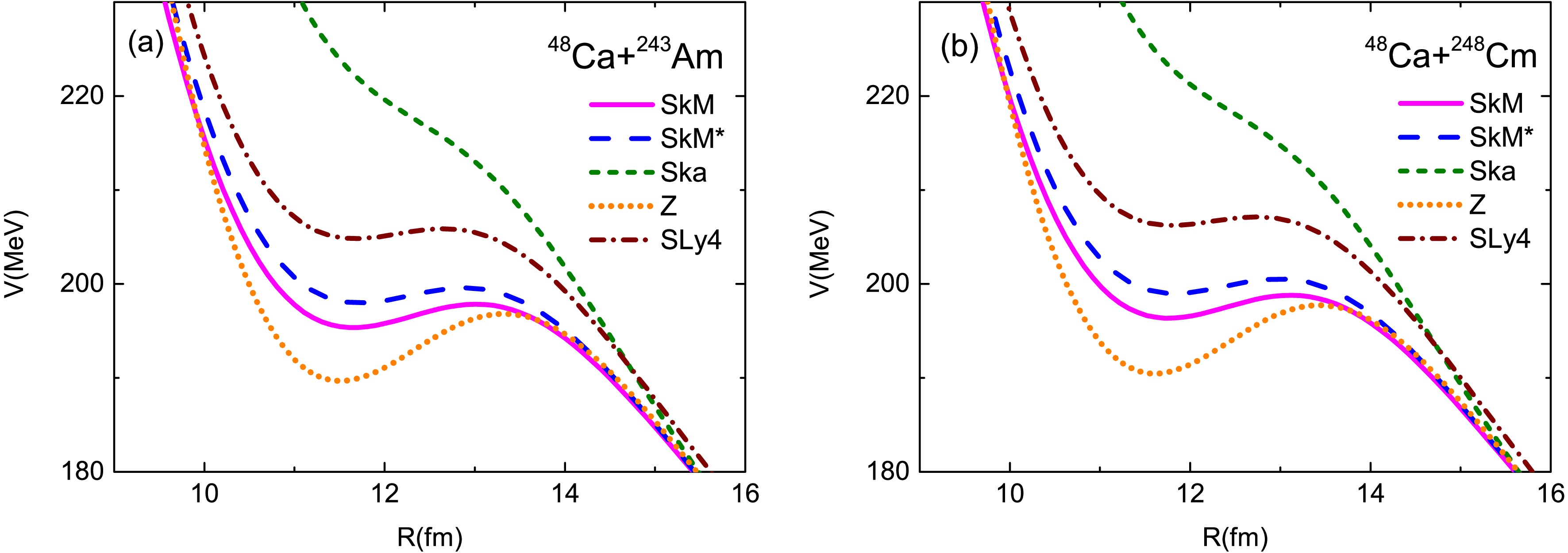
Figure 1. (color online) Comparison of the NN potentials calculated using the Skyrme forces SKM, SKM*, SKa, Z, and SLy4 for the reactions 48Ca+243Am (left panel) and 48Ca+248Cm (right panel), respectively.
The formation of superheavy nuclei in massive fusion reactions is complicated because of fusion hindrance and the involvement of a set of degrees of freedom, i.e., nucleon/cluster transfer, shape evolution, neck formation, relative-motion energy, and angular-momentum dissipation. In the DNS model, the density profiles of the colliding nuclei are assumed to be frozen, and the neck dynamics is not included. The nucleon/cluster transfer is coupled to the relative degrees of freedom through the master equations via the potential energy surface (PES). The PES is expressed as follows
$ U(R, {\alpha}_{P}, {\alpha}_{T}, J) = Q_{gg}(Z_{1},N_{1}) + V(R, {\alpha}_{P}, {\alpha}_{T}, J) $
(14) with
$ Q_{gg}(Z_{1},N_{1}) = B(Z_{1},N_{1})+B(Z_{2},N_{2}) - B(Z_{com},N_{com}) $ ,$ Z_{1}=Z_{com}-Z_{2} $ , and$ N_{1}=N_{com}-N_{2} $ . Here,$ B(Z_{i},N_{i}) $ $ (i=1,2) $ and$ B(Z_{com},N_{com}) $ are the ground-state binding energies of fragment$ (Z_{i},N_{i}) $ and compound nucleus$ (Z_{com},N_{com}) $ , respectively. It is obvious that nuclear-structure effects, such as shell effects and pairing correlations, are included in the PES. Figure 2 shows the driving potential as a function of mass asymmetry ($ \eta=(A_{1} - A_{2})/A_{CN} $ ) for the reactions 48Ca + 243Am and 48Ca + 248Cm, respectively. The Businaro-Gallone (B.G.) point is marked at the maximum of the driving potential. It should be noted that the driving potential is defined as the minimum value for a fixed mass asymmetry. The differences in the driving potentials obtained with the Skyrme forces SKM, SKM*, Ska, Z, and SLy4 arise from the NN potential. The fusion probability is related to the inner fusion barrier, which is defined as the difference between the driving potential at the B.G. point and that at the incident projectile-target mass asymmetry, according to the relation$ B_{fus}=U_{dr}(\eta_{B.G.}) - U_{dr}(\eta_{i}) $ . A lower inner fusion barrier is favorable for compound-nucleus formation, e.g., 7.43 MeV for the reaction 48Ca + 243Am and 7.17 MeV for 48Ca + 248Cm. The inner fusion barrier is a crucial quantity for evaluating fusion hindrance in massive fusion reactions.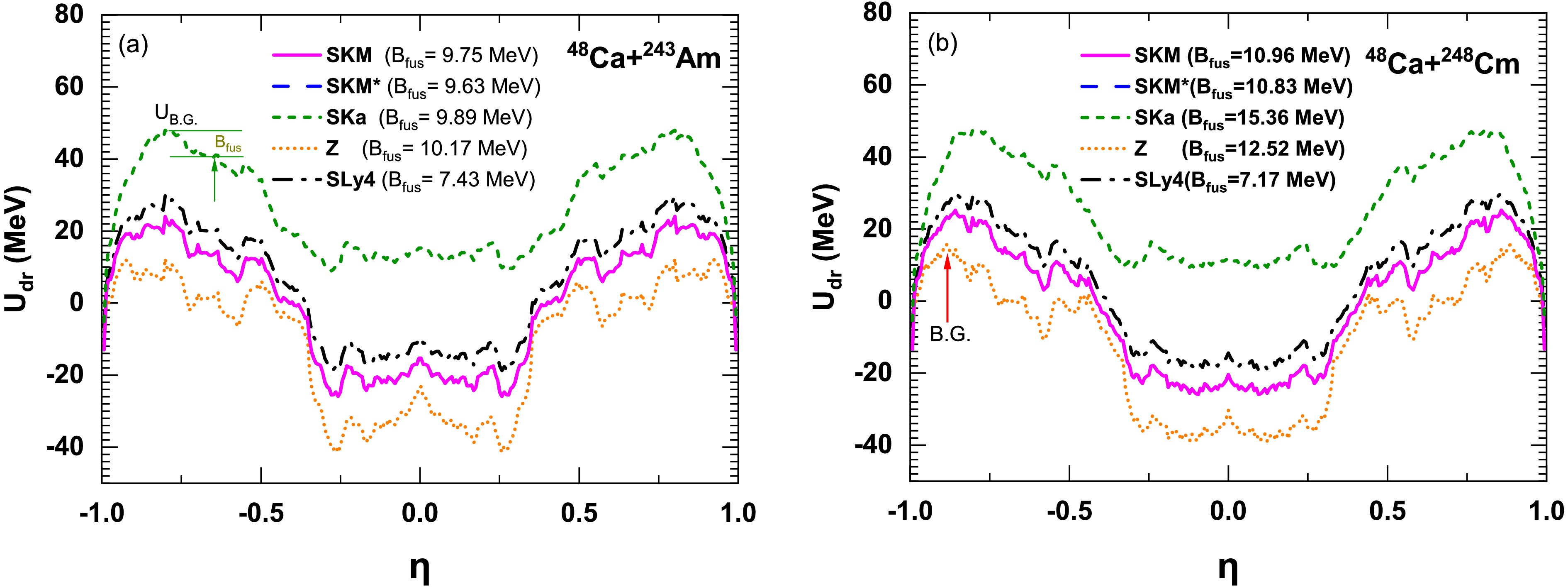
Figure 2. (color online) The driving potential as a function of mass asymmetry for the reactions (a) 48Ca + 243Am and (b) 48Ca + 248Cm.
Shown in Fig. 3 are the transmission probabilities and capture excitation functions for the reactions 48Ca + 243Am, 48Ca + 248Cm, 51V + 243Am, and 54Cr + 243Am with the parameter SKM, respectively. It is evident that the Dubna data for the reaction 48Ca + 248Cm are well reproduced by the Skyrme energy-density-functional approach [44]. The magnitudes of the cross sections are comparable for the systems 48Ca + 243Am, 48Ca + 248Cm, and 51V + 243Am. The enhancement of the capture cross section in the sub-barrier region for the reaction 54Cr + 243Am is caused by the larger negative Q-value, which is favorable for increasing the evaporation-residue cross section in the 2n channel. However, for the reaction 48Ca + 248Cm, the capture cross sections at excitation energies of 20–30 MeV are overestimated by one order of magnitude compared with the Dubna data. This discrepancy is caused by the width of the Gaussian-like barrier distribution in Eq. (2). A smaller barrier width leads to a reduction in the transmission probability at sub-barrier energies. For example, an asymmetric barrier distribution is favorable for reproducing the experimental data [25].
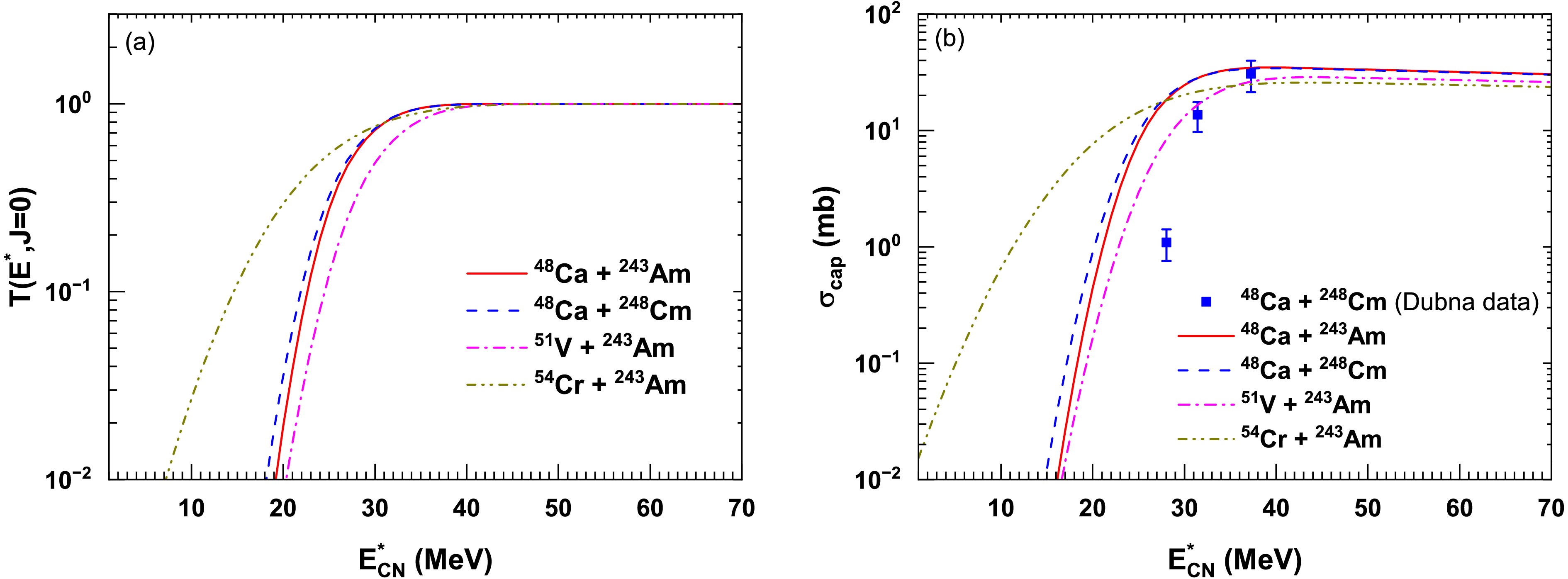
Figure 3. (color online) (a) The transmission probabilities at angular momentum
$ J=0 $ and (b) the capture cross sections as functions of the excitation energy of the compound nucleus for the reactions 48Ca + 243Am, 48Ca + 248Cm, 51V + 243Am, and 54Cr + 243Am, respectively. The available data for 48Ca + 248Cm are taken from Dubna [44].The fusion probability
$ P_{CN} $ is described within the DNS model by taking into account the competition with quasi-fission and fission of the heavy fragment [27]. In this model, nucleon transfer is described by solving a set of microscopically derived master equations while distinguishing the isospin effect as follows$ \begin{aligned}[b] \frac{d P(Z_{1},N_{1},E_{1}, t)}{dt} =\;& \sum_{Z^{\text{'}}_{1}}W_{Z_{1},N_{1};Z^{\text{'}}_{1},N_{1}}(t)[d_{Z_{1},N_{1}}P(Z^{\text{'}}_{1},N_{1},E^{\text{'}}_{1},t) \\ & - d_{Z^{\text{'}}_{1},N_{1}}P(Z_{1},N_{1},E_{1},t)] \\ & + \sum_{N^{\text{'}}_{1}}W_{Z_{1},N_{1};Z_{1},N^{\text{'}}_{1}}(t) [d_{Z_{1},N_{1}}P(Z_{1},N^{\text{'}}_{1},E^{\text{'}}_{1},t) \\ & - d_{Z_{1},N^{\text{'}}_{1}}P(Z_{1},N_{1},E_{1}, t)]. \end{aligned} $
(15) Here,
$ W_{Z_{1},N_{1};Z^{\text{'}}_{1},N_{1}} $ ($ W_{Z_{1},N_{1};Z_{1},N^{\text{'}}_{1}} $ ) denotes the mean transition probability from the channel ($ Z_{1},N_{1},E_{1} $ ) to ($ Z^{\text{'}}_{1},N_{1},E^{\text{'}}_{1} $ ) [or from ($ Z_{1},N_{1},E_{1} $ ) to ($ Z_{1},N^{\text{'}}_{1},E^{\text{'}}_{1} $ )], and$ d_{Z_{1},N_{1}} $ denotes the microscopic dimension corresponding to the macroscopic state ($ Z_{1},N_{1},E_{1} $ ). The sum is taken over all possible proton and neutron numbers that the fragment$ Z^{\text{'}}_{1} $ ,$ N^{\text{'}}_{1} $ may assume. However, only one-nucleon transfer is considered in the model, with the relations$ Z^{\text{'}}_{1}=Z_{1}\pm1 $ and$ N^{\text{'}}_{1}=N_{1}\pm1 $ . The excitation energy$ E_{1} $ is determined by the dissipation energy from the relative motion and the potential energy surface of the DNS.The compound nucleus is formed by overcoming the inner fusion barrier. The fusion probability is estimated by integrating the distribution probability
$ P(Z_{1},N_{1},E_{1}, t) $ to the B.G. point. The formation probability of the compound nucleus at the barrier B and angular momentum J is given by$ P_{CN}(E_{c.m.}, J)= \sum\limits^{Z_{B.G.}}_{Z=1}\sum\limits^{N_{B.G.}}_{N=1}P(Z_{1},N_{1},E_{1},\tau_{int}) $
(16) Here, the interaction time
$ \tau_{int} $ is obtained using the deflection-function method [25]. The fusion cross section is calculated as$ \sigma_{fus}(E_{c.m.}) =\frac{\pi\hbar^2}{2\mu E_{c.m.}} \sum \limits ^{J_{max}}_{J=0} (2J+1)T(E_{c.m.}, J) \times P_{CN}(E_{c.m.}, J). $
(17) The compound nucleus formed in fusion reactions is excited and cools by evaporating γ-rays and light particles (neutrons, protons, α particles, etc.), in competition with fission. The survival probability of the excited nucleus in the channel involving evaporation of the x-th neutron, the y-th proton, and the z-th alpha particle is expressed as [45]
$ \begin{aligned}[b] W_{sur}(E^*_{CN},x,y,z,J) =\;& P(E^*_{CN},x,y,z,J) \\ & \times \prod^x_{i=1} \frac{\Gamma_n(E^*_i,J)}{\Gamma_{tot}(E^*_i,J)} \prod^y_{j=1} \frac{\Gamma_p(E^*_j,J)}{\Gamma_{tot}(E^*_j,J)} \\ & \times \prod^z_{k=1} \frac{\Gamma_{\alpha}(E^*_k,J)}{\Gamma_{tot}(E^*_k,J)}. \end{aligned} $
(18) Here,
$ E^*_{CN} $ and J are the excitation energy, evaluated from the mass table in Ref. [46], and the spin of the excited nucleus, respectively. The total width$ \Gamma_{tot} $ is the sum of the partial widths for particle evaporation, γ emission, and fission. The excitation energy$ E^*_s $ before the evaporation of the s-th particle is evaluated by$ E^*_{s+1} = E^*_s - B^n_i - B^p_j - B^{\alpha}_k - 2T_s $
(19) with the initial condition
$ E^*_1 = E^*_{CN} $ and$ s=i+j+k $ . Here,$ B^n_i $ ,$ B^p_j $ , and$ B^{\alpha}_k $ denote the separation energies of the i-th neutron, j-th proton, and k-th alpha particle, respectively. The nuclear temperature$ T_i $ is given by$ E^*_i = aT_i^2-T_i $ , where a is the level density parameter. The excitation energy of the compound nucleus is estimated as$ E^*_{CN} = E_{c.m.}+Q_{PT} $ , where${\rm{E}} _{c.m.} $ is the incident energy in the center-of-mass system and the reaction Q-value is given by$ Q_{PT}=\bigtriangleup M_{P} + \bigtriangleup M_{T} - \bigtriangleup M_{C} $ , with the mass excesses$ M_{P} $ ,$ M_{T} $ , and$ M_{C} $ corresponding to the projectile, target, and compound nuclei, respectively.Assuming that electric dipole radiation dominates the γ-emission, the decay width is calculated by
$ \begin{aligned}[b]& \Gamma_\gamma(E^*_{CN},J) = \frac{3}{\rho(E^*,J)} \\& \int \limits ^{E^*-\delta -\frac{1}{a}}_{\varepsilon = 0} \rho(E^*-E_{rot}-\varepsilon,J) f_{E_1}(\varepsilon) d \varepsilon, \end{aligned} $
(20) and
$ f_{E_1}(\varepsilon) = \frac{4}{3\pi} \frac{1+\kappa}{mc^2} \frac{e^2}{\hbar c} \frac{NZ}{A} \frac{\Gamma_G\varepsilon^4}{(\Gamma_G\varepsilon)^2 + (\Gamma_G^2 - \varepsilon^2)^2}. $
(21) Here,
$ \kappa = 0.75 $ , and$ \Gamma _G $ and$ E_G $ denote the width and position of the electric dipole resonance, respectively. For a heavy nucleus,$ \Gamma _G = 5 $ MeV [47],$ E_G = \frac{167.23}{A^{1/3}\sqrt{1.959 + 14.074A^{-1/3}}} \mathrm{MeV}. $
(22) The particle decay widths are evaluated using Weisskopf evaporation theory [48].
$ \begin{aligned}[b] \Gamma_\nu(E^*,J) =\;& (2s_\nu + 1) \frac{m_\nu}{\pi^2 \hbar^2 \rho(E^*,J)} \int \limits ^{E^*-B_\nu-\delta-\delta_n -\frac{1}{a}}_0 \\ & \times \varepsilon \rho(E^*-B_\nu - \delta_n-E_{rot}-\varepsilon,J)\sigma_{inv}(\varepsilon) d \varepsilon . \end{aligned} $
(23) Here,
$ s_\nu $ ,$ m_\nu $ , and$ B_\nu $ are the spin, mass, and binding energy of the evaporated particle, respectively. The pairing correction energy δ is set to$ 12/\sqrt{A} $ ,$ 0 $ , and$ -12/\sqrt{A} $ MeV for even-even, even-odd, and odd-odd nuclei, respectively. The inverse cross section is given by$ \sigma_{inv}=\pi R_\nu^{2}T(\nu) $ . The penetration probability is taken to be unity for neutrons, whereas for charged particles,$ T(\nu) =(1 + \exp(\pi(V_C(\nu)-\varepsilon)/\hbar\omega))^{-1} $ , with$ \hbar \omega= 5 $ and 8 MeV for protons and alpha particles, respectively. The fission width is calculated using the Bohr-Wheeler formula in a manner similar to that in Ref. [25]. The energy spectra of neutrons and charged particles in fusion-evaporation reactions are well described by the evaporation approach [49].The level density is calculated using the Fermi-gas model as [50],
$ \begin{aligned}[b] \rho(E^*,J) =\;& K_{coll}\cdot \frac{2J+1}{24\sqrt{2}\sigma^3a^{1/4}(E^*-\delta)^{5/4}} \\ & \times \exp\left[ 2\sqrt{a(E^*-\delta)} - \frac{(J+1/2)^2}{2\sigma^2}\right], \end{aligned} $
(24) with
$ \sigma^2 = 6\bar{m}^2\sqrt{a(E^*-\delta)}/\pi^2 $ and$ \bar{m}\approx0.24A^{2/3} $ . Here,$ K_{coll} $ is the collective enhancement factor, which includes rotational and vibrational effects [51]. The level density parameter is related to the shell correction energy$ E_{sh}(Z,N) $ and the excitation energy$ E^{\ast} $ of the nucleus as$ a(E^{\ast},Z,N)=\tilde{a}(A)[1+E_{sh}(Z,N)f(E^{\ast}-\Delta)/(E^{\ast}-\Delta)]. $
(25) Here,
$ \tilde{a}(A)=\alpha A + \beta A^{2/3}b_{s} $ denotes the asymptotic Fermi-gas value of the level-density parameter at high excitation energy. The shell-damping factor is given by$ f(E^{\ast})=1-\exp(-\gamma E^{\ast}) $
(26) with
$ \gamma=\tilde{a}/(\epsilon A^{4/3}) $ MeV-1. The parameters α, β,$ b_{s} $ , and$ \epsilon $ are taken to be 0.114, 0.098, 1., and 0.4, respectively [27]. The shell-correction energy is taken from the mass table of the finite-range droplet model (FRDM2012) [52].For single-particle evaporation, the realization probability is given by
$ P(E^*_{CN},J) = \exp\left( -\frac{(E^*_{CN} - B_s - 2T)^2}{2\sigma^2} \right). $
(27) The width σ is chosen to reproduce the experimental width of fusion-evaporation excitation functions. The realization probability
$ P(E^*_{CN},x,y,z,J) $ for the evaporation of x neutrons, y protons, and z alpha particles at the excitation energy$ E^*_{CN} $ and angular momentum J is calculated using the Jackson formula [53] as$ P(E^*_{CN},s,J) = I(\Delta_s,2s-3) - I(\Delta_{s+1},2s-1), $
(28) where the quantities I and Δ are given as follows:
$ I(z,m) = \frac{1}{m!} \int ^z_0 u^m e^{-u} d u, $
(29) $ \Delta_s = \frac{E^*_{CN} - \sum \limits ^s_{i=1}B^\nu_i}{T_i}. $
(30) The
$ B^\nu_i $ is the separation energy for the evaporation of the i-th particle, and$ s(x,y,z)=x+y+z $ . The spectrum of realization probabilities determines the structure of the survival probability in each evaporation channel. The separation energies of neutrons and charged particles are calculated from the FRDM2012 mass table. It has been noted that the Skyrme EDF method has been used to calculate the nuclear masses of SHN with high accuracy in comparison with the AME2020 mass table [54, 55]. The survival probability of excited SHN is influenced by the particle separation energy and the fission barrier. A self-consistent description of fusion and survival probabilities in the formation of SHN based on the Skyrme EDF is expected to be improved in the future, including the mass table and fission barrier. More precise calculations of the nuclear mass table and fission barrier using the Skyrme EDF method may be feasible with artificial intelligence (AI) technology. -
The nucleus–nucleus potential is significant in low-energy heavy-ion collisions, including fusion cross sections, quasifission dynamics, fusion–fission reactions, and fusion–evaporation processes for synthesizing heavy or superheavy nuclei. A repulsive core with an incompressibility modulus of
$ K=228 $ MeV was introduced into the Michigan-3-Yukawa-Reid effective potential to describe the fusion cross sections at energies far below the Coulomb barrier in the reaction of 64Ni + 64Ni [56]. The energy-density functional method provides a bridge between the nucleon–nucleon effective force and the nuclear matter equation of state, i.e., the Skyrme effective interaction, relativistic invariant theory based on the meson-exchange concept, chiral effective theory, etc. The effective Skyrme force is expected to provide a unified description of nuclear ground-state properties, nuclear reactions, and nuclear matter. The potential energy surface influences nuclear dynamics in fusion–evaporation and fusion–fission reactions. Consequently, the fusion cross sections are correlated with the incompressibility modulus and the effective nucleon–nucleon interaction.Shown in Fig. 4 are the fusion–evaporation residue excitation functions for the reaction of 48Ca+243Am producing moscovium, calculated with the Skyrme parameters SKM, SKM*, Ska, Z, and SLy4, together with the available data from Dubna [57–63]. It is obvious from the experimental measurements that the maximum cross section of 20 pb is observed at an excitation energy of 35 MeV in the 3n evaporation channel. The production cross sections of SHNs with different Skyrme forces are related to the equation of state at densities in the overlap region and to nuclear matter properties. Overall, the fusion–evaporation excitation functions obtained with the parameter SLy4 (
$ K=230 $ MeV) are consistent with the available data. The uncertainties associated with the Skyrme forces in the SHN production cross sections are collected and compared in Fig. 4 (f). It is demonstrated that the maximum cross sections in the 2n–5n evaporation channels are similar for different Skyrme forces.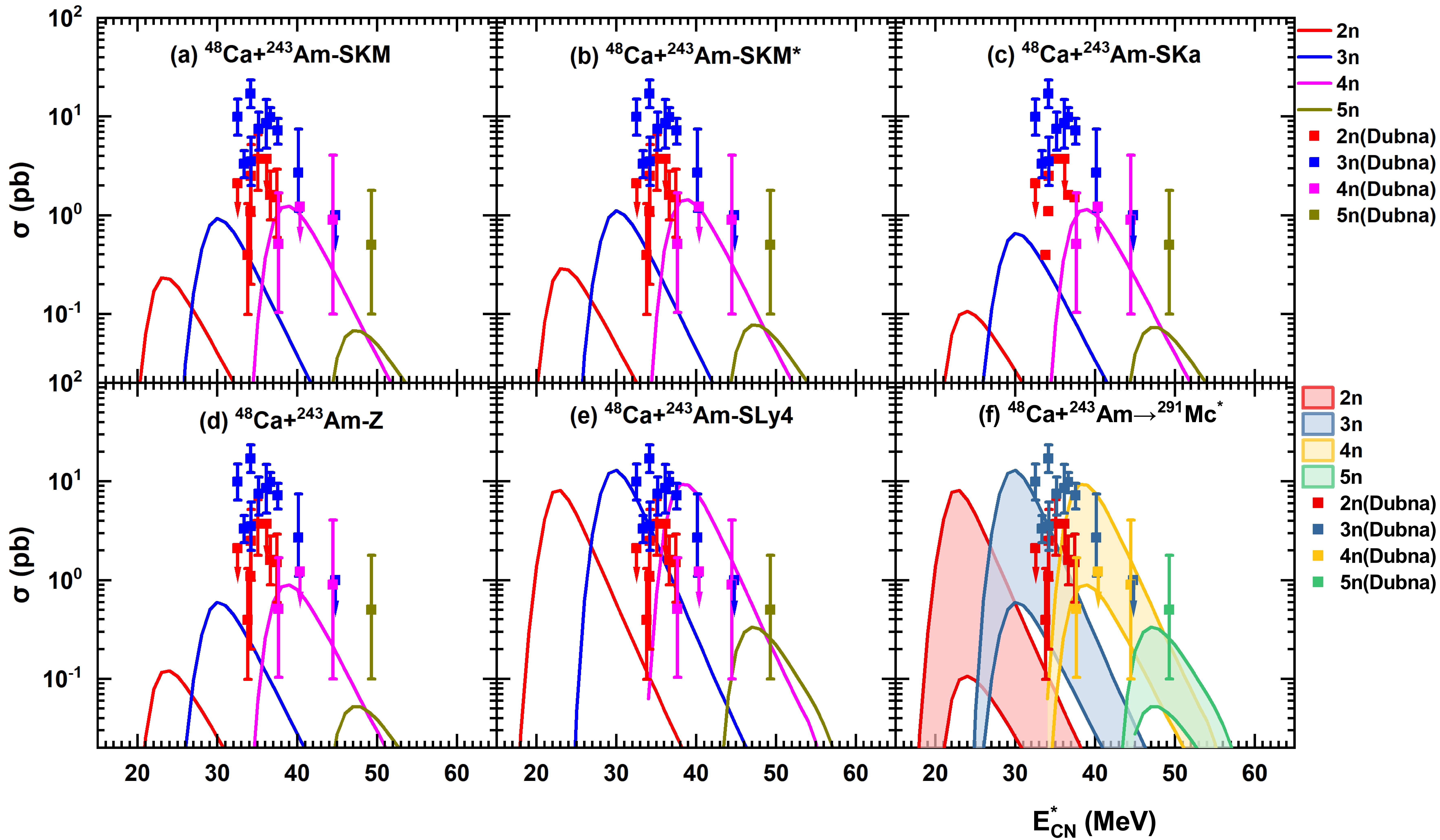
The fusion–evaporation residue excitation functions with the Skyrme parameters SKM, SKM*, Ska, Z, and SLy4 for the reaction of 48Ca+248Cm are calculated and compared with the available data from Dubna [64–68], GSI [69], and RIKEN [70], as shown in Fig. 5. It is obvious that the maximum cross section in the 4n channel is 5 pb at
$ E^{\ast}_{CN}=40 $ MeV. The uncertainties in the production cross sections are large for different Skyrme forces owing to the different equations of state in the overlap density region, in comparison with the reaction of 48Ca+243Am. The lower cross section for producing livermorium than for producing moscovium is mainly caused by the reduction of the fission barrier of the compound nucleus, which manifests the dominance of the shell effect in the formation of SHN. The ER cross section in the 2n channel with SLy4 is higher than those with the other Skyrme forces because of the larger fusion probability (lower inner fusion barrier).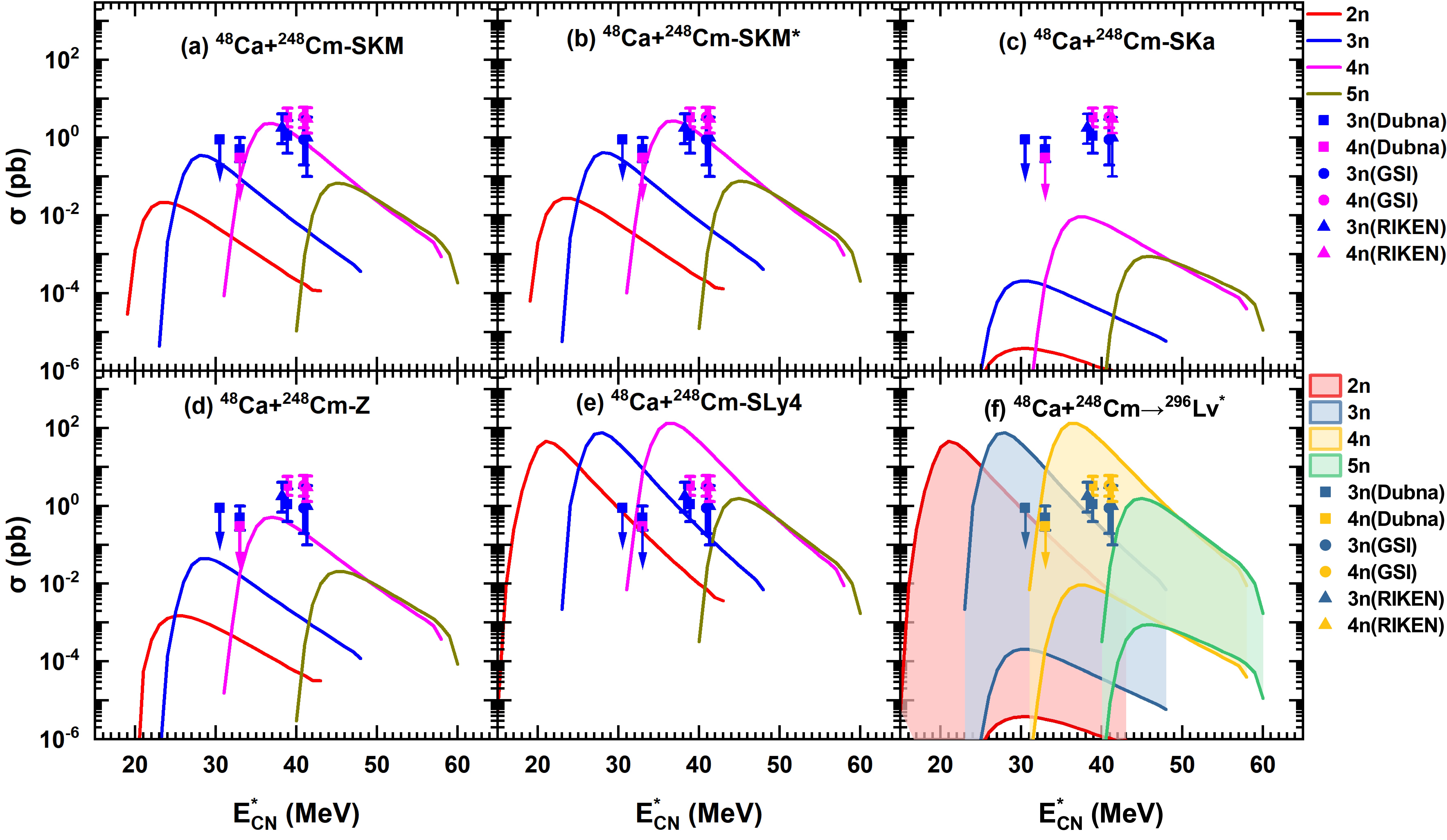
Figure 5. (color online) The fusion-evaporation residue excitation functions calculated with the Skyrme parameters SKM, SKM*, Ska, Z, and SLy4 for the 48Ca+248Cm reaction leading to the production of livermorium are compared with the available data from Refs. [64–68], the GSI data from Ref. [69], and the RIKEN data from Ref. [70].
Recently, new superheavy elements beyond oganesson have attracted attention in both experimental and theoretical studies. The 48Ca-induced reactions face some obstacles owing to the handling of target materials. Combinations of 50Ti, 51V, and 54Cr projectiles with actinide nuclei possibly pave the way for synthesizing the new elements 119 and 120. Experimental attempts to produce these new elements are being carried out at IMP, Dubna, RIKEN, and Berkeley. In comparison with the 48Ca-induced reactions, the production cross sections of SHN are usually reduced in the 50Ti-, 51V-, and 54Cr-induced reactions because of the higher inner fusion barrier and smaller Q-value.
Shown in Fig. 6 are the fusion-evaporation residue excitation functions for the reaction 50Ti+238U. It is obvious that the 5n channel has a cross section below 0.01 pb, and the distribution structure differs among the Skyrme parameters SKM, SKM*, SKa, Z, and SLy4. Roughly, the 2n-4n channels, with maximal cross sections of 0.1-1 pb, are obtained with the Skyrme forces SKM, SKM*, SKa, and Z. However, the parameter SLy4 predicts larger cross sections for flerovium production. The differences among the Skyrme forces in calculating the fusion-evaporation excitation functions are mainly caused by the NN potential and the potential pocket (width and height). A narrower potential pocket leads to a lower fusion probability and results in reduced SHN cross sections.
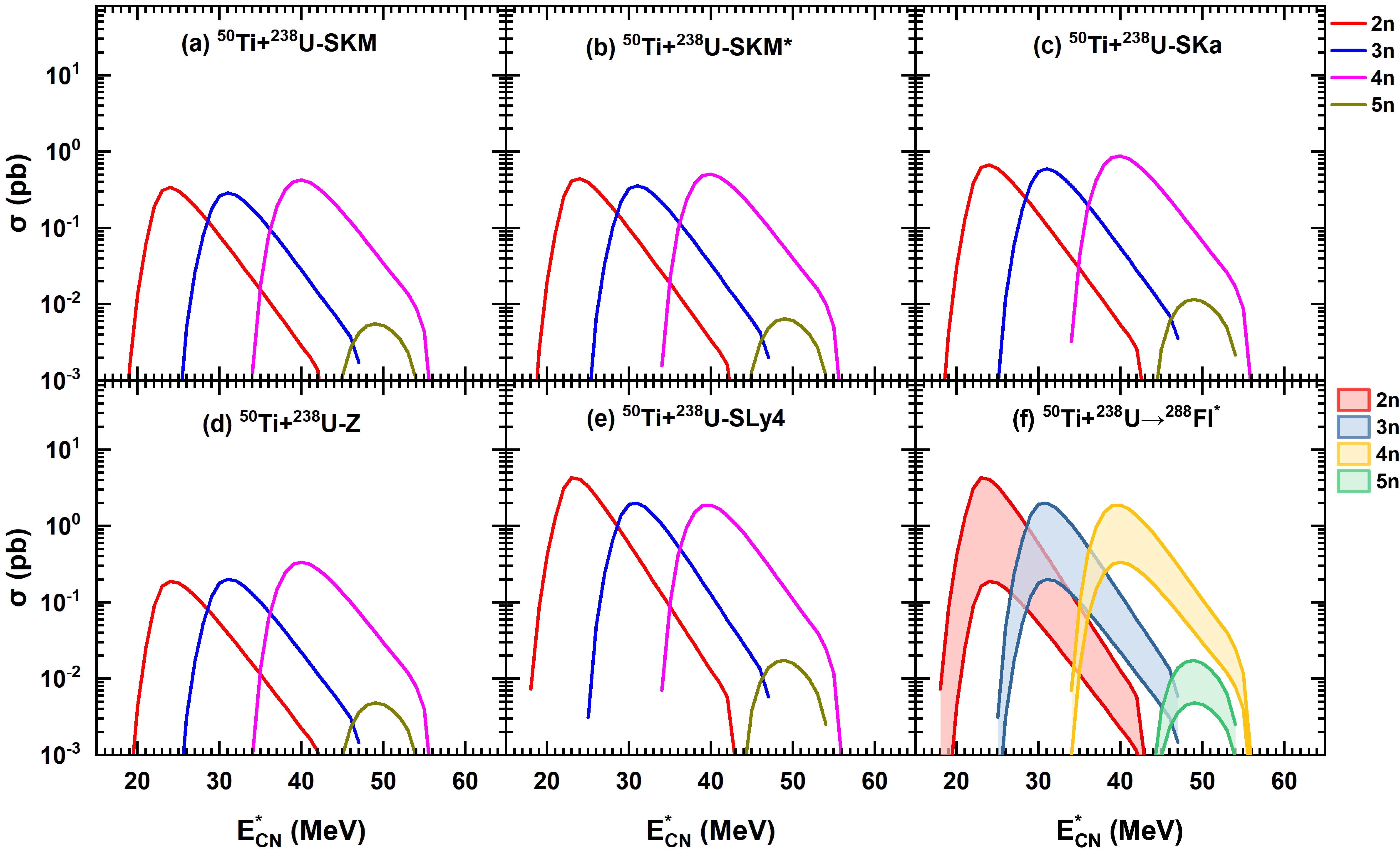
Figure 6. (color online) The fusion–evaporation residue excitation functions were calculated using the DNS model with the Skyrme parameter sets SKM, SKM*, SKa, Z, and SLy4 for the 50Ti+238U reaction.
The attempt using a 50Ti beam on 244Pu was performed at Berkeley [71]. A comparison between the calculated results and the experimental data is shown in Fig. 7. Basically, the 4n channel is available for producing livermorium and is consistent with the data for the Skyrme forces SKM, SKM*, and Z. The parameter SKa predicts unexpectedly very low cross sections. The uncertainties in the SHN production cross sections are huge, with a magnitude of 2-5 orders, particularly at decreasing excitation energy. Besides the capture probability and PES, the neutron separation energy, level density, fission barrier, etc. can also be calculated by the energy-density functional method. The most credible predictions are obtained with the Skyrme parameters SKM (SKM*), e.g., 0.44 pb (2n), 0.36 pb (3n), 0.51 pb (4n), and 6.5 fb (5n) at excitation energies of 24 MeV, 31 MeV, 40 MeV, and 49 MeV for the reaction 50Ti+238U, and 0.86 pb (2n), 0.50 pb (3n), 1.37 pb (4n), and 0.047 pb (5n) at excitation energies of 24 MeV, 32 MeV, 42 MeV, and 50 MeV for the reaction 50Ti+244Pu.
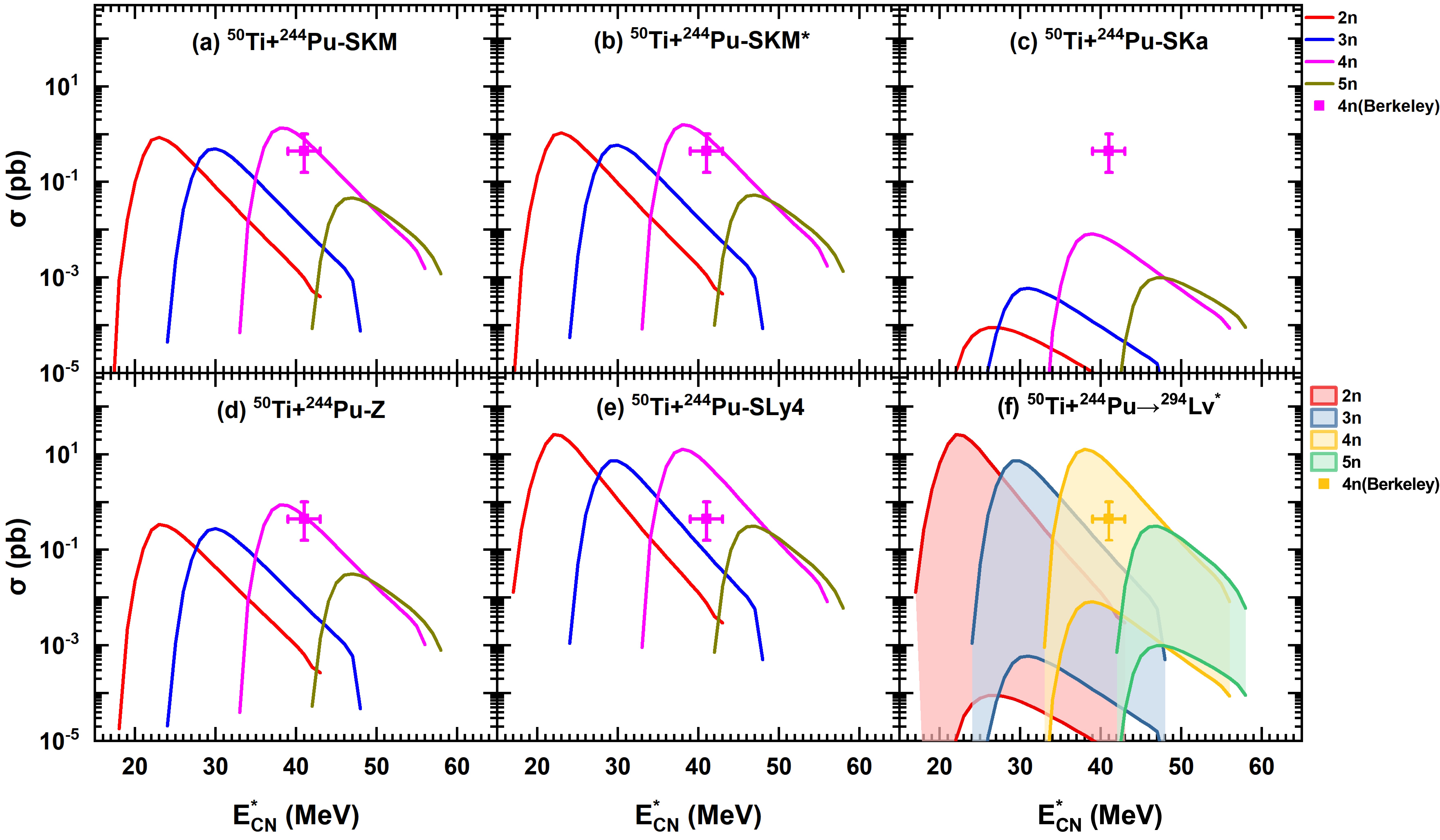
Figure 7. (color online) Production of the SHN livermorium using the Skyrme energy density functional with SkM, SkM*, Ska, Z, and SLy4 in the 50Ti+244Pu reaction, compared with recent experimental data from Berkeley [71].
The 51V-induced reactions have attracted considerable attention for the synthesis of new SHN beyond 48Ca. A more mass-asymmetric system is available for enhancing the fusion probability. As a test of the new reaction mechanism, the 51V + 243Am system is feasible for producing oganesson in experiments. The fusion-evaporation excitation functions calculated with the Skyrme parameters SKM, SKM*, SKa, Z, and SLy4 are compared, as shown in Fig. 8. The cross sections in the 2–4n channels may be measurable in experiments.
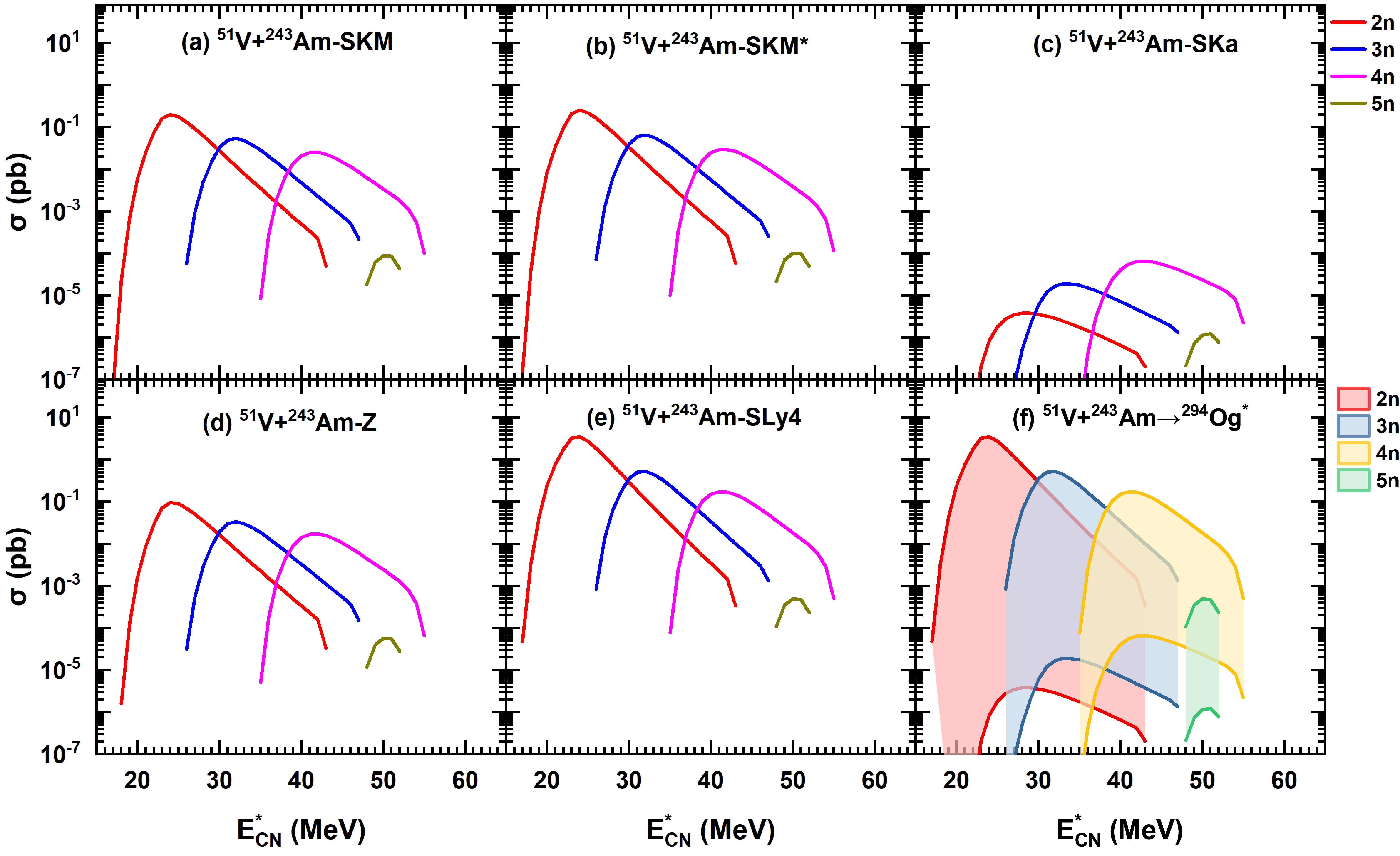
Figure 8. (color online) Same as shown in Fig. 6, but for the reaction 51V + 243Am.
The 51V-induced reactions are of particular interest in experiments at RIKEN, i.e., 51V + 248Cm for synthesizing the new element 119. However, for the synthesis of element 119, a production cross section below 1 fb is found with the Skyrme forces SKM, SKM*, SKa, and Z, as shown in Fig. 9. Such a very low cross section still poses difficulties for the synthesis of element 119 in laboratories. It is noticed that unexpectedly larger cross sections in the 2n channel exist in the 50Ti-, 51V-, and 54Cr-induced reactions, although the excitation energies are below the Coulomb barrier. The optimal evaporation channel for synthesizing SHNs is related to the energy dependence of the capture, fusion, and survival probabilities. The rapid increase in the capture and fusion probabilities enhances the 2n channel. The overestimation of the fusion probability in the low-excitation-energy domain increases the 2n cross section. Multi-dimensional diffusion in the formation of SHN is expected to solve this problem, e.g., through neck evolution and cluster transfer.
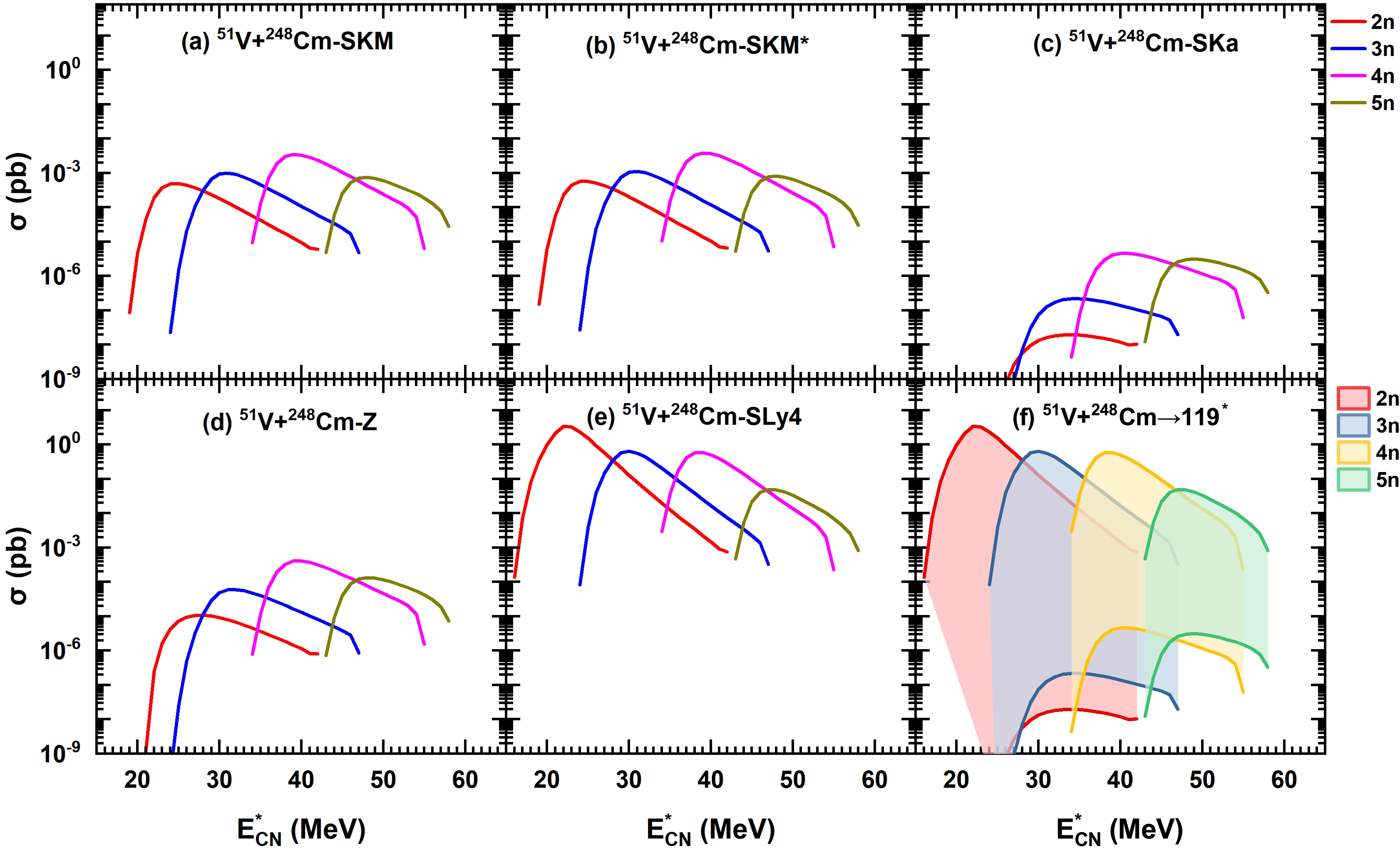
Figure 9. (color online) The fusion-evaporation excitation functions for the reaction 51V+248Cm, calculated using the Skyrme parameter sets SKM, SKM*, SKa, Z, and SLy4, for the production of the superheavy element with Z=119.
In recent years, high-intensity 54Cr beams have become available at accelerators worldwide, i.e., the SHE factory in Dubna, the SHE special accelerator (CAFe), and the gas-filled recoil separator spectrometer (SHANS2). Figure 10 shows the fusion-evaporation excitation functions calculated by the DNS model with the Skyrme energy density functional using SKM, SKM
$ \ast $ , SKa, Z, and SLy4 for the reaction 54Cr+238U, together with the Dubna data [72]. The production cross section of 288Lv in the 4n channel is well reproduced with the Skyrme forces SKM, SKM* and Z. The 4n channel at an excitation energy of 41 MeV is the optimal route for synthesizing SHN, and the excitation energy is higher than that of 38 MeV in the reaction of 48Ca+248Cm for producing livermorium. The larger binding energy of the doubly magic nucleus increases the Q-value and favors SHN formation through the survival probability. Accurate estimation of the fusion-evaporation excitation function induced by 54Cr on actinide nuclei is helpful for synthesizing new elements in laboratories.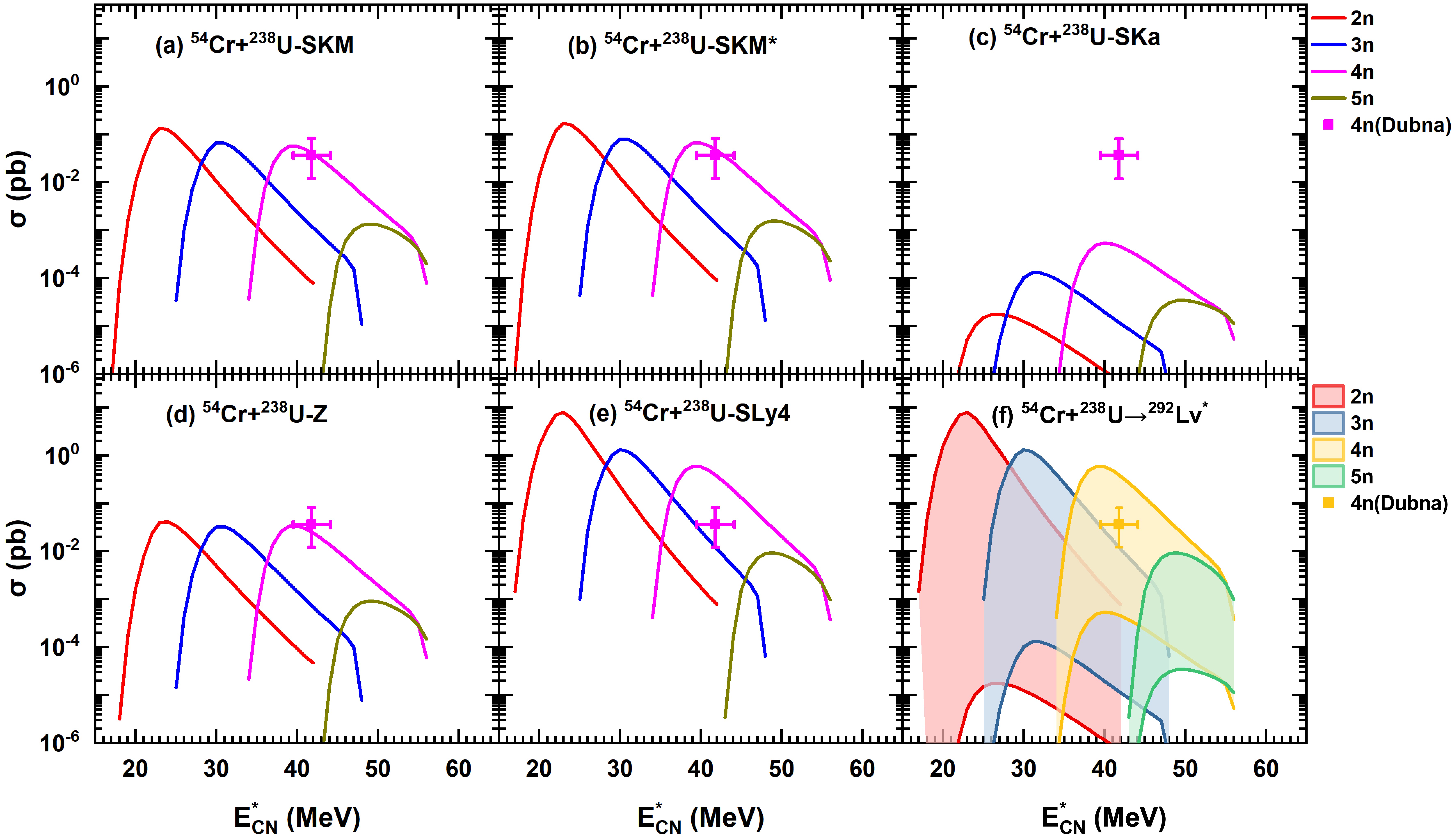
Figure 10. (color online) Production of the superheavy nucleus livermorium, calculated using the DNS model with the Skyrme energy density functional parameterizations SKM, SKM*, SKa, Z, and SLy4 for the reaction 54Cr+238U, is compared with recent experimental data from Dubna [72].
We calculated the oganesson production in the 54Cr+244Pu reaction, as shown in Fig. 11. The 2-4n evaporation channels dominate SHN formation, with cross sections in the range of 1-10-5 pb. Measurements of this system are expected to test the prediction and extend the synthesis of new SHN with 54Cr beams. The synthesis of new elements has attracted much experimental attention, e.g., 58Fe+244Pu [73], 64Ni+238U, 54Cr+248Cm and 50Ti+249Cf [74]. The fusion-evaporation excitation functions for synthesizing the new SHEs with Z=119 and Z=120 in the reactions of 54Cr+243Am and 54Cr+248Cm are calculated, as shown in Fig. 12 and Fig. 13, respectively. It is evident that the production cross sections of 119 and 120 are below 1 fb for the Skyrme forces SKM, SKM
$ \ast $ , SKa, and Z, except for SLy4. With the SKM parameter set, the predicted cross sections are 0.83 fb (2n), 2.1 fb (3n), 1.7 fb (4n), and 0.07 fb (5n) at excitation energies of 24 MeV, 31 MeV, 41 MeV, and 50 MeV, respectively, for the reaction 54Cr+243Am. The fission barrier is strongly correlated with the survival probability of SHN and, consequently, with the production cross section. The depth and width of the potential pocket of the NN potential are correlated with the nuclear matter properties of the equation of state and the diffuseness of the proton and neutron density profiles. It has also been shown that the mass tables of nuclides influence the PES and separation energies and, consequently, SHN production [75].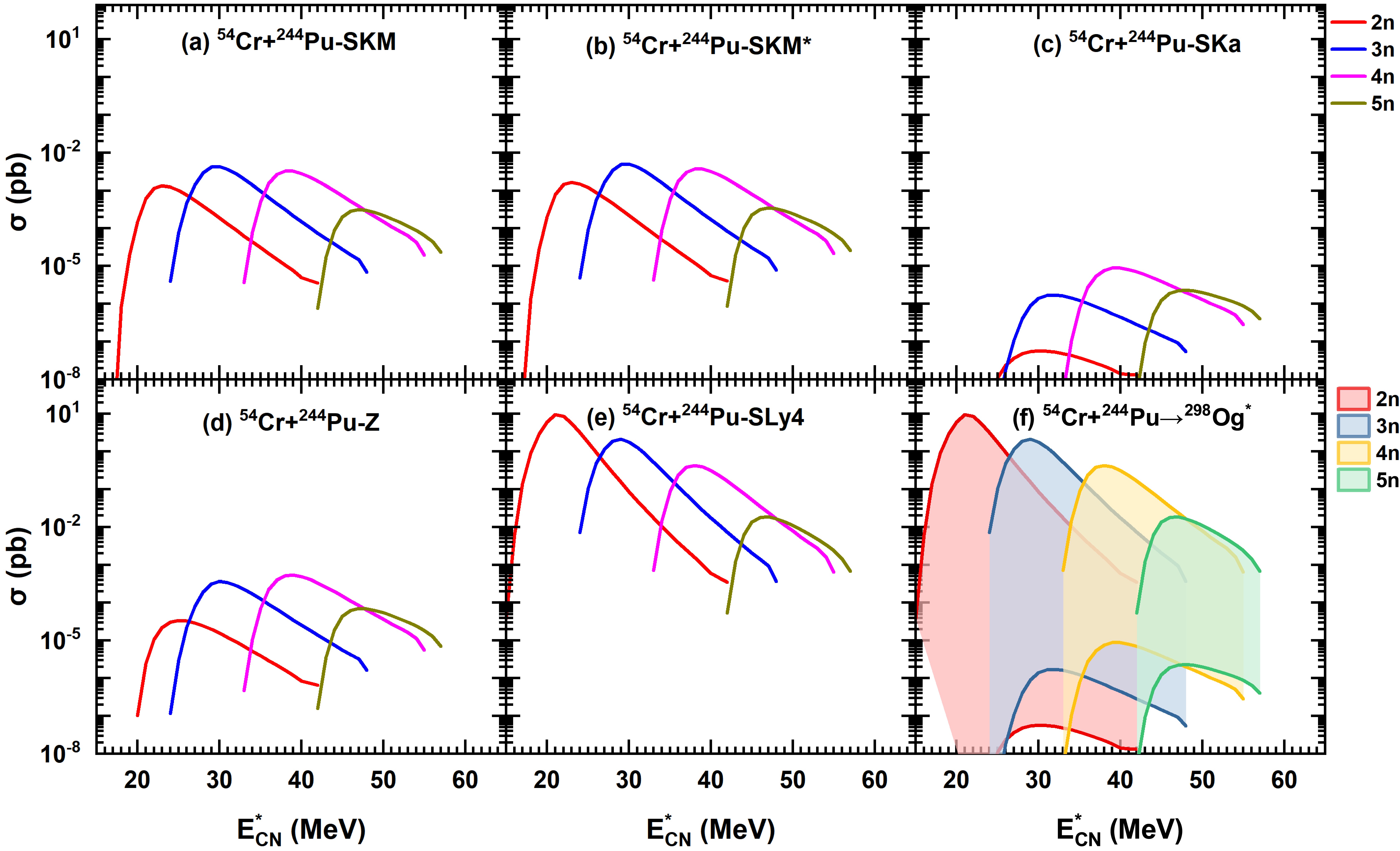
Figure 11. (color online) Same as shown in Fig. 6, but for the reaction 54Cr+244Pu.
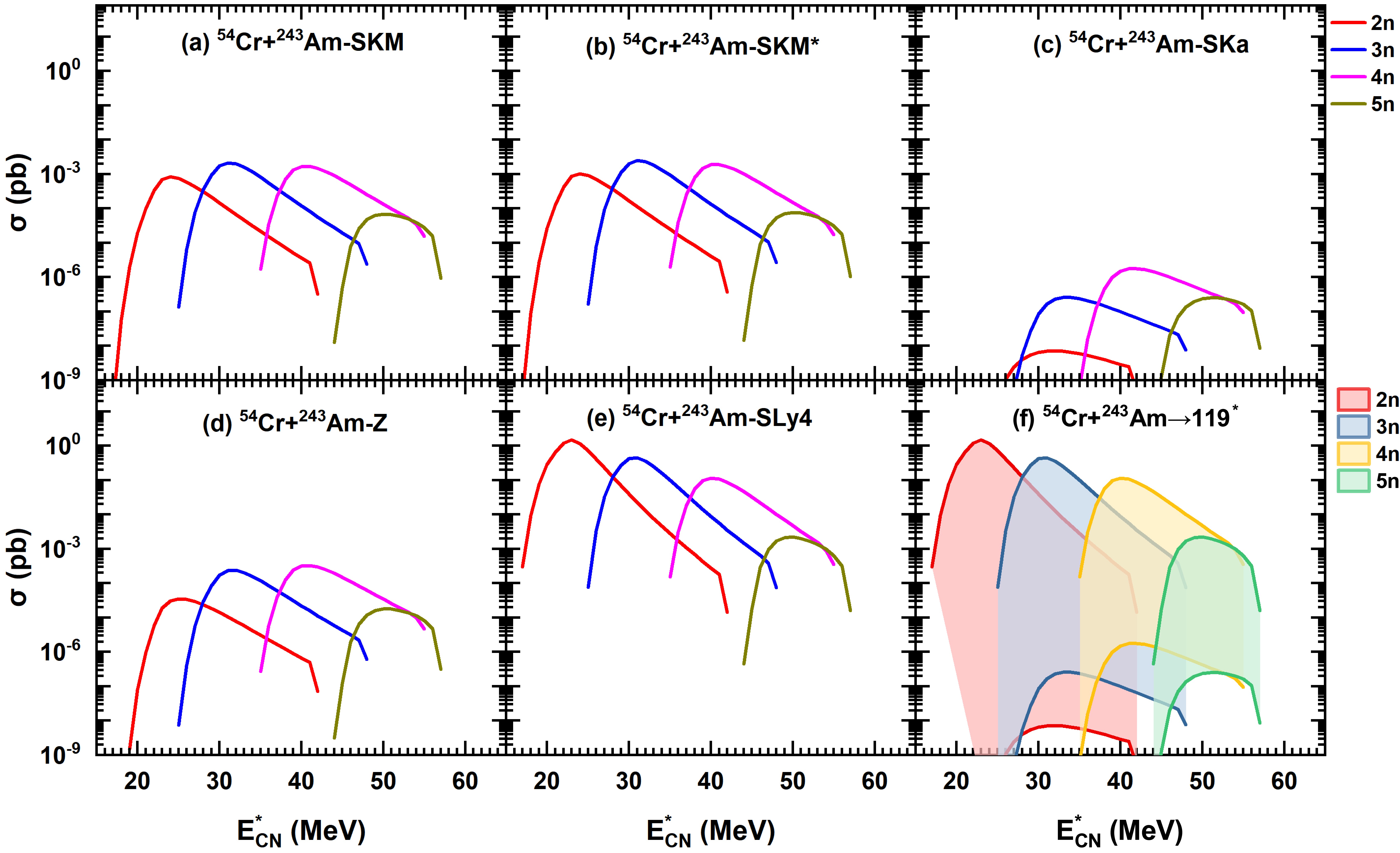
Figure 12. (color online) The fusion-evaporation excitation functions for synthesizing a new SHE with
$ Z=119 $ in the reaction 54Cr+243Am.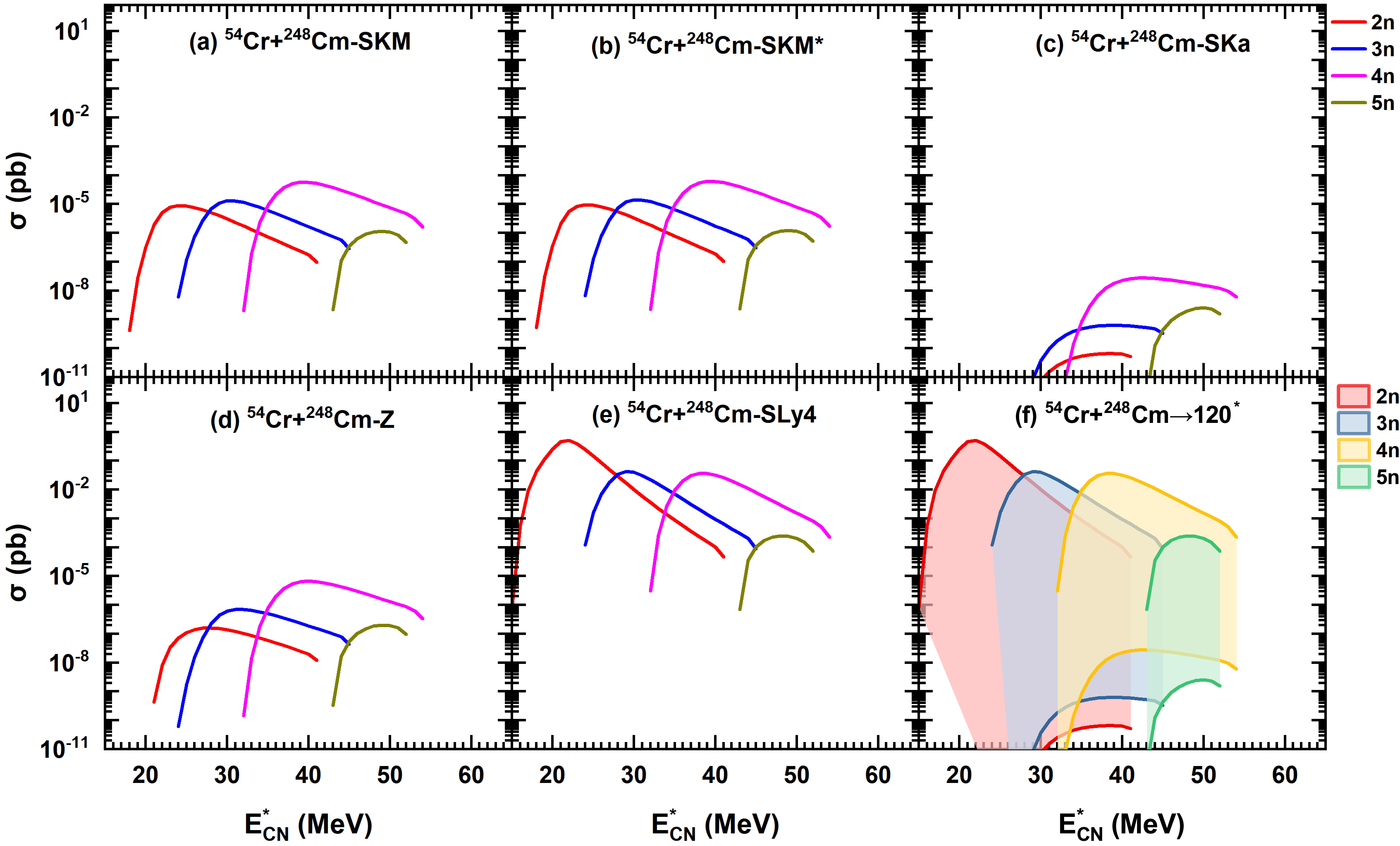
Figure 13. (color online) Same as shown in Fig. 12, but for the production of the new SHE with
$ Z=120 $ in the reaction 54Cr+248Cm. -
In summary, the nucleus-nucleus potential is calculated using the Skyrme energy density functional, which is correlated with the different properties of isospin-symmetric nuclear matter for the Skyrme forces SKM, SKM*, Ska, Z, and SLy4. The NN potential and PES in the DNS model are calculated with these Skyrme forces. The fusion-evaporation excitation functions for the 48Ca-, 50Ti-, 51V-, and 54Cr-induced reactions on actinide nuclei are systematically investigated for the production of SHN within the DNS model. It is demonstrated that the discrepancy in SHN production cross sections among the different Skyrme forces is correlated with the nuclear matter properties and the inner fusion barriers in the PES. The available data from Dubna, GSI, and RIKEN for the fusion-evaporation residue excitation functions in the reactions 48Ca+243Am and 48Ca+248Cm have been well reproduced by the DNS model with the parameters SKM, SKM
$ \ast $ , and Z. The larger cross section obtained with SLy4 arises from the lower inner fusion barrier. The predicted cross sections for the synthesis of new SHEs with Z=119 and 120 differ among the Skyrme forces, e.g., 10-8-1 pb (2n), 5$ \times $ 10-7-0.4 pb (3n), 2$ \times $ 10-6-0.1 pb (4n), and 2$ \times $ 10-7-3$ \times $ 10-3 pb (5n) for 54Cr+243Am, and 10-10-0.8 pb (2n), 10-9-3$ \times $ 10-2 pb (3n), 2$ \times $ 10-8-3$ \times $ 10-2 pb (4n), and 2$ \times $ 10-9-2$ \times $ 10-4 pb (5n) for 54Cr+248Cm, respectively. The credible cross sections with the SKM parameter are 0.83 fb (2n), 2.1 fb (3n), 1.7 fb (4n), and 0.07 fb (5n), at excitation energies of 24 MeV, 31 MeV, 41 MeV, and 50 MeV, respectively, for the synthesis of element 119 in the reaction 54Cr+243Am. Very low cross sections are predicted for the production of element 120 in the reaction 54Cr+248Cm, i.e., 8.8$ \times 10^{-6} $ pb (2n), 1.3$ \times 10^{-5} $ pb (3n), 5.8$ \times 10^{-5} $ pb (4n), and 1.1$ \times 10^{-6} $ pb (5n), respectively. The calculations of the mass table and fission barrier in the survival probability should be improved using the Skyrme energy density functional in future work. The shape evolution and density rearrangement of the binary nuclei might be improved by one-body density evolution and the time-dependent Schrödinger equation.
Production of superheavy nuclei in collisions of 48Ca, 50Ti, 51V and 54Cr on actinide nuclei with the Skyrme energy-density functional
- Received Date: 2026-07-31
- Available Online: 2026-12-01
Abstract: Within the framework of the dinuclear system (DNS) model, the synthesis of superheavy nuclei in 48Ca-, 50Ti-, 51V-, and 54Cr-induced fusion reactions on actinide nuclei has been systematically investigated. The nucleus–nucleus potential and the potential energy surface in the DNS model are calculated using the well-established Skyrme energy-density functional with the parameter sets SKM, SKM*, Ska, Z, and SLy4, respectively. The available experimental data from Dubna, GSI, RIKEN, and Berkeley are well reproduced by the model. It is found that the fusion-evaporation residue excitation functions and production cross sections of superheavy nuclei are correlated with nuclear matter properties. The 48Ca-induced reaction, i.e., 48Ca + 248Cm, has a larger production cross section for synthesizing the superheavy nucleus livermorium than the non-magic systems 50Ti + 244Pu and 54Cr + 238U. The production cross sections of new superheavy elements with atomic numbers $ Z=119 $ and 120 in the reactions 51V+248Cm and 54Cr+243Am/248Cm are thoroughly investigated. The fusion-evaporation excitation functions strongly depend on the Skyrme parameters, particularly at excitation energies below 40 MeV.



 DownLoad: