


 Abstract
 HTML
 Reference
 Related
 PDF




-
The baryon-to-meson ratio as a function of transverse momentum (
$ p_{T} $ ) is a sensitive probe of the hadronization mechanism of final-state parton systems created in high-energy collisions. Measurements of the enhancement of the$ p/\pi $ ratio at RHIC [1, 2] have motivated the application of the quark combination mechanism to describe the hadronization of the hot, dense quark matter created in ultra-relativistic heavy-ion collisions [3−6]. The$ p/\pi $ and$ \Lambda/K_{S}^{0} $ ratios are two of the most easily measured baryon/meson ratios; they have been widely reported in$ pp $ , pA, and AA collisions at RHIC and LHC energies [2, 7−14] and extensively studied and discussed in various theoretical models of hadron production [3−6, 15−20]. In recent years, baryon/meson ratios in the charm sector, such as$ \Lambda_{c}^{0}/D^{0} $ , have also been measured [21−25], which has shed new light on the hadronization of charm quarks in the low and intermediate$ p_{T} $ range in high-energy collisions [26−31].Because they involve only strange (anti-)quarks, the production of Ω and ϕ is particularly interesting for revealing the properties of hadron production during the hadronization of soft quark systems created in high-energy collisions. As is well known, strange hadrons have relatively small interaction cross sections with other hadrons and are only weakly affected by hadronic re-scattering [32, 33]. Compared with those for π, protons, and
$ K_{S}^{0} $ , the feed-down corrections for Ω and ϕ are also relatively weak. These advantages make Ω and ϕ clean probes of the hadron production mechanism at the hadronization stage. However, the$ \Omega/\phi $ ratio is not often reported in experiments [34, 35], mainly because of the relatively poor statistics for the Ω baryon, and theoretical studies in various popular combination (coalescence) models are also limited [4, 6, 36−38].In recent years, the LHC has accumulated extensive data on Ω and ϕ in
$ pp $ , p-Pb, and Pb-Pb collisions, making a meaningful analysis of the$ \Omega/\phi $ ratio feasible. To investigate the underlying dynamics of the$ \Omega/\phi $ ratio as a function of$ p_{T} $ , we select two collision systems: high-multiplicity$ pp $ collisions at$ \sqrt{s}= $ 13 TeV and central Pb-Pb collisions at$ \sqrt{s_{NN}}= $ 2.76 TeV. In Fig. 1(a), we show the experimental data for the$ p_{T} $ spectra of ϕ and Ω (i.e.,$ \Omega^{-}+\bar{\Omega}^{+} $ ) for the event class I+II in$ pp $ collisions at$ \sqrt{s}= $ 13 TeV [39, 40] and for 0-10% centrality in Pb-Pb collisions at$ \sqrt{s_{NN}}= $ 2.76 TeV [41, 42]. The two collision systems differ considerably in system volume, as can be inferred from the charged-particle multiplicity at mid-rapidity,$ \langle dN_{ch}/d\eta\rangle =21.0\pm0.25 $ for class I+II$ pp $ collisions at$ \sqrt{s}= $ 13 TeV [39] and$ \langle dN_{ch}/d\eta\rangle =1446\pm39 $ for 0-10% centrality in Pb-Pb collisions at$ \sqrt{s_{NN}}= $ 2.76 TeV [43]. However, Fig. 1(a) shows that, apart from the global normalization (i.e., the yield density at mid-rapidity), the inclusive$ p_{T} $ spectrum of ϕ in$ pp $ collisions is similar to that in Pb-Pb collisions in the range$ p_{T}\lesssim 2 $ GeV/c but is flatter than the latter at larger$ p_{T} $ . The$ p_{T} $ spectrum of Ω show a similar behavior. The average transverse momentum$ \langle p_{T}\rangle $ for ϕ in$ pp $ collisions is$ 1.456\pm0.015 $ GeV/c [39], which is also larger than the value of$ 1.325\pm0.028 $ GeV/c in central Pb-Pb collisions [42]. Using the above data for Ω and ϕ, we evaluate the$ \Omega/\phi $ ratio1 and show the results in Fig. 1(b). In the low-$ p_{T} $ range, the$ \Omega/\phi $ ratio in$ pp $ collisions is close to (only slightly smaller than) that in central Pb-Pb collisions, but in the range$ 2\lesssim p_{T}\lesssim5 $ GeV/c it is clearly smaller than the latter. In fact, the$ \Omega/\phi $ ratio in high-multiplicity$ pp $ collisions is quite similar to that in peripheral (60-80% centrality) Pb-Pb collisions at$ \sqrt{s_{NN}}= $ 2.76 TeV. In other words, although we observe flatter$ p_{T} $ spectra of Ω or ϕ in$ pp $ collisions, implying relatively more Ω or ϕ at intermediate$ p_{T} $ in$ pp $ collisions, the significant enhancement of Ω production relative to ϕ does not occur in high-multiplicity$ pp $ collisions.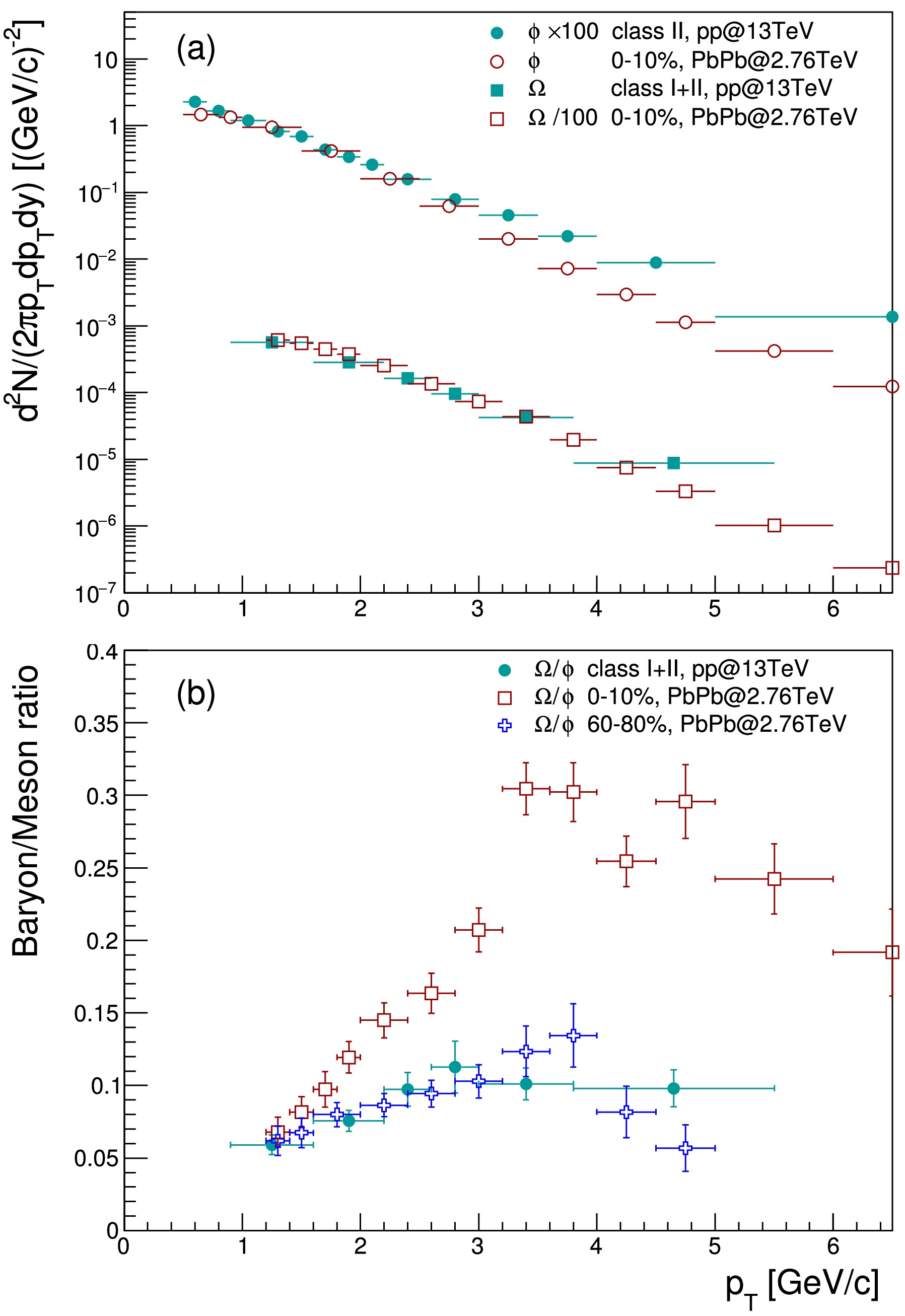
Figure 1. (color online) (a)
$ p_{T} $ spectra of Ω and ϕ in$ pp $ collisions at$ \sqrt{s}=13 $ TeV and in Pb-Pb collisions at$ \sqrt{s_{NN}}= $ 2.76 TeV, and (b) the$ \Omega/\phi $ ratio in the two collision systems. Symbols in (a) represent experimental data [39−42], and symbols in (b) represent calculations based on the data.An interesting question is what underlying dynamics is responsible for such a significant change in the
$ \Omega/\phi $ ratio from$ pp $ collisions to central Pb-Pb collisions at LHC energies. In previous studies of the$ p/\pi $ and$ \Lambda/K_{S}^{0} $ ratios, it has usually been argued that the change in the hadron production mechanism from parton fragmentation to quark combination is a sound explanation for such a significant change in baryon/meson ratios at intermediate$ p_{T} $ in small and large collision systems. However, our recent studies show that the quark combination mechanism is also quite effective in explaining the$ p_{T} $ spectra of hadrons in the low and intermediate$ p_{T} $ range in$ pp $ collisions at LHC energies [44−46]. One typical piece of evidence is the quark number scaling property of the$ p_{T} $ spectra of Ω and ϕ [44−47]$ \begin{array}{l} F_{\Omega}^{1/3}(3p_{T})=\kappa F_{\phi}^{1/2}(2p_{T}) \end{array} $
(1) where
$ F(p_{T})\equiv dN/dp_{T} $ and κ is the$ p_{T} $ -independent coefficient. In Fig. 2, we test this scaling property using experimental data for Ω and ϕ at mid-rapidity in different multiplicity classes in$ pp $ collisions at$ \sqrt{s}=13 $ TeV [13, 39−42]. The coefficient κ is chosen to keep the global magnitude of the scaled ϕ data as close as possible to that of Ω and is set to 0.50, 0.57, 0.57, 0.59, 0.59, and 0.65 in multiplicity classes I, II, III+IV, V+VI, VII+VIII, and inel, respectively. Within the current statistics, the scaling property holds well in high-multiplicity events as well as in inelastic events. The scaling property for Pb-Pb collision data at$ \sqrt{s_{NN}}= $ 2.76 TeV was already tested [48]. This scaling property can be understood through the quark equal-velocity combination mechanism via$ F_{\Omega}(3p_{T})\propto F_{s}^{3}(p_{T}) $ and$ F_{\phi}(2p_{T})\propto F_{s}^{2}(p_{T}) $ , with$ F_{s}(p_{T}) $ interpreted as the$ p_{T} $ spectra of strange quarks just before hadronization. We therefore argue that the significant change in the$ \Omega/\phi $ ratio from$ pp $ collisions to central Pb-Pb collisions at LHC energies might not be due to a change in the hadronization mechanism but rather to other dynamics, such as changes in the properties of quark$ p_{T} $ spectra in different collision systems, which is the focus of this paper.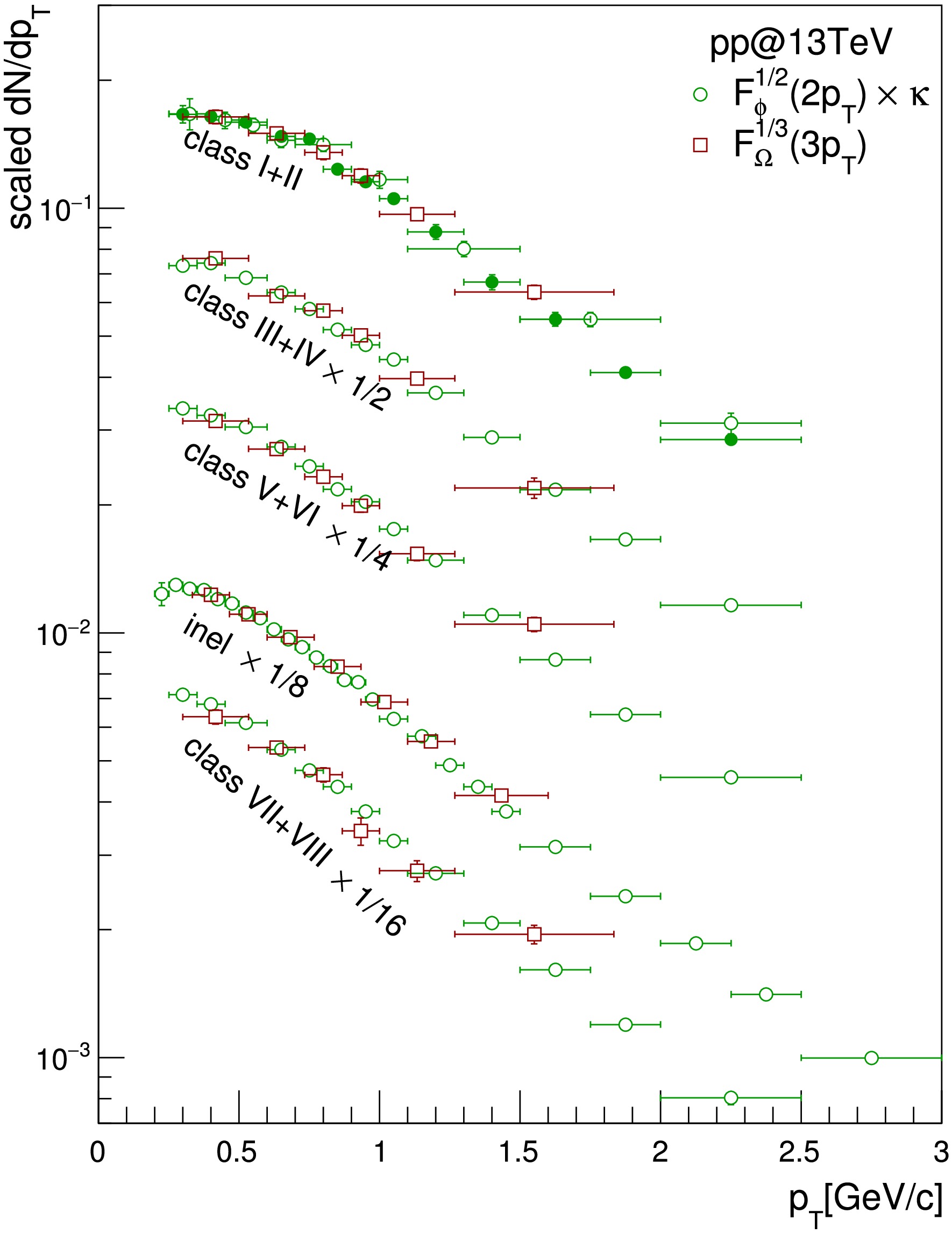
Figure 2. (color online) The quark number scaling test for the
$ p_T $ spectra of Ω and ϕ in different multiplicity classes in$ pp $ collisions at$ \sqrt{s}=13 $ TeV is presented. The symbols represent the scaling results obtained from experimental data [13, 39−42]. Since the ϕ data in classes I and II have different$ p_T $ bins, the scaling results for the ϕ data in these two classes are shown as open and solid circles, respectively. The results for the other multiplicity classes are multiplied by a factor for clarity.In this paper, we apply a constituent quark equal-velocity combination mechanism to study the production of Ω and ϕ in high-energy
$ pp $ , p-Pb, and Pb-Pb collisions. We explain the underlying dynamics that influences the$ p_{T} $ dependence of the$ \Omega/\phi $ ratio by focusing in particular on the shape of the$ p_{T} $ spectrum of strange quarks just before hadronization. We propose a discrete curvature for the$ p_{T} $ spectrum of strange quarks that can directly determine the rate at which the$ \Omega/\phi $ ratio increases or decreases as a function of$ p_{T} $ . We analyze this curvature property of the strange-quark$ p_{T} $ spectra using the scaled ϕ data in$ pp $ , p-Pb, and Pb-Pb collisions at LHC energies and use it to explain the$ \Omega/\phi $ ratio data in these collisions.The paper is organized as follows. In Sec. II, we apply the equal-velocity quark combination mechanism to demonstrate how the curvature property of the strange-quark
$ p_{T} $ spectrum influences the$ p_{T} $ dependence of the$ \Omega/\phi $ ratio. In Sec. III, we discuss the curvature property of the strange-quark$ p_{T} $ spectra obtained from the scaled ϕ data in$ pp $ , p-Pb, and Pb-Pb collisions at LHC energies and explain the$ \Omega/\phi $ ratio data in these collisions. Section IV presents the summary and discussion. -
We apply a specific quark equal-velocity combination (EVC) model [44, 47] to study the
$ p_{T} $ dependence of the$ \Omega/\phi $ ratio in high-energy collisions. To model the hadronization of the final-state parton system produced in high-energy collisions, we treat constituent quarks and antiquarks as the effective degrees of freedom of the parton system just before hadronization, and assume that hadron formation is mainly characterized by the combination of these constituent quarks and antiquarks with the same velocity. In this framework, the$ p_{T} $ distribution of a hadron ($ F(p_{T})\equiv dN/dp_{T} $ ) is the product of the corresponding distributions of the (anti) quarks$ \begin{array}{l} F_{B_{i}}\left(p_{T}\right) =\kappa_{B_{i}}F_{q_{1}}\left(x_{1}p_{T}\right)F_{q_{2}}\left(x_{2}p_{T}\right)F_{q_{3}}\left(x_{3}p_{T}\right), \end{array} $
(2) $ \begin{array}{l} F_{M_{i}}\left(p_{T}\right) =\kappa_{M_{i}}F_{q_{1}}\left(x_{1}p_{T}\right)F_{\bar{q}_{2}}\left(x_{2}p_{T}\right). \end{array} $
(3) Here, the momentum fractions satisfy
$ x_{1}+x_{2}+x_{3}=1 $ , with$ x_{i}=m_{i}/(m_{1}+m_{2}+m_{3}) $ ($ i=1,2,3 $ ), for baryon formation, and$ x_{1}+x_{2}=1 $ , with$ x_{i}=m_{i}/(m_{1}+m_{2}) $ ($ i=1,2 $ ), for meson formation.$ m_{i} $ is the constituent mass of quark$ q_{i} $ . The coefficients$ \kappa_{B_{i}} $ and$ \kappa_{M_{i}} $ are independent of$ p_{T} $ and can be further decomposed and determined by the unitarity of hadronization and several experimental constraints [44, 49].Applying EVC to
$ \Omega^{-} $ and ϕ,$ \begin{array}{l} F_{\Omega^-}(p_{T}) =\kappa_{\Omega^-}F_{s}^{3}(p_{T}/3), \end{array} $
(4) $ \begin{array}{l} F_{\phi}(p_{T}) =\kappa_{\phi}F_{s}^{2}(p_{T}/2). \end{array} $
(5) In the LHC case, where the production of
$ \Omega^{-} $ and$ \bar{\Omega}^{+} $ is almost symmetric, the κ coefficients of Ω (i.e.,$ \Omega^{-}+\bar{\Omega}^{+} $ ) and ϕ can be written as$ \kappa_{\Omega} =\frac{2}{3a}A_{sss}/N_{q}^{2}, $
(6) $ \kappa_{\phi} =\left(1-\frac{1}{a}\right)A_{ss}C_{\phi}/N_{q}. $
(7) Here,
$ N_{q} $ denotes the total number of quarks in the system at hadronization, and$ N_{q}=N_{u}+N_{d}+N_{s} $ when only light-flavor quarks are considered. The parameter a describes the competition between baryon and meson production through the relation$ N_{M}/N_{B}=3(a-1) $ in the quark combination model. The parameter a is constrained to$ 4.86\pm0.14 $ in our previous studies [50, 51] by reproducing data on proton-antiproton asymmetry in heavy-ion collisions at RHIC and SPS energies and mid-rapidity yields of light-flavor hadrons in p-Pb and Pb-Pb collisions at LHC energies.$ C_{\phi} $ is the conditional probability of forming a ϕ meson from an$ s\bar{s} $ pair destined to form a meson. Using the model to reproduce data on the$ \phi/K $ yield ratio in$ pp $ , p-Pb and peripheral Pb-Pb collisions at LHC energies [40, 42],$ C_{\phi} $ is fixed to$ 0.33\pm0.02 $ .$ A_{ss}^{-1}=2\int dp_{T}[F_{s}^{(n)}(p_{T})]^{2} $ and$ A_{sss}^{-1}=3\int dp_{T}[F_{s}^{(n)}(p_{T})]^{3} $ are determined, respectively, by the integrals of the square and cube of the normalized$ p_{T} $ distribution of strange quarks$ F_{s}^{(n)}(p_{T})\equiv F_{s}(p_{T})/N_{s} $ .The
$ \Omega/\phi $ ratio in the EVC$ \frac{F_{\Omega}(p_{T})}{F_{\phi}(p_{T})}=\frac{2\lambda_{s}}{3C_{\phi}\left(a-1\right)(2+\lambda_{s})}\frac{A_{sss}F_{s}^{(n)}(p_{T}/3)}{A_{ss}F_{s}^{(n)}(p_{T}/2)}. $
(8) The second fraction on the right-hand side of the equation corresponds to the normalized distributions of Ω and ϕ, which determines the
$ p_{T} $ dependence of the$ \Omega/\phi $ ratio. The first fraction denotes the global yield ratio of Ω to ϕ.$ \lambda_{s}=N_{s}/N_{u}\approx N_{s}/N_{d} $ is the factor describing the production suppression of strange quarks relative to up/down quarks, with$ N_{u}\approx N_{d} $ often assumed in collisions at LHC energies.To reveal the key ingredient influencing the
$ p_{T} $ dependence of the$ \Omega/\phi $ ratio, we evaluate$ \left[\frac{F_{\Omega}(p_{T})}{F_{\phi}(p_{T})}\right]^{\text{'}}=\frac{F_{\Omega}(p_{T})}{F_{\phi}(p_{T})}\left[\frac{\partial\ln F_{s}^{(n)}(\frac{p_{T}}{3})}{\partial\left(p_{T}/3\right)}-\frac{\partial\ln F_{s}^{(n)}(\frac{p_{T}}{2})}{\partial\left(p_{T}/2\right)}\right] $
(9) and obtain the relative rate of change
$ \left[\ln\frac{F_{\Omega}(p_{T})}{F_{\phi}(p_{T})}\right]^{\text{'}}=\left[\frac{\partial\ln F_{s}^{(n)}(\frac{p_{T}}{3})}{\partial\left(p_{T}/3\right)}-\frac{\partial\ln F_{s}^{(n)}(\frac{p_{T}}{2})}{\partial\left(p_{T}/2\right)}\right]. $
(10) It depends only on the shape property of the strange quark
$ p_T $ spectrum. Using the mean-value theorem$ \frac{\partial\ln F_{s}^{(n)}(\frac{p_{T}}{3})}{\partial\left(p_{T}/3\right)}-\frac{\partial\ln F_{s}^{(n)}(\frac{p_{T}}{2})}{\partial\left(p_{T}/2\right)}=-\frac{p_{T}}{6}\left[\ln F_{s}^{(n)}(\xi)\right]^{''} $
(11) where
$ p_{T}/3\leq\xi\leq p_{T}/2 $ , we find that the curvature property (convex or concave) of$ F_{s}(p_{T}) $ is the key factor influencing the$ p_{T} $ dependence of the$ \Omega/\phi $ ratio$ \left[\ln\frac{F_{\Omega}(p_{T})}{F_{\phi}(p_{T})}\right]^{\text{'}} = -\frac{p_{T}}{6}\left[\ln F_{s}^{(n)}(\xi)\right]^{''}. $
(12) -
Given that experimental data for ϕ are usually more abundant than those for Ω, we can extract
$ F_{s}(p_{T}) $ from the experimental data of ϕ$ F_{s}(p_{T})=\frac{1}{\sqrt{\kappa_{\phi}}}\left[F_{\phi}^{(data)}(2p_{T})\right]^{1/2}. $
(13) In Fig. 3(a), we show the scaling results for the experimental
$ p_T $ spectra of ϕ in high-multiplicity (class II)$ pp $ collisions at$ \sqrt{s}= $ 13 TeV and in central Pb-Pb collisions at$ \sqrt{s_{NN}}= $ 2.76 TeV [40, 42]. These results allow us to study the shape of the strange-quark distribution at hadronization. ϕ production in Pb-Pb collisions at LHC energies may contain the contribution of kaon coalescence in hadronic rescattering stage, which can increase$ v_2 $ of ϕ and lead to the break of number of constituent-quark scaling for$ v_2 $ of ϕ and strange baryons [38, 52, 53] but do not cause the obvious change of$ p_T $ spectrum of ϕ [53] and the extracted strange quark distribution.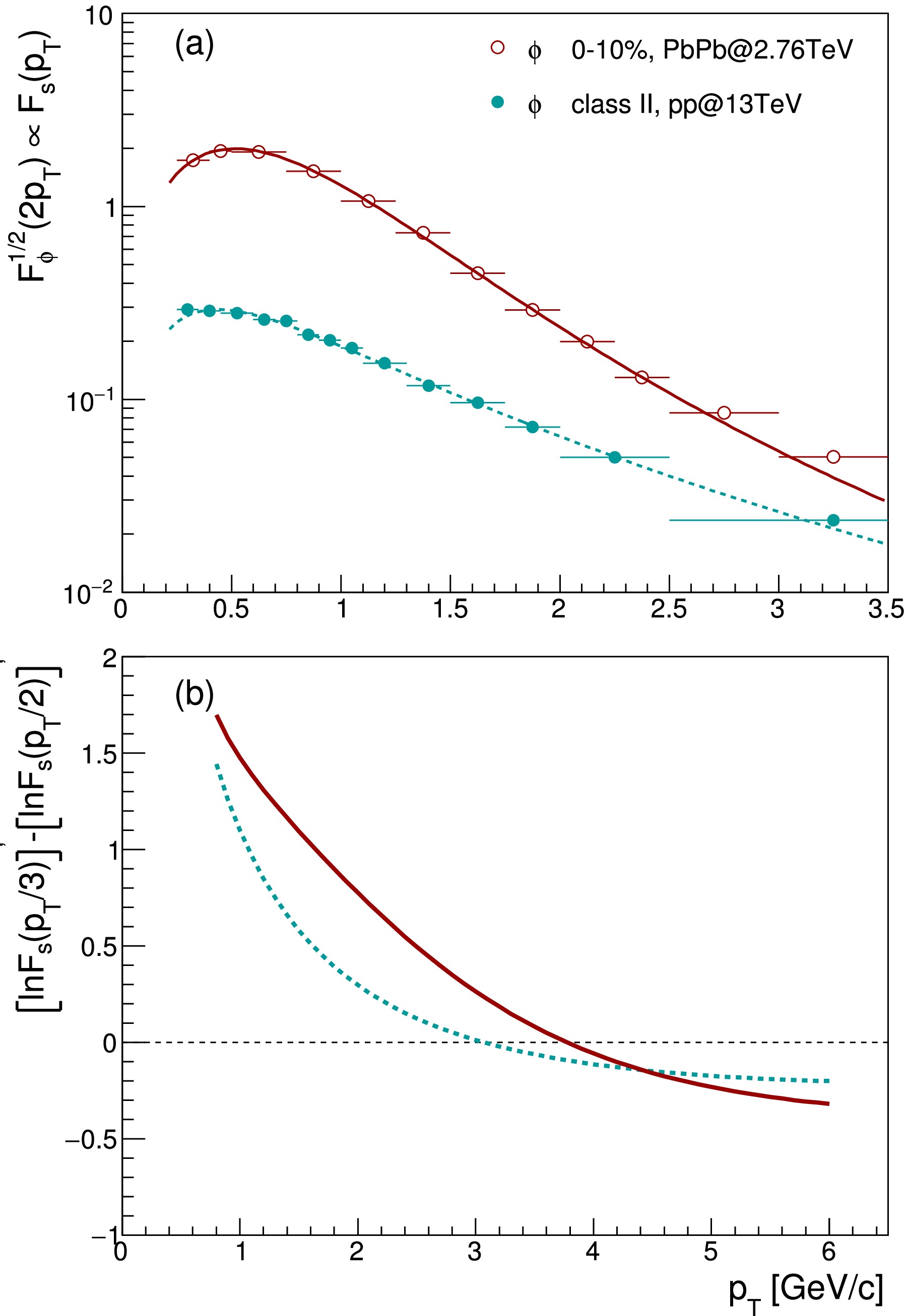
Figure 3. (color online) (a) The scaled
$ p_{T} $ spectra of ϕ in high-multiplicity (class II)$ pp $ collisions at$ \sqrt{s}= $ 13 TeV and in central Pb-Pb collisions at$ \sqrt{s_{NN}}= $ 2.76 TeV. Symbols represent the scaled results from experimental data [40, 42], and lines represent fits using the Lévy-Tsallis function; (b) the curvature$ \left[\ln F_{s}(p_{T}/3)\right]^{\text{'}}-\left[\ln F_{s}(p_{T}/2)\right]^{\text{'}} $ of the$ p_{T} $ spectra of strange quarks.To evaluate the curvature of the strange-quark
$ p_{T} $ spectrum, we fit the discrete data points of$ F_{s}(p_{T}) $ using the Lévy–Tsallis function [54] and its two variants.$ \frac{dN^{Levy}}{2\pi p_{T}dp_{T}} =N\left[1+\frac{m_{T}-m}{nC}\right]^{-n}, $
(14) $ \frac{dN^{Levy-v2}}{2\pi p_{T}dp_{T}} =N\left[1+\frac{\left(m_{T}-m\right)^{a}}{nC}\right]^{-n}, $
(15) $ \frac{dN^{Levy-v3}}{2\pi p_{T}dp_{T}} =N\left[1+\frac{\left(m_{T}-m-p_{T}v\right)}{nC\sqrt{1-v^{2}}}\right]^{-n}. $
(16) where N, m, n, and C are parameters of the Lévy-Tsallis function, and parameters a and v are introduced into the latter two functions to better tune the shape. The purpose of choosing three fitting functions is to reduce the bias arising from the choice of fitting function. In practical fits, the latter two functions are usually slightly better than the standard Lévy-Tsallis function. The final curvature
$ \left[\ln F_{s}(p_{T}/3)\right]^{\text{'}}-\left[\ln F_{s}(p_{T}/2)\right]^{\text{'}} $ is obtained by averaging the results from the three functions, weighted by the inverse of their fitting-quality values$ \chi^{2} $ .Based on the above fits, we show in Fig. 3(b) the curvature
$ \left[\ln F_{s}(p_{T}/3)\right]^{\text{'}}-\left[\ln F_{s}(p_{T}/2)\right]^{\text{'}} $ for the$ p_{T} $ spectra of strange quarks in high-multiplicity (class II)$ pp $ collisions at$ \sqrt{s}= $ 13 TeV and in central Pb-Pb collisions at$ \sqrt{s_{NN}}= $ 2.76 TeV. The curvatures of the strange-quark spectra in both collision systems are positive in the range$ p_T \lesssim $ 3 GeV/c and become negative at larger$ p_{T} $ , which indicates that the$ \Omega/\phi $ ratio first increases with$ p_{T} $ , then decreases, and thus exhibits an overall non-monotonic dependence on$ p_{T} $ . Comparing the curvature of the strange-quark spectrum in central Pb-Pb collisions at$ \sqrt{s_{NN}}= $ 2.76 TeV with that in high-multiplicity$ pp $ collisions at$ \sqrt{s}= $ 13 TeV, we find that the former is clearly higher than the latter in the low$ p_{T} $ range, indicating that the$ \Omega/\phi $ ratio in central Pb-Pb collisions increases faster than that in$ pp $ collisions. In addition, the$ p_{T} $ position at which the curvature of the strange-quark spectrum vanishes in Pb-Pb collisions is about 0.5 GeV/c larger than that in$ pp $ collisions, indicating that the increasing trend of the$ \Omega/\phi $ ratio in Pb-Pb collisions can extend to higher$ p_{T} $ .Using the
$ p_{T} $ spectra of strange quarks in Fig. 3(a), which are obtained by fitting ϕ data, we apply the EVC model to calculate the$ p_{T} $ spectrum of Ω and the$ p_{T} $ dependence of the$ \Omega/\phi $ ratio in high-multiplicity (class II)$ pp $ collisions at$ \sqrt{s}= $ 13 TeV and in central Pb-Pb collisions at$ \sqrt{s_{NN}}= $ 2.76 TeV. The results are shown in Fig. 4. The ϕ data and our model fits are also shown in Fig. 4(a). In the calculations,$ C_{\phi}=0.35 $ and$ a=4.90 $ are used for both collision systems. Because these two parameters affect only the global magnitude of the$ \Omega/\phi $ ratio and do not determine its$ p_T $ dependence (see Eq. (8)), the effects of their uncertainties, shown below Eq. (7), are not discussed separately in this work. The strangeness suppression factor$ \lambda_{s} $ is set to 0.32 in$ pp $ collisions and 0.42 in Pb-Pb collisions. As expected from the above curvature analysis, the$ \Omega/\phi $ ratio in$ pp $ collisions increases relatively slowly with$ p_{T} $ , reaches a peak value of about 0.1 at$ p_{T}\approx3.0 $ GeV/c, and then decreases at larger$ p_{T} $ . In central Pb-Pb collisions, owing to the more concave behavior shown in Fig. 3(b), the$ \Omega/\phi $ ratio increases rapidly with$ p_{T} $ in the range$ p_{T} \lesssim $ 3 GeV/c, reaches a peak value of about 0.25 at$ p_{T}\approx3.7 $ GeV/c, and then decreases at larger$ p_{T} $ .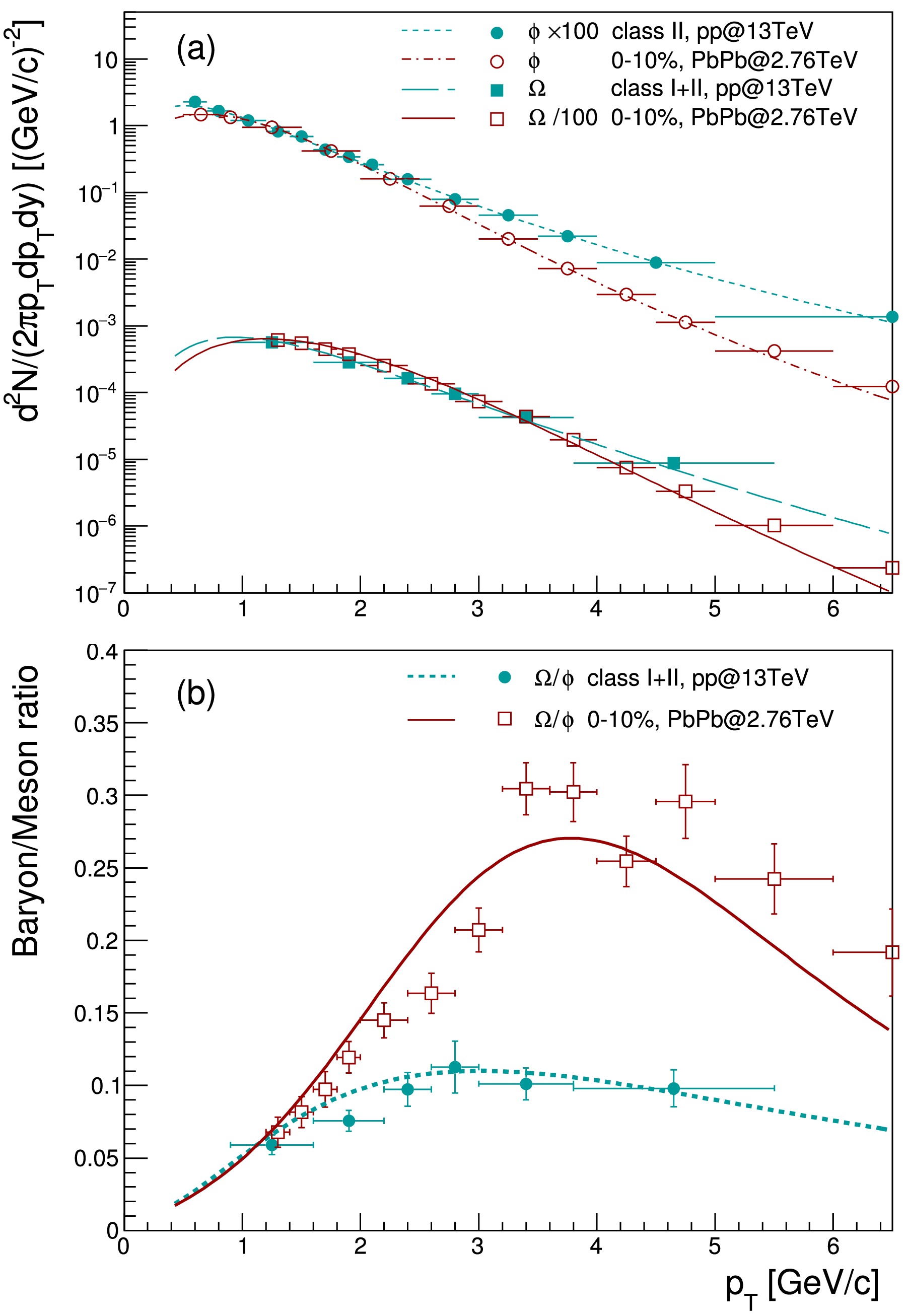
Figure 4. (color online) (a)
$ p_{T} $ spectra of Ω and ϕ in$ pp $ collisions at$ \sqrt{s}=13 $ TeV and in Pb-Pb collisions at$ \sqrt{s_{NN}}= $ 2.76 TeV and (b) the$ \Omega/\phi $ ratio in the two collision systems. The symbols in (a) represent experimental data [39, 40, 41, 42], and those in (b) represent our calculations based on these data. The lines for the$ p_T $ spectra of ϕ in (a) are model fits used to fix the$ p_T $ spectra of strange quarks just before hadronization, while the other lines are predictions of the EVC model.In Fig. 5, we show a systematic analysis of the
$ \Omega/\phi $ ratio as a function of$ p_{T} $ in$ pp $ collisions at$ \sqrt{s}= $ 7 and 13 TeV, p-Pb collisions at$ \sqrt{s_{NN}}= $ 5.02 TeV, and Pb-Pb collisions at$ \sqrt{s_{NN}}= $ 2.76 TeV. One high-multiplicity and one low-multiplicity event class are selected for each collision system. Panels (a-d) of Fig. 5 show the quark-number-scaling results for the experimental$ p_{T} $ spectra of Ω and ϕ [13, 39−42, 55, 56], from which the shape of the strange-quark distributions just before hadronization can be inferred. The lines are the best fits to these discrete points obtained using Eqs. (14)-(16). Using these smoothed fits, we evaluate the discrete curvature$ \left[\ln F_{s}(p_{T}/3)\right]^{\text{'}}-\left[\ln F_{s}(p_{T}/2)\right]^{\text{'}} $ for the$ p_{T} $ distribution of the strange quark and show the results in Fig. 5(e-h). A certain difference is observed between the curvature in the low-multiplicity event class and that in the high-multiplicity event class for each collision system. In particular, the difference between the curvatures in central and peripheral Pb-Pb collisions in panel (h) is relatively larger than the corresponding differences in$ pp $ and p-Pb collisions in panels (e-g).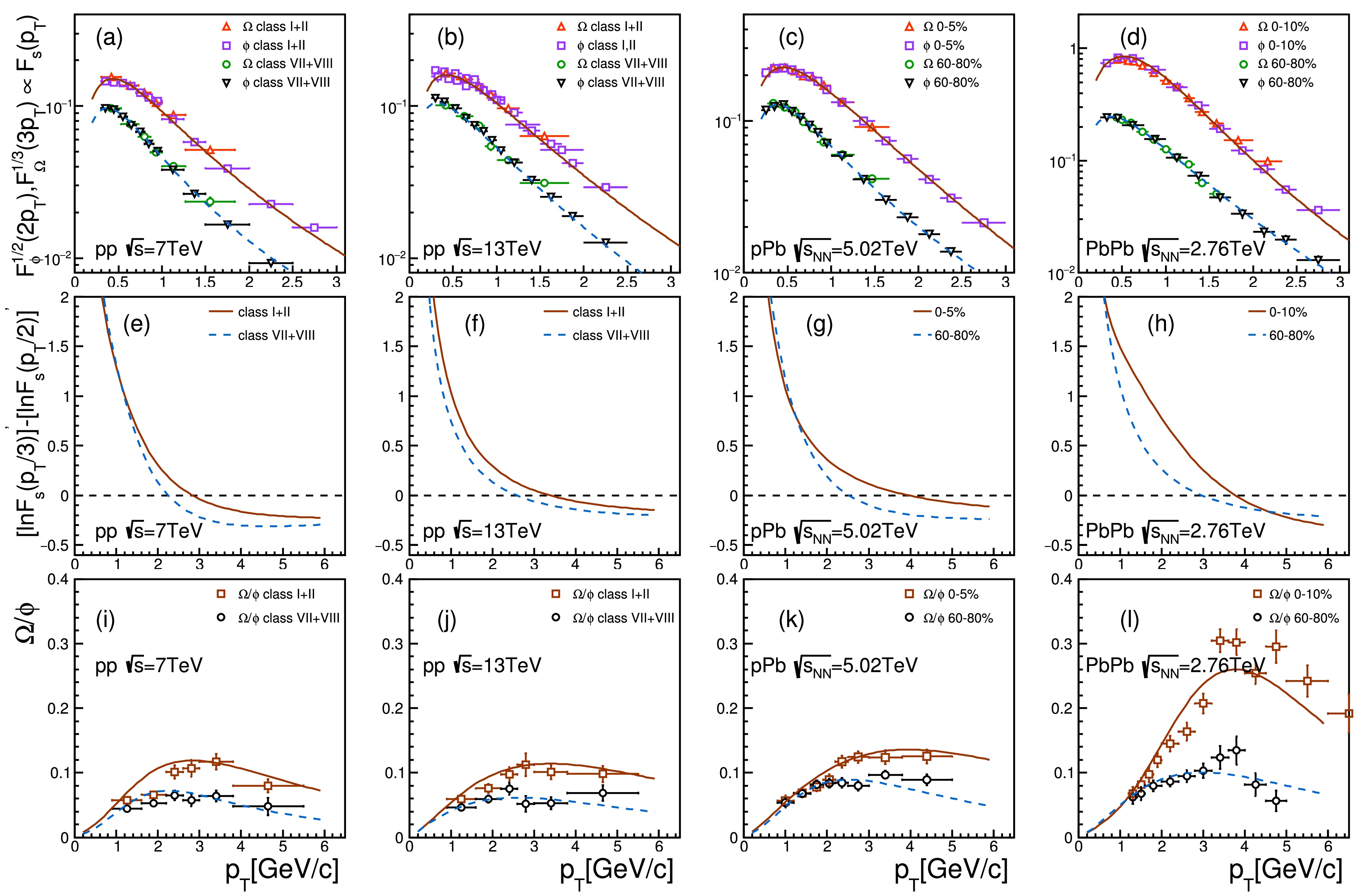
Figure 5. (color online) (a-d) The quark-number scaling results for experimental data on the
$ p_{T} $ spectra of Ω and ϕ in$ pp $ , p-Pb, and Pb-Pb collisions at LHC energies [13, 39−42, 55, 56, 61]. The lines are fits to the scaled data; (e-h) the discrete curvature of the$ p_{T} $ distributions of strange quarks calculated from the above fit lines; (i-l) the$ \Omega/\phi $ ratios as a function of$ p_{T} $ . Symbols are calculated from the$ p_T $ spectra data of Ω and ϕ [13, 39−42, 55, 56, 61]. The lines show model results.In Fig. 5(i-l), we show the model results for the
$ p_{T} $ dependence of$ \Omega/\phi $ ratio in the four collision systems. In the evaluation of the$ \Omega/\phi $ ratio, the parameters$ C_{\phi}=0.35 $ and$ a=4.90 $ are used in all collision systems for simplicity. The strangeness factor$ \lambda_{s} $ is set to 0.32 (0.29) for high-multiplicity (low-multiplicity) events in$ pp $ collisions at$ \sqrt{s}= $ 7 and 13 TeV, to 0.36 (0.32) for high-multiplicity (low-multiplicity) events in p-Pb collisions at$ \sqrt{s_{NN}}= $ 5.02 TeV, and to 0.42 (0.33) for central (peripheral) Pb-Pb collisions at$ \sqrt{s_{NN}}= $ 2.76 TeV. These choices of$ \lambda_s $ for the different collision systems are based on our previous studies [44, 47, 51]. The selected values, such as$ \lambda_s=0.42 $ in central AA collisions and$ \lambda_s=0.29 $ in low-multiplicity$ pp $ collisions, are consistent with calculations of the Wróblewski parameter in the statistical model [57] and in quenched QCD [58], as well as with available experimental measurements [59, 60].In addition to the suppression of Ω production due to
$ \lambda_{s} $ , Ω production in low-multiplicity events is subject to additional dynamical effects. In low-multiplicity event classes, such as those in$ pp $ and p-Pb collisions, the average strange-quark number at midrapidity is very small (less than one for$ pp $ collisions) [44, 45]. The formation of Ω in a low-multiplicity event class occurs only in the subset of events containing three or more strange quarks. The Ω yield depends on the fraction of these effective events and therefore on the event-by-event distribution of the strange-quark number at hadronization in this event class. In previous studies [44, 45, 51], we applied a truncated Poisson distribution to study the effect of strange-quark number fluctuations on multistrange baryon production and quantified the resulting suppression of Ω in low-multiplicity event classes. To account for this additional suppression of Ω production in the present study, we introduce an extra suppression factor in front of the normal$ \Omega/\phi $ ratio calculated by Eq. (8) for low-multiplicity event classes. Following our previous studies [44, 45, 51], we set it to 0.66 for multiplicity event class VII+VIII in$ pp $ collisions at$ \sqrt{s}= $ 7 and 13 TeV, and to 0.85 for 60-80% centrality in p-Pb collisions at$ \sqrt{s_{NN}}= $ 5.02 TeV and Pb-Pb collisions at$ \sqrt{s_{NN}}= $ 2.76 TeV.We observe several features of the
$ \Omega/\phi $ ratio in the above four collision systems. Comparing the$ \Omega/\phi $ ratios in the low- and high-multiplicity event classes in each collision system shown in Fig. 5(i-l), we see that the peak position of the$ \Omega/\phi $ ratio shifts to higher$ p_{T} $ in the high-multiplicity event class. This is also reflected in the curvature of the strange-quark distribution in Fig. 5(e-h). Comparing the$ \Omega/\phi $ ratios in the high-multiplicity event class in$ pp $ collisions at$ \sqrt{s}= $ 7 and 13 TeV with those in p-Pb collisions at$ \sqrt{s_{NN}}= $ 5.02 TeV, we observe a weak increase in the$ \Omega/\phi $ ratio as the mid-rapidity multiplicity of the systems changes from 21.3 to 45 [55, 56]. However, we observe a strong increase in the$ \Omega/\phi $ ratio in central Pb-Pb collisions, which is also reflected in the higher curvature of the strange-quark distribution in the range$ p_{T}<3 $ GeV/c in Fig. 5(h).Considering the values
$ \langle p_{T}\rangle = $ $ 1.440\pm0.023 $ ,$ 1.456\pm0.015 $ GeV/c for ϕ in the highest-multiplicity$ pp $ collisions at$ \sqrt{s}= $ 7 and 13 TeV [40, 56],$ \langle p_{T}\rangle =1.429\pm0.008 $ GeV/c for central (0-10%) p-Pb collisions at$ \sqrt{s_{NN}}= $ 5.02 TeV [55], and$ \langle p_{T}\rangle = $ $ 1.325\pm0.028 $ GeV/c for central Pb-Pb collisions at$ \sqrt{s_{NN}}=2.76 $ TeV [42], we see that the$ p_{T} $ spectra of ϕ (equivalently, strange quarks) in the three small collision systems are overall flatter/broader than those in central Pb-Pb collisions, but this does not lead to the enhancement of Ω production at intermediate$ p_{T} $ . As explained in this work, the curvature of the strange-quark$ p_{T} $ distribution is more relevant to the enhancement of the$ \Omega/\phi $ ratios at relatively intermediate$ p_{T} $ . This difference in the curvature of the quark$ p_{T} $ distribution should be related to the difference between the evolution properties of parton systems just before hadronization in small and large systems.The expansion and evolution of the bulk and hot parton medium produced in relativistic heavy-ion collisions is well modeled by relativistic hydrodynamics, and strong collective flow is established in central collisions [62, 63]. Collective flow has also recently been studied and observed in
$ pp $ and p-Pb collisions at the LHC [64−66]. Here, we qualitatively demonstrate the influence of strong collective flow on the curvature of the particle$ p_{T} $ spectrum using the fit function in Eq. (16), which is the Lévy-Tsallis function boosted by a radial velocity v. The function has the asymptotic behavior of a thermal distribution as$ n\to\infty $ . At finite n, the function also behaves like$ \exp\left[-(m_{T}-p_{T}v-m)/\left(C\sqrt{1-v^{2}}\right)\right] $ at low$ p_{T} $ , which is the thermal distribution$ \exp\left[-(m_{T}-m)/C\right] $ boosted with velocity v. Here, C can be roughly viewed as the temperature in the low-$ p_{T} $ range. At large$ p_{T} $ , the function behaves as a power-law form,$ (1+p_{T}/a)^{-n} $ , whose shape is not influenced by v.In Fig. 6(a), we show examples of the function in Eq. (16) for three different parameter sets. We choose
$ v=0 $ ,$ C=0.3 $ as the baseline, which represents a static source with a relatively high temperature (plus the power-law tail from jet physics). We choose$ v=0.6 $ ,$ C=0.3 $ as the second example, a high-temperature source with strong collective flow, and$ v=0.6 $ ,$ C=0.164 $ as the third example, a low-temperature source with strong collective flow. The third example is intended to capture the expansion and cooling properties of hot-medium evolution; its parameters are chosen so that its$ \langle p_{T}\rangle $ is the same as that of the baseline. The corresponding curvatures of the strange-quark$ p_{T} $ spectrum for these parameter sets are shown in Fig. 6(b). Fig. 6(c) shows the schematic behavior of the$ \Omega/\phi $ ratios for the three cases, with the same magnitude set at$ p_{T}=0.5 $ GeV/c, solely to demonstrate the influence of the curvature property of the strange-quark$ p_{T} $ spectrum. The$ \Omega/\phi $ ratio in the baseline case (solid line in Fig. 6(c)) increases slowly in the range$ p_{T} \lesssim 3 $ GeV/c and then begins to decrease at larger$ p_{T} $ . For the high-temperature, strong-collective-flow case (dashed line), the$ \Omega/\phi $ ratio increases rapidly with$ p_{T} $ and then begins to decrease at larger$ p_{T}\gtrsim5.5 $ GeV/c. For the low-temperature, strong-collective-flow case (long-dashed line), the$ \Omega/\phi $ ratio increases most rapidly with$ p_{T} $ in the range$ p_{T}\lesssim 3 $ GeV/c, can reach a rather high value at$ p_{T} $ of about 3.5 GeV/c, and finally begins to decrease with$ p_{T} $ .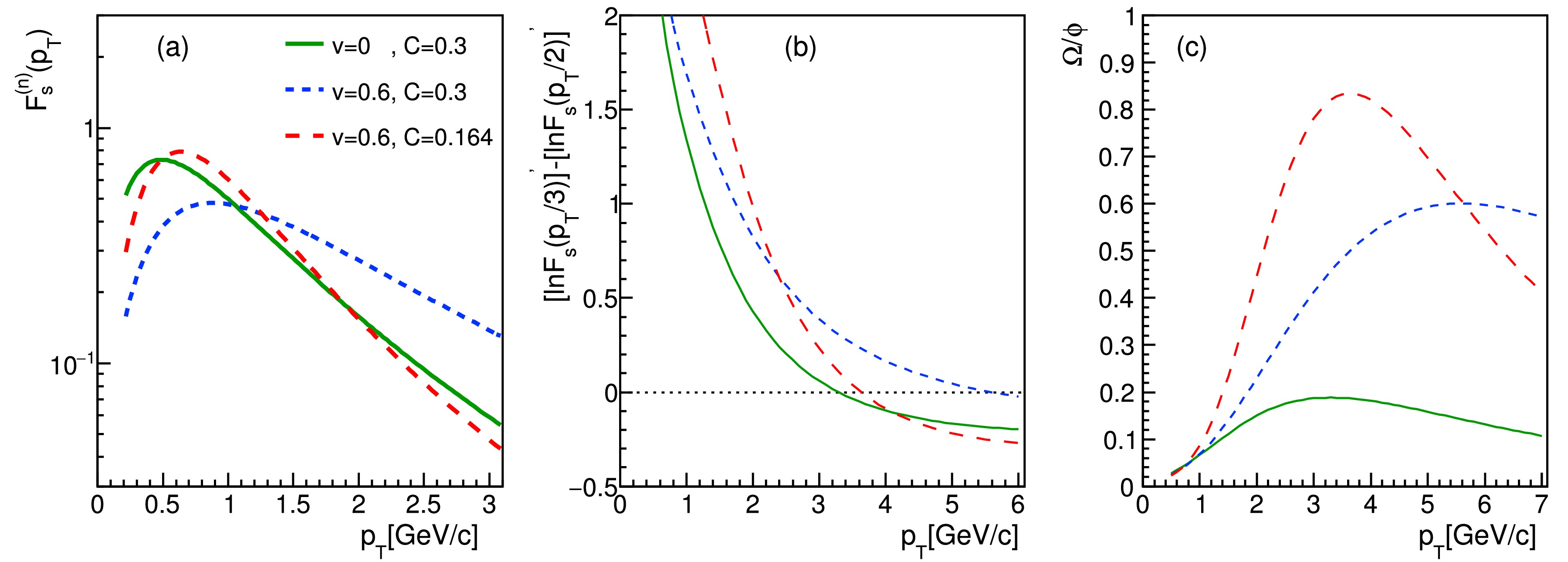
Figure 6. (color online) (a) The normalized
$ p_{T} $ spectrum of strange quarks for different parameter values; (b) the curvature of the spectrum; (c) the schematic behavior of the$ \Omega/\phi $ ratio with the same magnitude set at$ p_{T}=0.5 $ GeV/c. -
In this paper, we have applied the constituent quark equal-velocity combination model to study the
$ p_{T} $ dependence of the$ \Omega/\phi $ ratio in$ pp $ , p-Pb, and Pb-Pb collisions at LHC energies. In this model, the$ p_{T} $ distributions of the produced Ω and ϕ are simple products of the$ p_{T} $ spectra of strange quarks just before hadronization. Therefore, we can derive an analytical result for the$ \Omega/\phi $ ratio as a function of$ p_{T} $ and identify the key factor influencing the$ p_{T} $ dependence of the$ \Omega/\phi $ ratio, i.e., the discrete curvature of the strange quark$ p_{T} $ spectrum. Using the quark number scaling property, we extracted the$ p_{T} $ spectra of strange quarks from the experimental data for ϕ and studied the curvature properties of the strange quark$ p_{T} $ spectra in high- and low-multiplicity events in$ pp $ collisions at$ \sqrt{s}= $ 7 and 13 TeV, p-Pb collisions at$ \sqrt{s_{NN}} $ = 5.02 TeV, and Pb-Pb collisions at$ \sqrt{s_{NN}} $ = 2.76 TeV. Finally, using these curvature properties of the strange quark$ p_{T} $ spectra, we successfully explained the observed$ p_{T} $ dependence of the$ \Omega/\phi $ ratio in these collisions.One implication of this work is that the shape property of the quark
$ p_{T} $ distribution provides useful information for understanding hadron production in high-energy collisions. In this work, we establish a simple connection between the discrete curvature of the strange quark$ p_{T} $ distribution just before hadronization and the$ p_{T} $ dependence of the$ \Omega/\phi $ ratio. By comparing the curvature of the strange quark distributions in$ pp $ , p-Pb, and Pb-Pb collisions, we find a relatively large change in the curvature of the quark distribution when the collision system changes from$ pp $ and p-Pb to Pb-Pb collisions. This large change can be qualitatively understood as a consequence of strong collective flow, such as that formed in central AA collisions.Similar curvature-property analyses can also be applied to the
$ p_{T} $ distributions of hadrons. In our latest work [67], we observed a systematic difference between the curvatures of baryon and meson distributions, which can be explained by the quark combination mechanism at hadronization. In addition, correlations between the characteristic points of the curvature of hadronic$ p_{T} $ distributions and the measured$ \langle p_{T}\rangle $ of hadrons in$ pp $ , p-A, and AA collisions suggest an obvious change related to the size (charged-particle multiplicity) of the collision system. This property is also closely connected to the influence of collective flow. In summary, we argue that quantifying the local shape property of particle$ p_{T} $ distributions is a new and effective way to understand particle production in high-energy collisions.Finally, a comparative discussion on the current work and available studies of
$ \Omega/\phi $ ratio in other theoretical models and event generators is helpful for readers. According to our previous simulations [45], event generator PYTHIA with the string fragmentation hadronization fails to reproduce the quark number scaling property for$ p_{T} $ spectra of Ω and ϕ shown in Fig. 2 and predicts a relatively small$ \Omega/\phi $ ratio in$ pp $ collisions at LHC energy which is mainly due to the under prediction of Ω production [39]. EPOS [68] applies a collective hadronization (microcanonical statistical hadronization with an additional longitudinal and radial flow) for central part of collision zone and a parameterization string fragmentation for peripheral part of collision zone. The simulation of EPOS4 [69] in Ref. [70] predicts an increasing$ \Omega/\phi $ ratio in range$ p_{T}\lesssim3.5 $ GeV/c in central O+O collisions at$ \sqrt{s_{NN}}=7 $ TeV and an increase of$ \Omega/\phi $ ratio in range$ p_{T}\lesssim2 $ GeV/c from central to peripheral collisions. Hydrodynamic model of high-energy collisions applies a thermal freeze-out mechanism and predicts a fast increasing$ \Omega/\phi $ ratio in low$ p_{T} $ range in Pb-Pb collisions at LHC [36]. Event generator AMPT (string melting version) [71] with a spatial coalescence model for hadronization predicts an increasing$ \Omega/\phi $ ratio in range$ p_{T}<5 $ GeV/c with maximum magnitude$ \lesssim0.06 $ in central O+O collisions at$ \sqrt{s_{NN}}=7 $ TeV according to calculations in [70]. A dynamical quark coalescence model [6] applying the quark information generated by AMPT predicts an increasing$ \Omega/\phi $ ratio in range$ p_{T}<3 $ GeV/c with maximum magnitude about$ 0.7 $ in central Au+Au collisions at$ \sqrt{s_{NN}}=200 $ GeV. A parton recombination model [4] explains the$ p_{T} $ dependence of$ \Omega/\phi $ ratio in heavy-ion collisions via the variant contributions of thermal-thermal, thermal-shower and shower-shower components in combination at different$ p_{T} $ . In comparison with these available studies, the current study focuses on the influence of the equal-velocity quark combination hadronization on the$ p_{T} $ dependence of$ \Omega/\phi $ ratios in high-energy collisions at LHC energies.$ p_{T} $ distribution of strange quarks just before hadronization is reversely extracted from data of$ p_{T} $ spectrum of ϕ and then is used to calculate Ω spectra and$ \Omega/\phi $ ratio. Taking advantage of analytical feature of equal-velocity combination mechanism, the$ p_{T} $ dependence of$ \Omega/\phi $ ratio is related to the shape property (i.e., the curvature) of$ p_{T} $ spectrum of strange quarks. The non-monotonic$ p_{T} $ dependence of$ \Omega/\phi $ ratio in$ pp $ , p-Pb and Pb-Pb collisions at LHC energies was systematically explained via the analysis of the shape property of$ p_{T} $ spectrum of strange quarks in these collisions. In comparison with those avaialable studies, the current study provides a new viewpoint of studying$ p_{T} $ dependence of baryon/meson ratios in high-energy collisions by suggesting the attention to the shape property (e.g., the curvature) of$ p_{T} $ spectra of quarks just before hadronization. -
In Table A1, we show parameter values of Eqs. (14)-(16) in fitting the scaled
$ p_T $ spectra of ϕ in$ pp $ , p-Pb and Pb-Pb collisions, which are used to calculate results shown in Figs. 3 and 5. In order to best fit the shape of the scaled ϕ spectra, here we treat m as a free parameter. Parameter v in Eq. (16) is set to be$ v\geq 0.02 $ in order to show the difference from fittings by Eq. (14).system Eq. (14) Eq. (15) Eq. (16) n m C a n m C v n m C $ pp $ $ \sqrt{s}= $ 13TeV class II4.813 0.318 0.305 0.592 5.776 2.412 0.144 0.024 4.826 0.310 0.299 $ pp $ $ \sqrt{s}= $ 13TeV class VII5.430 0.050 0.264 0.733 18.49 0.050 0.279 0.020 5.429 0.050 0.259 $ pp $ $ \sqrt{s}= $ 7TeV class II4.419 0.440 0.265 0.691 4.547 1.895 0.140 0.020 4.437 0.430 0.262 $ pp $ $ \sqrt{s}= $ 7TeV class VII3.505 0.520 0.184 0.781 2.954 2.078 0.081 0.020 3.526 0.504 0.182 p-Pb $ \sqrt{s_{NN}}= $ 5.02TeV 0-5%7.983 0.200 0.374 0.903 13.63 0.200 0.382 0.031 9.447 0.020 0.377 p-Pb $ \sqrt{s_{NN}}= $ 5.02TeV 60-80%4.504 0.333 0.248 1.243 3.270 0.158 0.256 0.020 4.512 0.327 0.244 Pb-Pb $ \sqrt{s_{NN}}= $ 2.76TeV 0-10%6.314 1.008 0.218 0.910 4.700 2.217 0.121 0.021 4.192 1.507 0.144 Pb-Pb $ \sqrt{s_{NN}}= $ 2.76TeV 60-80%6.992 0.230 0.284 0.582 7.928 2.347 0.130 0.020 7.000 0.226 0.279 Table A1. Parameter values of Eqs. (14)–(16) used in fitting the scaled
$ p_T $ spectra of ϕ in$ pp $ , p-Pb, and Pb-Pb collisions.If we assign a physical mass to m, for example constituent mass
$ m=0.5 $ GeV of strange quarks just before hadronizaiton, the fitting quality is decreased in general. In Fig. A1 (a), we show the fitting results by Eq. (16) with fixed$ m=0.5 $ GeV in Pb-Pb collisions at$ \sqrt{s_{NN}}= $ 2.76 TeV and compare them with the best fittings with free m setting. We see that$ \chi^2/N_{data} $ with fixed$ m=0.5 $ GeV, the dashed line, is larger than that with free m setting, the solid line, although both are quite close in the figure. In central collisions, we obtain$ v=0.44 $ and$ C=0.17 $ GeV at fixed$ m=0.5 $ GeV, which can be interpreted as an indication of strong collective flow in central Pb-Pb collisions. Therefore, at the end of Sec. 3, we discuss the influence of strong collective flow on the curvature of$ p_T $ spectra of strange quarks and the resulting$ \Omega/\phi $ ratio in central Pb-Pb collisions at LHC. In peripheral Pb-Pb collisions at$ \sqrt{s_{NN}}=2.76 $ TeV, high-multiplicity class II in$ pp $ at$ \sqrt{s}=7,13 $ TeV and high-multiplicity 0-5% centrality class in p-Pb collisions at$ \sqrt{s_{NN}}=5.02 $ TeV, fitting results by Eq. (16) with fixed$ m=0.5 $ GeV, as shown in Fig. A1 (a-c), do not show a tendency to obvious v.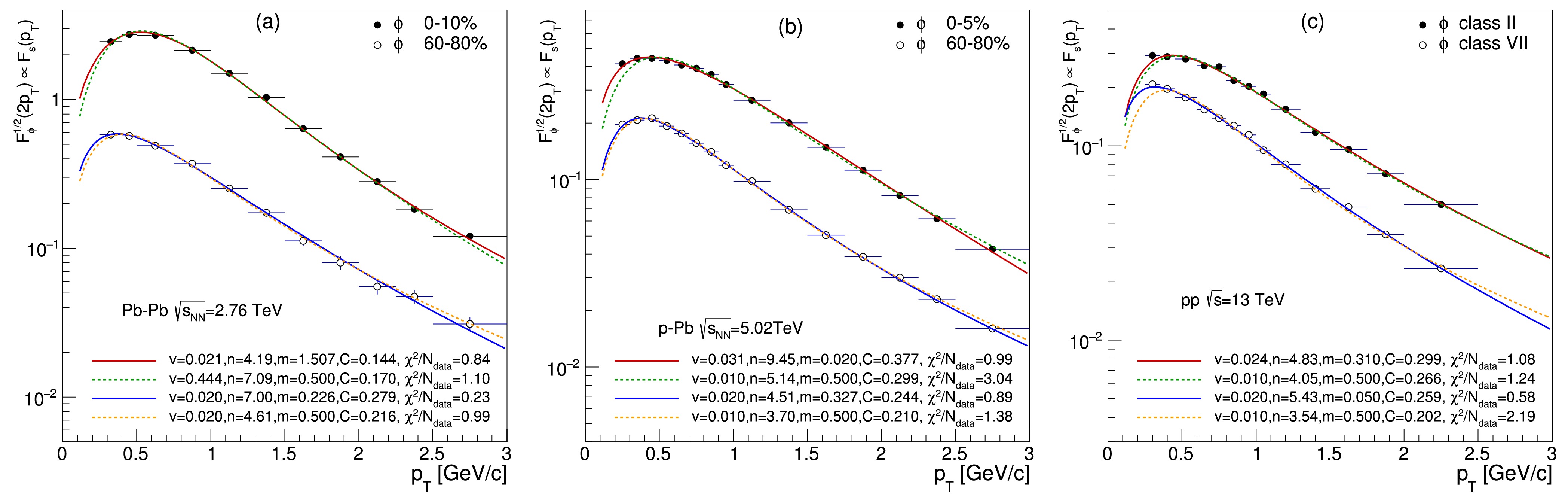
Figure A1. (color online) The scaled
$ p_T $ spectra of ϕ in Pb-Pb collisions at$ \sqrt{s_{NN}}=2.76 $ TeV (a), p-Pb collisions at$ \sqrt{s_{NN}}=5.02 $ TeV (b), and$ pp $ collisions at$ \sqrt{s}=13 $ TeV (c), together with their corresponding function fits. The symbols represent scaled ϕ data [40, 42, 55], and the lines show the fit results from Eq. (16).
Transverse momentum dependence of $\Omega/\phi$ ratio in high energy collisions
- Received Date: 2026-08-16
- Available Online: 2027-01-01
Abstract: We apply a constituent-quark equal-velocity combination model to study the $p_{T}$ dependence of the $\Omega/\phi$ ratio in $pp$, p-Pb, and Pb-Pb collisions at LHC energies. We demonstrate that the relative rate of change of the $\Omega/\phi$ ratio is dominated by the curvature property of the $p_{T}$ spectrum of strange quarks just before hadronization. Using experimental data for ϕ mesons after applying a quark-number scaling procedure, we extract the $p_{T}$ spectrum of strange quarks just before hadronization and study its curvature property in high- and low-multiplicity events in $pp$ collisions at $\sqrt{s}=$ 7 and 13 TeV, p-Pb collisions at $\sqrt{s_{NN}}$= 5.02 TeV, and Pb-Pb collisions at $\sqrt{s_{NN}}$= 2.76 TeV. We use these curvature properties of the $p_{T}$ spectra of strange quarks to explain the observed $p_{T}$ dependence of the $\Omega/\phi$ ratio in these collisions. We discuss the possible origin of the change in the curvature property of the $p_{T}$ spectra of strange quarks just before hadronization by considering the influence of strong collective flow formed during partonic-stage evolution in collisions at LHC energies.



 DownLoad: