


 Abstract
 HTML
 Reference
 Related
 PDF



-
The nuclear shell model (SM) has long served as a cornerstone for understanding nuclear structure [1, 2]. In the independent-particle shell-model picture, the nuclear mean field and spin-orbit splitting give rise to the conventional magic numbers 2, 8, 20, 28, 50, 82, and 126. However, this paradigm breaks down in neutron-rich nuclei with a large neutron-to-proton ratio (
$ N/Z $ ), where the conventional magic numbers (e.g., N = 8, 20 and 28) are weakened or disappear, whereas new magic numbers (e.g., N = 14, 16, 32 and 34) emerge [3−6]. These observations highlight the plasticity of shell structure and offer key insights into the mechanisms underlying shell evolution, many-body correlations, and nuclear collectivity.In the traditional SM framework, nuclei with magic or semi-magic numbers are expected to possess spherical ground states. Nevertheless, low-lying deformed configurations can arise through many-particle–many-hole (
$ mp $ -$ mh $ ) excitations across a major shell gap (intruder configurations) in large-scale shell-model (LSSM) calculations. As protons are removed from neutron-rich magic nuclei, shell evolution can compress the spacing between single-particle orbitals straddling the magic gap, allowing intruder configurations—through enhanced quadrupole correlations—to gain more correlation energy than the normal spherical configuration. When such inversions become systematic in a region of nuclei, they delineate an "island of inversion" (IOI), such as the Ne, Na, and Mg isotopes near N = 20 [7, 8]. Within IOIs, strong mixing between normal and intruder configurations makes shape coexistence not exceptional but pervasive: multiple shapes (e.g., spherical, prolate, and oblate) occur at low excitation energies. Empirically, the appearance of low-lying 0+ states in even-even nuclei constitutes a key signature of shape coexistence [9, 10]. Establishing and quantifying shape coexistence in IOIs is therefore of broad significance: it constrains effective interactions, illuminates the mechanisms driving shell evolution, and tests many-body descriptions of emergent collectivity far from stability.Recent experimental and theoretical studies demonstrate the merging of the inversion regions at N = 20 and N = 28 [11−13], where abundant shape coexistence phenomena are observed. The neutron-rich nucleus 32Mg exhibits shape coexistence, with a spherical excited 0+ state at 1058(2) keV and a strongly deformed ground state. Comprehensive investigations of 68Ni have elucidated detailed features of shape coexistence [14−18], while revealing a nascent IOI (N = 40) centered on 64Cr [19−23]. Simultaneously, excited spherical isomers coexisting with deformed ground states have been definitively identified in odd-odd Mn nuclei near N = 40 [24]. This critical evidence, combined with prior studies, experimentally establishes extensive shape coexistence across the N = 40 region [25, 26]. Recent experimental evidence for axial shape asymmetry and configuration coexistence in 74Zn, however, suggests a potential northward extension of the N = 40 IOI beyond Z = 30 [27]. Subsequently, independent high-precision mass spectrometry using Penning traps and MR-TOF techniques, combined with LSSM calculations, has unambiguously established the coexistence of a deformed
$ 1/2^+ $ isomer (942 keV) with the spherical ground state in 79Zn [28]. Furthermore, these investigations reveal compelling evidence for shared deformation mechanisms involving the doubly magic nucleus 78Ni [28]. The potential appearance of shape coexistence in 78Ni has also been pointed out in Ref. [29]. Combined theoretical and experimental studies near 78Ni reveal emerging shape coexistence and identify a prospective N = 50 IOI [27, 28, 30, 31]. These established deformation mechanisms near neutron closures motivate comprehensive investigations of shape coexistence in the N = 40 and N = 50 regions [32−34].To investigate the physical mechanisms driving shape coexistence in nuclei around the N = 40 and N = 50 regions, several theoretical approaches have been employed. For instance, both the LSSM and the Monte Carlo shell model (MCSM) have been employed to investigate shape coexistence and shell evolution in nuclei within the N = 40 IOI [35−37]. These approaches are complemented by state-of-the-art
$ ab $ $ initio $ techniques such as the valence-space in-medium similarity renormalization group (VS-IMSRG) [38, 39] and coupled-cluster calculations [40], as well as by beyond-mean-field frameworks employing diverse effective interactions [33, 41]. The recently developed shell-model interaction PFSDG-U, which employs the$ pf $ shell for valence protons and the$ sdg $ shell for valence neutrons above 60Ca, successfully models nuclei near N = 50 for proton numbers Z = 20 to Z = 28 [10]. To extend coverage beyond this domain, we perform LSSM calculations with realistic shell-model interactions. Specifically, we examine shape coexistence phenomena across the N = 40 and N = 50 IOIs, using orbital occupations and particle-hole excitation probabilities as complementary microscopic indicators of the configuration changes associated with candidate shape-coexisting states.The article is organized as follows. First, a brief description of the realistic effective Hamiltonian is provided. This is followed by results for low-lying states in even-even nuclei with proton numbers from Z = 20 to Z = 28 and neutron numbers N = 40 and N = 50; these results are used to explore shape coexistence phenomena. Subsequently, we present neutron and proton orbital occupancies, along with particle-hole excitation configurations for the shape-coexisting
$ 0_1^+ $ and 02+ states. In addition, we systematically quantify the excitation energies of low-lying states and neutron occupancies across even-even neutron-rich Ti, Cr, and Fe isotopes spanning$ N=38 $ to$ 52 $ . Finally, we summarize the present work. -
Following our previous works [31, 32], we construct an effective Hamiltonian (
$ H_{{\rm{eff}}} $ ) in a valence-space configuration in which protons occupy the full$ pf $ shell,$ {0f_{7/2},1p_{3/2},0f_{5/2},1p_{1/2}} $ , while neutrons are active across the extended$ \{1p_{1/2}, 0f_{5/2}, 0g_{9/2}, 1d_{5/2,3/2}, 2s_{1/2}\} $ orbitals. Both sets of orbitals are built above the 52Ca inner core. The effective-interaction framework originates from the intrinsic Hamiltonian of an A-body system. Starting from a realistic nucleon-nucleon (NN) interaction, such as the CD-Bonn interaction [42], an effective Hamiltonian can be constructed in a truncated valence space. In our previous works [31, 32], the CD-Bonn interaction was softened using the$ V_{{\rm{low}}-{\rm{k}}} $ method with a cutoff of 2.6 fm-1, and the shell-model effective interaction was derived using open-shell many-body perturbation theory [41, 43, 44], i.e., the folded-diagram$ \hat{Q} $ -box method, including Goldstone diagrams up to third order. The present LSSM calculations employ the effective Hamiltonian obtained in these works [31, 32]. For further technical details, see Ref. [31, 32]. Although the neutron$ 1p_{3/2} $ orbital is in principle relevant for maintaining SU(3) coherence, it is not included in the valence space of the present effective Hamiltonian. LSSM calculations for 66Fe and$ ^{65} $ Co with the LNPS interaction [45, 46], as well as MCSM calculations for 66Fe and 66Co [36], show that excitations involving the neutron$ 1p_{3/2} $ orbital are not prominent. On this basis, we omit the neutron$ 1p_{3/2} $ orbital from the present valence space, although some quantitative uncertainty associated with this omission cannot be excluded.We performed LSSM calculations using the KSHELL code [47] with the constructed shell-model effective Hamiltonian. For electric quadrupole transition strengths, the standard effective charges
$ e_p=1.5e $ and$ e_n=0.5e $ are adopted. Because the untruncated model space has a prohibitive dimensionality that exceeds the capabilities of current supercomputers, appropriate configuration truncations were necessary. We adopted suitably chosen truncations to keep the model space sufficiently large while approaching a dimension of approximately$ 10^{9.4} $ . The largest matrix dimension encountered in our calculations was for 70Cr, approximately$ 10^{9.54} $ . -
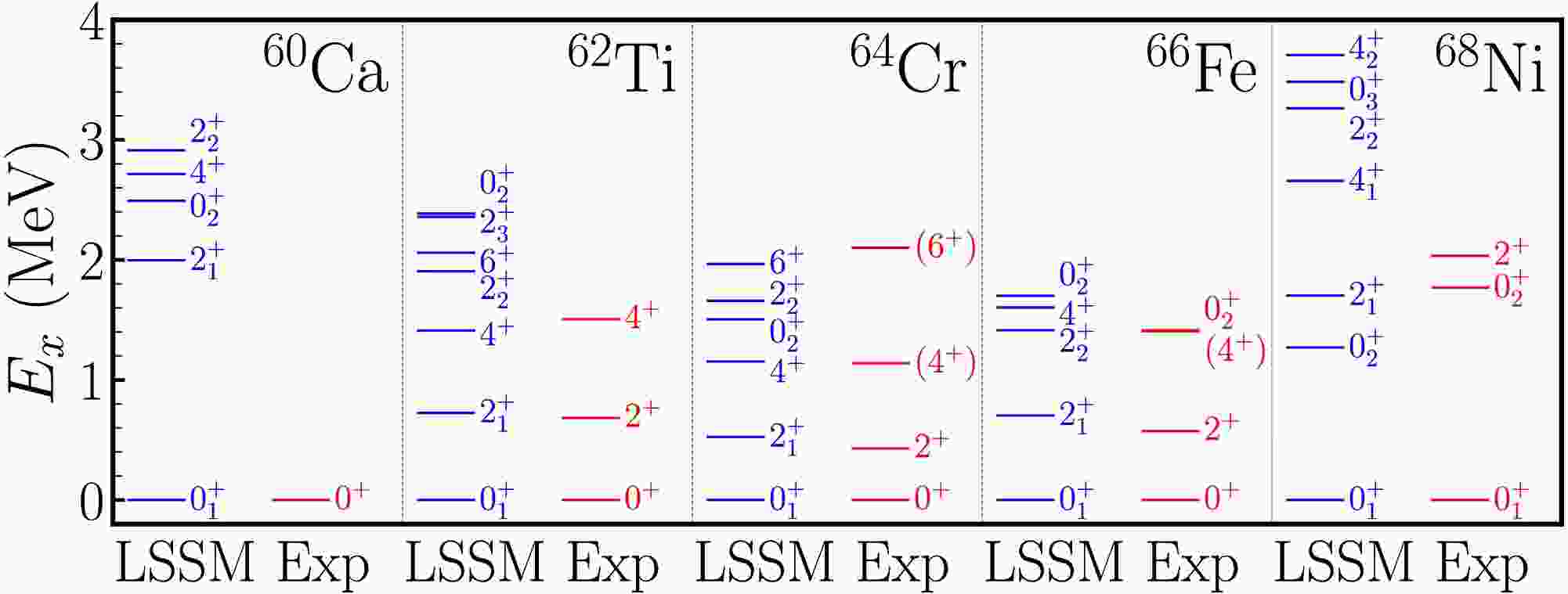
We first performed LSSM calculations for the excitation spectra of the even-even N = 40 isotones spanning 60Ca to 68Ni. The results are shown in Fig. 1, together with available experimental data [36, 48−50]. Our calculations are in agreement with the available measurements. For 68Ni, the calculated 02+ state lies 432 keV below the 21+ state, in agreement with experimental observations and indicative of shape coexistence in 68Ni. As discussed in our previous work [32], the maximum deformation occurs at 64Cr, characterized by the smallest
$ E(2_1^+) $ values. Moreover, our calculations reveal that across the N = 40 isotonic chain, the$ E(0_2^+) $ energies follow trends parallel to those of the$ E(2_1^+) $ energies in all N = 40 isotones except 68Ni, demonstrating rich shape coexistence in this region. In particular, 64Cr exhibits the lowest 02+ excitation energy among the N = 40 isotones. To further examine the deformation of 64Cr, we calculated electric quadrupole transition strengths for 64Cr. The obtained value of$ B(E2;2_1^+\rightarrow0_1^+)=466.3\; e^2{\rm{fm}}^4 $ is comparable in magnitude to the experimental value of$ 312(79)\; e^2{\rm{fm}}^4 $ obtained from intermediate-energy Coulomb excitation [23], supporting strong quadrupole collectivity in 64Cr. In addition, the much smaller calculated value of$ B(E2;0_2^+\rightarrow2_1^+)= 1.42\; e^2{\rm{fm}}^4 $ , for which no experimental value is currently available, suggests weak mixing between the 02+ state and the collective ground-state structure. These electromagnetic properties provide additional support for the coexistence of distinct low-lying structures in 64Cr.
To further clarify the microscopic origin of the candidate shape-coexisting states in the N = 40 isotones, we calculate the orbital occupations and particle-hole excitation probabilities of the
$ 0_1^+ $ and 02+ states. Although orbital occupations and particle-hole excitation patterns within the LSSM do not determine deformation directly, they provide useful microscopic information on the underlying configurations associated with low-lying coexisting states. For the N = 40 isotones, the deviations in occupancy for the$ 0_1^+ $ and 02+ states represent the differences between our LSSM average orbital occupancies and those of the conventional shell-model baseline. The results are presented in Fig. 2. Overall, the dominant proton excitations occur from the$ \pi0f_{7/2} $ orbital to the$ \pi1p_{3/2} $ and$ \pi0f_{5/2} $ orbitals, while the primary neutron excitations occur from the$ \nu0f_{5/2} $ and$ \nu1p_{1/2} $ orbitals to the$ \nu0g_{9/2} $ and$ \nu1d_{5/2} $ orbitals. In the ground state of 68Ni, both proton and neutron excitations are notably suppressed, consistent with its doubly magic character. By contrast, the 02+ state of 68Ni displays enhanced proton and neutron excitations relative to the ground state. For 60Ca, the neutron-excitation patterns in the ground state and the 02+ state are similar. In 62Ti, proton excitations are slightly enhanced in the 02+ state compared with the ground state, while neutron excitations from the$ \nu0f_{5/2} $ orbital are reduced, with a concurrent increase in the occupation of the$ \nu1d_{5/2} $ orbital. For 64Cr, both proton and neutron excitations are strengthened in the 02+ state compared with those in the ground state. In 66Fe, however, both proton and neutron excitations in the 02+ state are reduced relative to the ground state.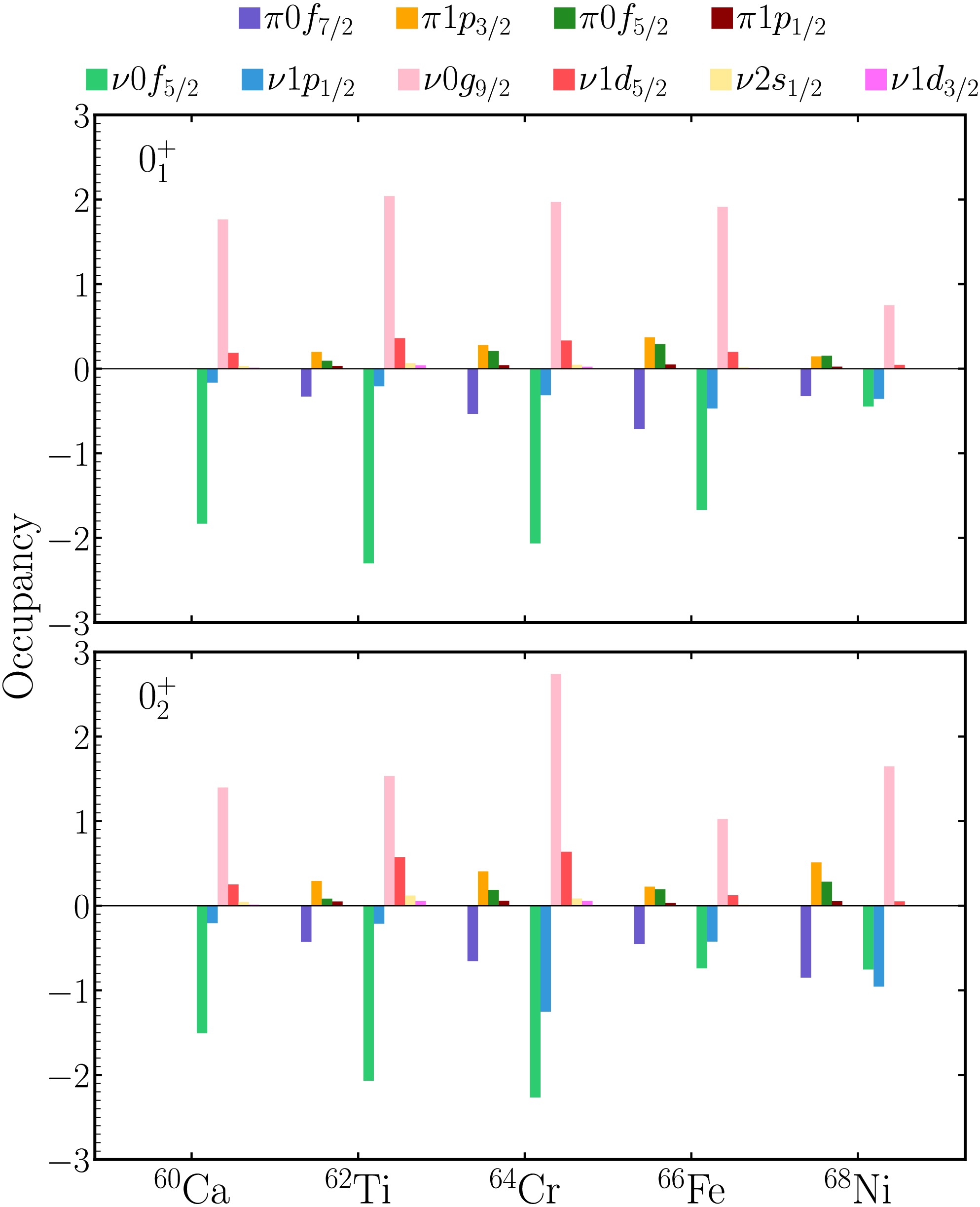
Figure 2. (color online) The calculated deviation of proton and neutron occupancies from the expected normal filling for the
$ 0_1^+ $ and 02+ states in even-even isotones at N = 40.The calculated particle-hole excitation probabilities for the ground state and the 02+ state are shown in Fig. 3. We adopt the conventional SM configuration associated with the Z = 28 shell closure and the N = 40 subshell closure as the 0p-0h reference. Here, the 0p-0h configuration serves only as a reference for quantifying particle-hole excitations and does not imply a robust N = 40 subshell closure throughout the isotonic chain. In 60Ca, the particle-hole configurations are similar for the ground state and the 02+ state. For 62Ti, the proton configurations in the two states are nearly identical. The situation is markedly different for neutrons: the 4p-4h and 0p-0h configurations are enhanced, whereas the 2p-2h configuration is reduced in the 02+ state relative to the
$ 0_1^+ $ state. For 64Cr, the neutron excitations in the 02+ state are dominated by 2p-2h and 4p-4h configurations, with the 4p-4h component contributing nearly 80% of the total, consistent with previous LSSM calculations [33], whereas the ground state is dominated by 2p-2h configurations. The proton particle-hole excitation patterns in 66Fe are analogous to those in 62Ti and 64Cr. For neutrons in 66Fe, the ground-state excitations are more pronounced and are dominated by 2p-2h and 4p-4h configurations, with 2p-2h accounting for approximately 70%. In the 02+ state, the combined contribution of 2p-2h and 4p-4h is less than 50%, and the 0p-0h configuration becomes dominant. For 68Ni, both proton and neutron excitations are minimal in the ground state. In the 02+ state, neutron 2p-2h configurations are dominant, with the 2p-2h component accounting for more than 70%, and proton excitations are significantly enhanced relative to the ground state; this is also consistent with previous LSSM calculations [51].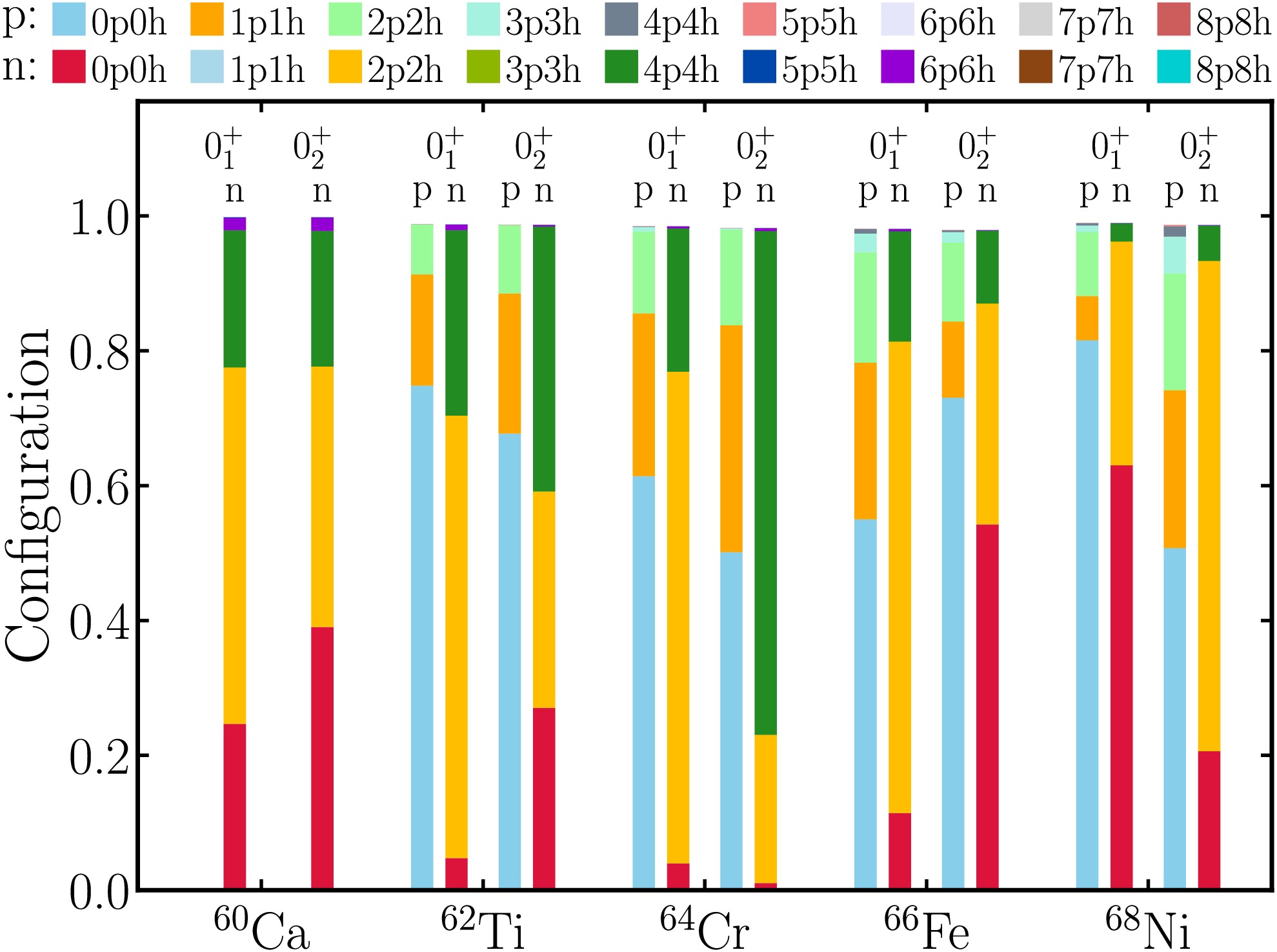
Figure 3. (color online) Proton and neutron particle-hole excitation probabilities for the ground state and the 02+ state of N = 40 isotones.
We performed analogous calculations for the N = 50 isotone chain to investigate shape coexistence in this region. The experimental information currently available for the N = 50 isotones remains limited and is essentially restricted to 78Ni, which therefore serves as a crucial benchmark. Recent measurements confirm that 78Ni exhibits the characteristic features of a doubly magic nucleus [29]. At the same time, a deformed rotational band has been identified in its low-lying spectrum, providing clear evidence for shape coexistence in this nucleus [29]. A variety of theoretical approaches have been applied to 78Ni [10, 29], including LSSM, MCSM, coupled-cluster, and VS-IMSRG methods. These studies, together with our own LSSM calculations, generally reproduce the excitation energies of the 21+ and 41+ states within a reasonable range of the experimental values. In our calculations, we also obtain a high-lying 02+ state in 78Ni. Compared with other LSSM calculations using the PFSDG-U interaction and with MCSM results, the corresponding 0+ state in those works appears about 700 keV lower than in our calculation. However, the calculated excitation energy of the 02+ state in 78Ni is not fully converged. LSSM calculations with a 4p–4h truncation yield
$ E(0_2^+) = 4.4 $ MeV. When the truncation is extended to 5p–5h, 6p–6h, and 7p–7h, the excitation energy of the 02+ state decreases to 3.96 MeV, 3.5 MeV, and 3.3 MeV, respectively. An exponential extrapolation of these truncation-dependent results yields an estimated asymptotic excitation energy of approximately$ 2.8 \pm 0.4 $ MeV, where the uncertainty reflects the dependence on the truncation range used in the extrapolation. Thus, the calculated energy of the 02+ state systematically decreases as the truncation space is enlarged. However, larger truncation spaces rapidly become computationally intractable and cannot be treated within the LSSM framework. Furthermore, we have verified that the many-body configurations of the ground state of 78Ni are nearly converged for the 6p–6h and 7p–7h truncations. In contrast, the calculated configurations of the 02+ state still show noticeable differences among the 5p–5h, 6p–6h, and 7p–7h truncations, indicating that this state is not fully converged. Nevertheless, the calculated wave functions consistently show that neutron 2p–2h excitations play a dominant role in the structure of the 02+ state.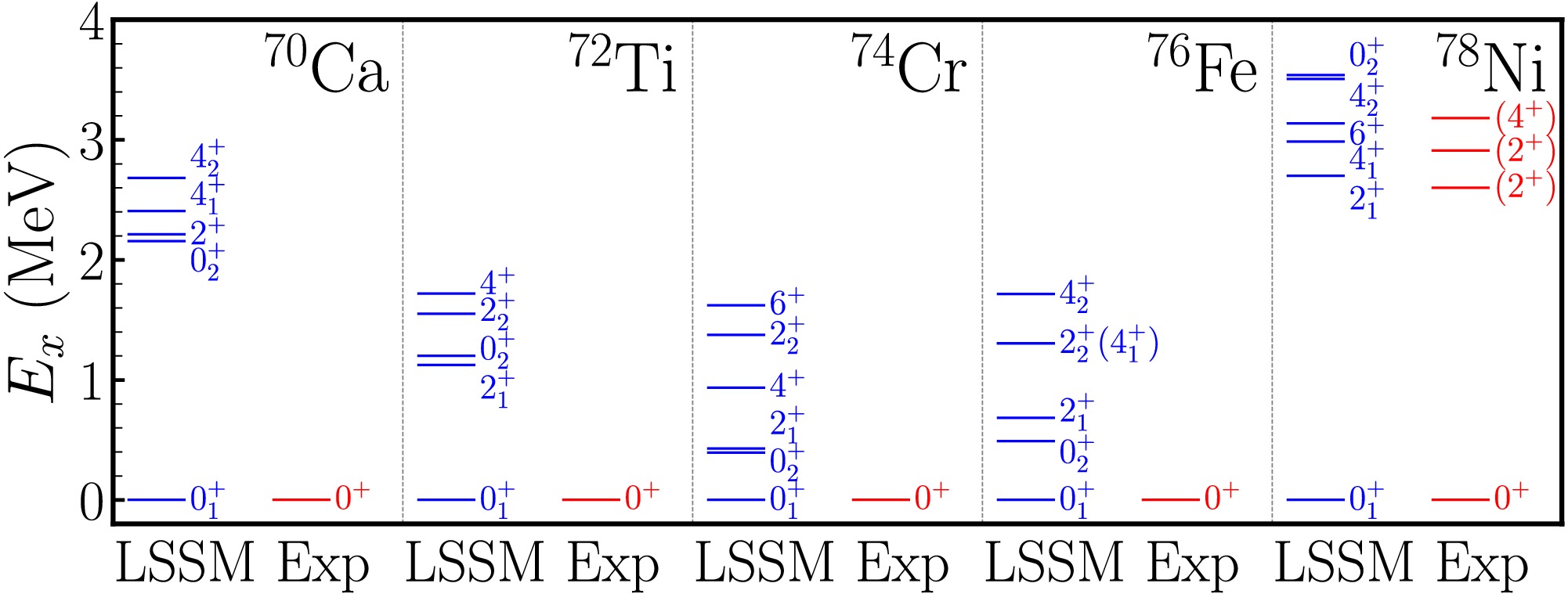
Figure 4. (color online) The calculated energy spectrum of the even-even isotones at N = 50, with proton numbers ranging from Z = 20 (Ca) to Z = 28 (Ni), is shown together with available experimental data [29].
Similar to the N = 40 isotones, the trends of
$ E(2_1^+) $ and$ E(0_2^+) $ for the N = 50 isotones exhibit parabolic systematics with a minimum at 74Cr, where$ E(2_1^+) = $ 427 keV and$ E(0_2^+) = $ 393 keV. These trends differ markedly from those obtained in LSSM calculations with the PFSDG-U interaction [10], which predict low-lying 02+ states in 70Ca, 76Fe, and 78Ni, but rigid prolate deformation (and thus no shape coexistence) in 72Ti and 74Cr. For 74Cr, we obtain$ B(E2;2_1^+\rightarrow0_1^+)=216.0\; e^2{\rm{fm}}^4 $ and$ B(E2;0_2^+\rightarrow2_1^+)= 808.6\; e^2{\rm{fm}}^4 $ . Experimental$ B(E2) $ data are currently unavailable for this very neutron-rich nucleus. The sizable calculated transition strengths indicate pronounced quadrupole collectivity, while the strong 02+–21+ E2 connection suggests substantial mixing among the low-lying collective structures. Together with the low excitation energies, these results further support the shape-coexistence interpretation for 74Cr and provide predictions for future experimental studies.Deviations in orbital occupancies along the N = 50 isotone chain are shown in Fig. 5. Both the ground state and the 02+ state exhibit complementary systematic trends. For protons, excitations increase from 70Ca to 78Ni, opposite to the pattern in the N = 40 isotone chain. In particular, the 78Ni ground state shows enhanced proton excitations relative to 76Fe, whereas in the N = 40 isotone chain the 68Ni ground state exhibits reduced proton excitation compared with 66Fe. Moreover, proton excitations are stronger in the 78Ni ground state than in the 68Ni ground state. For neutrons, the leading promotions are from
$ \nu0g_{9/2} $ orbitals to the$ \nu1d_{5/2,3/2} $ and$ \nu2s_{1/2} $ orbitals. Moving from 78Ni to 70Ca, neutron excitations in the ground states increase, peak at 74Cr, and then decrease, while those in the 02+ states follow the opposite trend. Consequently, sizable differences in configuration content between the ground state and the 02+ state are found for the N = 50 isotones (70Ca, 72Ti, 76Fe, and 78Ni), supporting the common occurrence of shape coexistence in this region.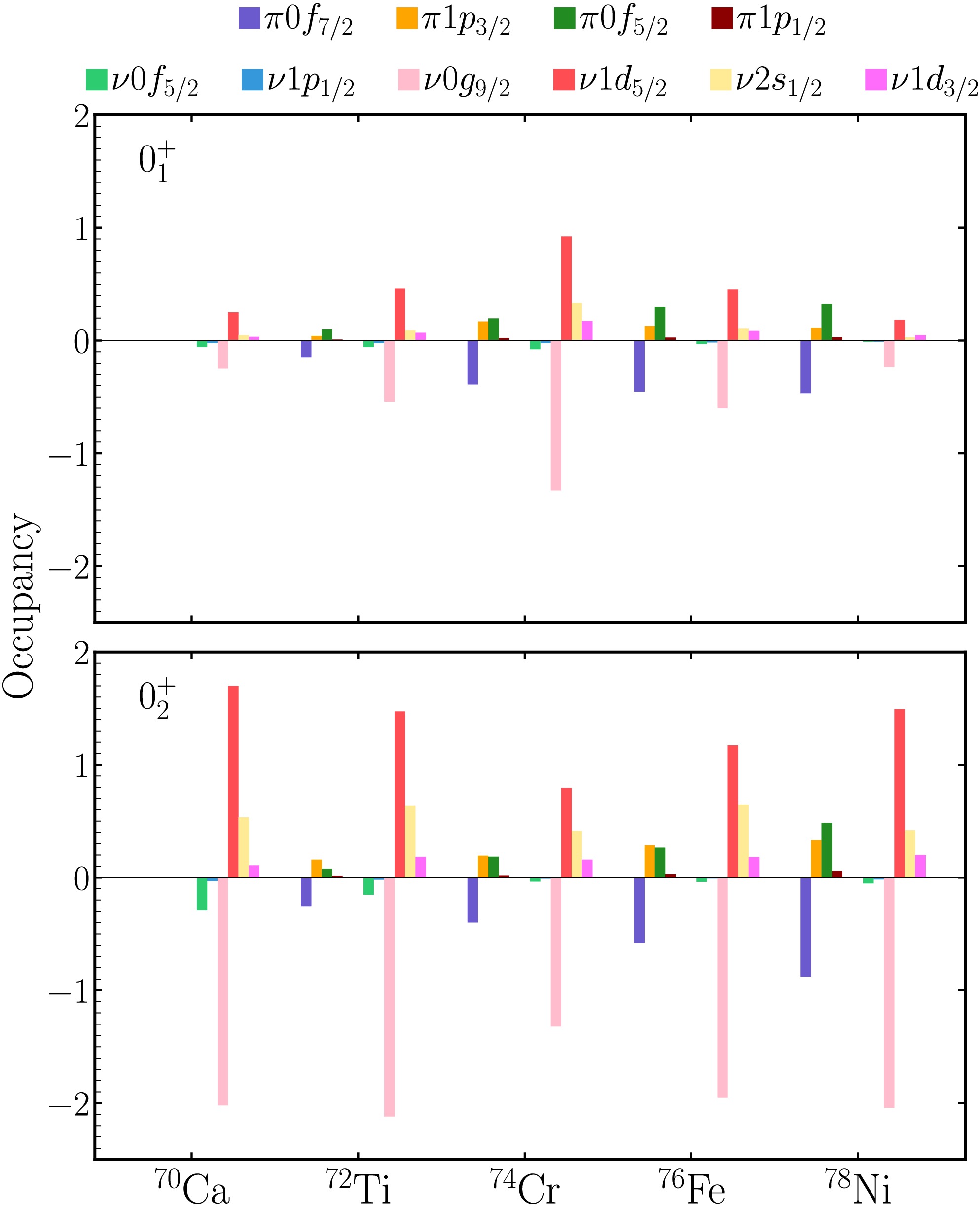
Figure 5. (color online) The calculated deviation of proton and neutron occupancy from the expected normal filling for the
$ 0_1^+ $ and 02+ states in even-even N = 50 isotones.A comparison with LSSM calculations using the PFSDG-U interaction [10] also reveals notable discrepancies in the average number of p-h excitations across the Z = 28 and N = 50 shell closures. Although the model spaces are not identical, comparing the average p-h excitations remains informative. For the 02+ state of 78Ni, our calculation gives about 1 proton excited across the Z = 28 closure and approximately 2 neutrons across the N = 50 closure. By contrast, LSSM calculations with the PFSDG-U interaction yield about 2.7 protons and 2.3 neutrons excited across these closures. Both the proton and neutron excitations are stronger in the LSSM calculations with the PFSDG-U interaction than in our LSSM calculations. For the 74Cr and 72Ti ground states, the same pattern is found for proton and neutron excitations across the closures. In particular, LSSM calculations with the PFSDG-U interaction predict stronger neutron excitation across the N = 50 closure, with values of 4.9 for 74Cr and 4.8 for 72Ti, compared with our results of 1.5 and 0.8, respectively.
For the N = 50 isotones, the proton and neutron particle-hole excitation probabilities for the ground state and the 02+ state are calculated and shown in Fig. 6. We have taken the Z = 28 and N = 50 shell closures as reference points for studying particle-hole excitations. Along the isotone chain from 78Ni to 70Ca, the average
$ mp-mh $ excitations in the ground states increase toward 74Cr, reach a maximum there, and then decrease toward 70Ca. Moreover, our calculations show that the ground states of 74Cr, 72Ti, and 70Ca are governed by neutron 0p-0h and 2p-2h configurations, whereas LSSM calculations with the PFSDG-U interaction predict dominant neutron 4p-4h configurations [10]. For the ground state of 76Fe, our calculation yields about 65% neutron 0p-0h and 20% neutron 2p-2h; in contrast, LSSM calculations with the PFSDG-U interaction give 21% neutron 0p-0h and 33% neutron 2p-2h.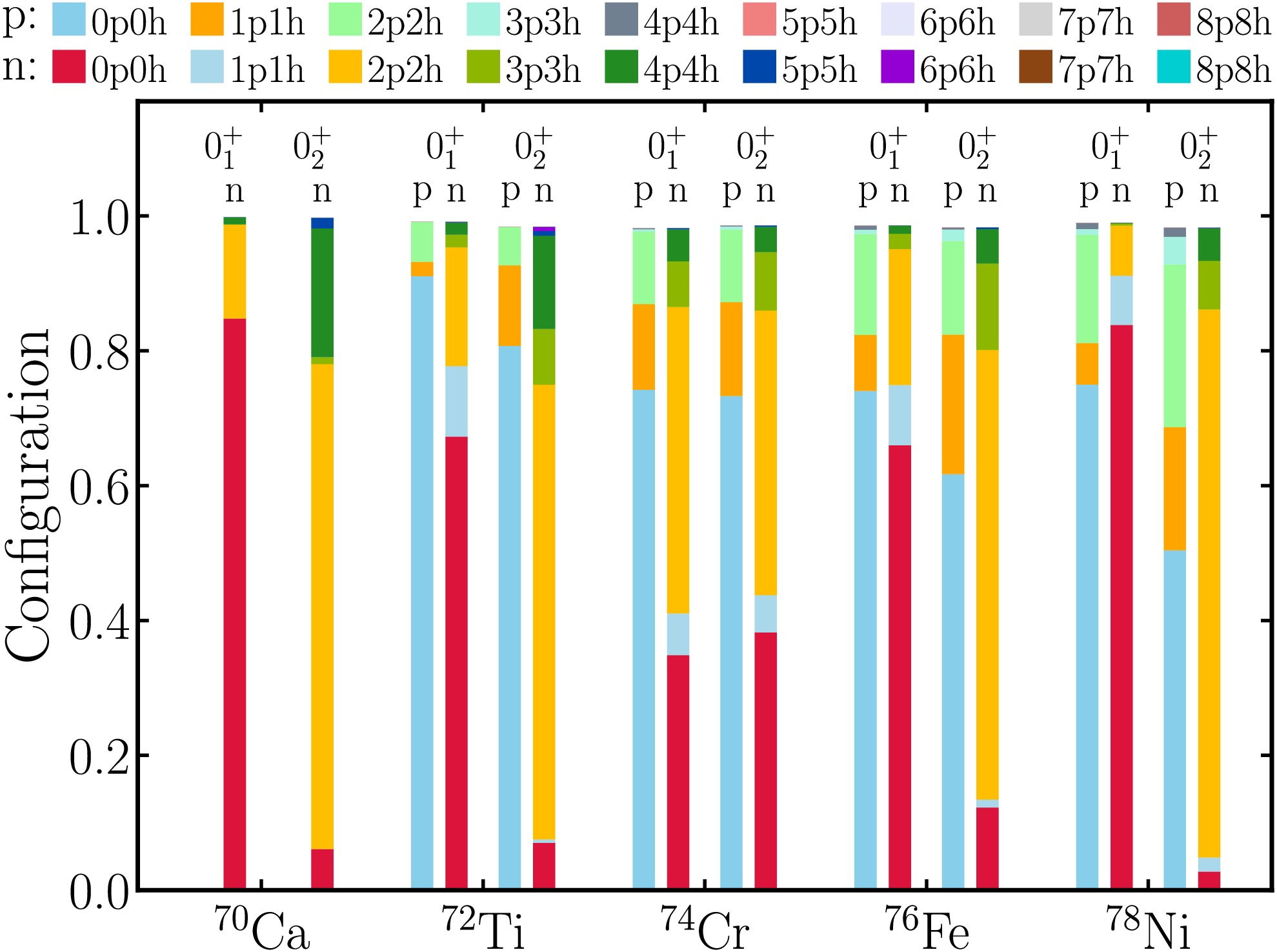
Figure 6. (color online) Proton and neutron particle-hole excitation probabilities for the ground and 02+ states of N = 50 isotones.
In the 02+ state, the proton
$ mp $ -$ mh $ excitations retain configurations similar to those of the ground state, but their strengths are noticeably enhanced in some nuclei (e.g., 76Fe and 78Ni). By contrast, the neutron$ mp $ -$ mh $ components of the 02+ states differ markedly from those of the ground state for most isotones, except in 74Cr, where the ground and 02+ states display nearly identical configuration mixing. Overall, our calculations show that the neutron component of the 02+ states is predominantly 2p-2h, with non-negligible$ 3p $ -$ 3h $ and 4p-4h configurations in all studied nuclei, except in 74Cr, where the probabilities of 2p-2h and 0p-0h configurations are comparable. Taken together, these systematics indicate 2p-2h-dominated shape coexistence in the 02+ states of the N = 50 isotones 70Ca, 72Ti, 74Cr, 76Fe, and 78Ni.Furthermore, we performed VS-IMSRG calculations using the chiral N3LO NN interaction supplemented with the N2LO 3Nlnl interaction [52]. The valence space adopted in these calculations is the same as that used with the PFSDG-U interaction above the 60Ca core. Our VS-IMSRG results indicate the presence of a low-lying 02+ state in 72Ti, 74Cr, and 76Fe. These results are consistent with our LSSM calculations but contrast with the LSSM results obtained using the PFSDG-U interaction.
Furthermore, we extended our LSSM to neutron-rich Ti, Cr, and Fe isotopes to investigate shell evolution, shape competition, and collective phenomena. We systematically calculated the low-lying states and neutron occupancies. The calculated excitation energies for the
$ 0_{1,2}^+ $ , 21+, 41+, and 61+ states in the neutron-rich Ti, Cr, and Fe isotopes (N = 38–52) are presented in Table 1, alongside available experimental data [30, 36, 48−50, 53, 55−57]. These calculations reproduce the systematics of the low-lying states in these isotopes, with the largest discrepancy relative to experimental data being approximately 460 keV for the 02+ state in 66Fe. In addition, for the Cr and Fe isotopes near N = 40, our results are in close agreement with LSSM calculations employing the LNPS interaction [30].01+ 21+ 41+ 61+ 02+ 22+ 60Ti Theo. 0 0.775 1.496 2.193 1.842 1.623 Expt. [53] 0 0.850 1.716 62Ti Theo. 0 0.726 1.411 2.061 2.386 1.905 Expt. [48] 0 0.683 1.506 64Ti Theo. 0 0.639 1.215 1.807 1.826 1.875 66Ti Theo. 0 0.681 1.31 1.861 2.095 1.939 68Ti Theo. 0 0.664 1.281 1.872 1.924 1.623 70Ti Theo. 0 0.721 1.463 1.936 1.475 1.403 72Ti Theo. 0 1.125 1.718 2.034 1.201 1.551 74Ti Theo. 0 0.538 1.184 1.867 1.476 1.317 62Cr Theo. 0 0.59 1.24 2.019 1.325 1.423 Expt. [54] 0 0.446 1.174 2.190 (1.379) (1.955) 64Cr Theo. 0 0.525 1.155 1.965 1.505 1.659 Expt. [49] 0 0.422 1.132 2.094 66Cr Theo. 0 0.362 0.855 1.515 1.844 1.926 Expt. [30] 0 0.386 1.069 68Cr Theo. 0 0.489 1.064 1.831 1.483 1.957 70Cr Theo. 0 0.437 0.960 1.684 1.444 1.67 72Cr Theo. 0 0.402 0.921 1.606 0.588 0.957 74Cr Theo. 0 0.427 0.933 1.621 0.393 1.374 76Cr Theo. 0 0.471 1.129 1.840 1.257 1.476 64Fe Theo. 0 0.73 1.755 2.397 1.291 1.516 Expt. [55, 56] 0 0.746 1.763 2.842 (1.443) 66Fe Theo. 0 0.705 1.604 2.340 1.701 1.415 Expt. [36, 50] 0 0.573 1.407 1.414 1.881 68Fe Theo. 0 0.653 1.450 2.167 1.680 1.703 Expt. [23, 50] 0 0.522 (1.381) 70Fe Theo. 0 0.577 1.332 1.993 2.176 1.852 Expt. [57] 0 0.477 1.334 72Fe Theo. 0 0.493 1.129 1.765 2.344 2.126 Expt. [30] 0 0.520 1.334 74Fe Theo. 0 0.531 1.380 2.307 1.971 2.122 76Fe Theo. 0 0.684 1.305 1.93 0.49 1.305 78Fe Theo. 0 0.49 1.267 1.664 0.805 1.079 Table 1. Our LSSM calculations for the low-lying states of neutron-rich Ti, Cr, and Fe isotopes are presented together with the available experimental data.
The energy of the 02+ state exhibits significant variations with increasing neutron number across the Ti, Cr, and Fe isotopic chains. It reaches a maximum of 2386 keV in 62Ti. These trends, together with additional low-lying 02+ states in 74Cr and 76Fe at N = 50, indicate pervasive shape coexistence across this region.
To further investigate shape coexistence, we calculated the neutron occupancies for the ground state and the shape-coexisting 02+ state along the Ti, Cr, and Fe isotopic chains. The deviations of the valence-neutron occupancies from a standard reference are presented in Fig. 7. Near the centers of the N = 40 and N = 50 IOIs, significant neutron excitations across these shell gaps occur in both the ground and 02+ states. For nuclei midway between N = 40 and N = 50, deformation persists. Although the occupancy deviations between our LSSM and conventional SM calculations are not large, strong configuration mixing between the
$ \nu 0f_{5/2} $ ,$ \nu 0g_{9/2} $ , and$ \nu 1d_{5/2} $ orbitals is still evident. Furthermore, the deviations in neutron occupancy are generally larger for the 02+ state than for the ground state in the isotopes between N = 40 and N = 50, with 68Ti as the only exception.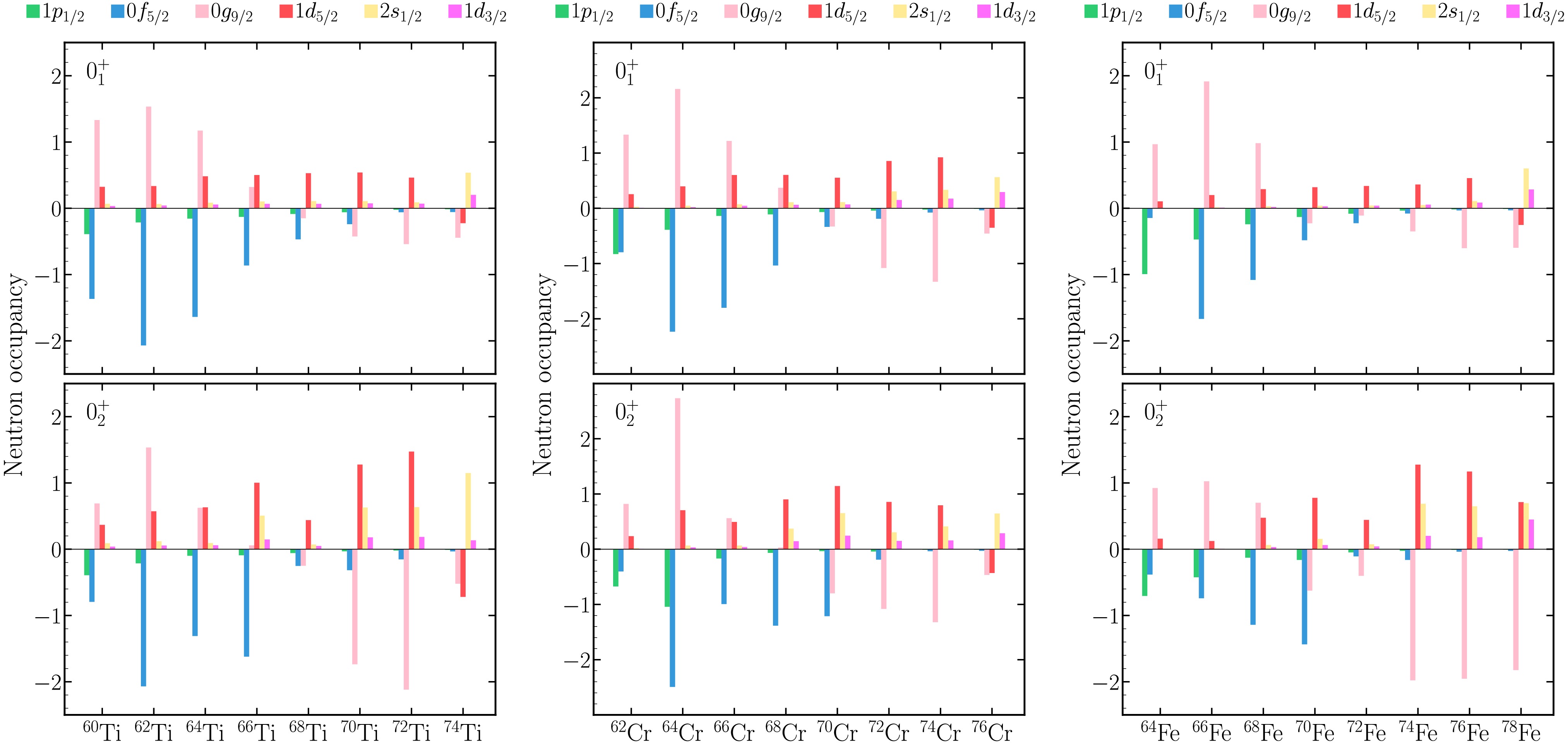
Figure 7. (color online) Calculated deviation of neutron occupancy from the expected normal filling for the
$ 0_1^+ $ and$ 0_2^+ $ states in the even-even isotopic chains of Ti, Cr, and Fe that span neutron numbers N = 38 to 52. -
We present LSSM calculations of shape coexistence in neutron-rich nuclei around the N = 40 and N = 50 islands of inversion. The calculations reproduce the available benchmarks where data exist—most notably the first 2+ energy of 78Ni and the well-known coexistence features near 68Ni. The spectroscopy identifies candidate shape-coexisting states, while the occupation and particle-hole systematics provide microscopic support for interpreting these states in terms of competing normal and intruder-like configurations. Along the N = 40 isotone chain (60Ca–68Ni),
$ E(0_2^+) $ tracks$ E(2_1^+) $ with maximal collectivity at 64Cr. Particle-hole excitation calculations corroborate these trends; for example, the 02+ state of 64Cr is dominated by$ 4p - 4h $ (~80%), whereas the ground state is predominantly$ 2p - 2h $ . Along the N = 50 isotone chain (70Ca–78Ni), both$ E(2_1^+) $ and$ E(0_2^+) $ evolve parabolically from 78Ni to 70Ca, with a common minimum at 74Cr. Within this chain, the 02+ states are predominantly$ 2p - 2h $ with modest$ 3p - 3h/4p - 4h $ admixtures; 74Cr is a notable exception in which the$ 0p - 0h $ and$ 2p - 2h $ components are comparable. These results contrast quantitatively with LSSM calculations using the PFSDG-U interaction. When extended to neutron-rich Ti, Cr, and Fe isotopes ($ N=38-52 $ ), our LSSM reproduces the global trends in low-lying levels, with the largest deviation of$ \sim 460 $ keV (for the 66Fe 02+ state). The 02+ energy varies rapidly—peaking at 62Ti and reaching minima at N = 50 in 74Cr and 76Fe.
Large scale shell model calculations for the shape coexistence at N = 40 and N = 50 island of inversion
- Received Date: 2026-07-31
- Available Online: 2027-01-01
Abstract: Shape coexistence—the competition between near-degenerate spherical and deformed configurations—is a pervasive feature of neutron-rich nuclei in and around the islands of inversion. Using a large-scale shell model (LSSM) with a realistic effective interaction, we systematically compute low-lying spectra, average orbital occupations, and particle–hole (p–h) excitation probabilities to investigate candidate shape-coexistence states in even–even N = 40 and N = 50 isotones. Where data are available, our LSSM reproduces the observed systematics, including the benchmark $ E(2_1^+) $ in 78Ni and the characteristic shape-coexisting structure near 68Ni. Along the N = 40 chain, $ E(0_2^+) $ closely tracks $ E(2_1^+) $, with a minimum at 64Cr indicating maximal collectivity. Along the N = 50 chain, both $ E(2_1^+) $ and $ E(0_2^+) $ follow a parabolic evolution from 78Ni to 70Ca, with a common minimum at 74Cr; microscopically, the 02+ states are predominantly $ 2p - 2h $ (with modest $ 3p - 3h/4p - 4h $ admixtures), while 74Cr is a controlled exception, exhibiting comparable $ 0p - 0h $ and $ 2p - 2h $ components. When the survey is extended to neutron-rich Ti, Cr, and Fe isotopes, the LSSM captures the pronounced variation of $ E(0_2^+) $, peaking at 62Ti and reaching minima at N = 50 (74Cr, 76Fe), suggesting widespread shape coexistence and its evolution in these regions.



 DownLoad: