Just Accepted
Display Method:

Published:
, doi: 10.1088/1674-1137/ae5a88


Abstract:
We investigate the pseudopotential of hybrid mesons in a holographic anisotropic background within the AdS/CFT correspondence. Hybrid states are modeled by introducing a defect, and we analyze the associated force-balance condition in the string configuration. From this setup, we derive the balance equation and compute key physical quantities, including the separation distance, pseudopotential, and binding energy of the hybrid mesons. We find that increasing the anisotropy parameter a decreases the separation distance for both ground and excited states. However, while the ground-state potential decreases, the pseudopotential of the hybrid state increases. Additionally, the pseudopotential of hybrid mesons exhibits significant sensitivity to variations in the angular parameter α.
We investigate the pseudopotential of hybrid mesons in a holographic anisotropic background within the AdS/CFT correspondence. Hybrid states are modeled by introducing a defect, and we analyze the associated force-balance condition in the string configuration. From this setup, we derive the balance equation and compute key physical quantities, including the separation distance, pseudopotential, and binding energy of the hybrid mesons. We find that increasing the anisotropy parameter a decreases the separation distance for both ground and excited states. However, while the ground-state potential decreases, the pseudopotential of the hybrid state increases. Additionally, the pseudopotential of hybrid mesons exhibits significant sensitivity to variations in the angular parameter α.


Published:
, doi: 10.1088/1674-1137/ae5b56
Abstract:
In this study, we investigate the influence of the parameters of ModMax nonlinear electrodynamics and perfect-fluid dark matter (PFDM) on the geometry and physical properties of charged black holes. A static, spherically symmetric solution to the Einstein field equations describing a charged ModMax black hole immersed in a PFDM background is obtained. The motion of charged test particles in this spacetime is analyzed in detail, including the effective potential, the conditions for stable and unstable circular orbits, and the radius of the innermost stable circular orbit (ISCO). It is shown that the ModMax parameter γ shifts the orbits outward for repulsive Coulomb interactions and inward for attractive forces, while increasing PFDM enhances gravitational attraction, shifting the ISCO inward. Furthermore, the interactions and collisions of charged particles near the event horizon are examined. The center-of-mass energy\begin{document}${\cal{E}}_{cm}$\end{document}
In this study, we investigate the influence of the parameters of ModMax nonlinear electrodynamics and perfect-fluid dark matter (PFDM) on the geometry and physical properties of charged black holes. A static, spherically symmetric solution to the Einstein field equations describing a charged ModMax black hole immersed in a PFDM background is obtained. The motion of charged test particles in this spacetime is analyzed in detail, including the effective potential, the conditions for stable and unstable circular orbits, and the radius of the innermost stable circular orbit (ISCO). It is shown that the ModMax parameter γ shifts the orbits outward for repulsive Coulomb interactions and inward for attractive forces, while increasing PFDM enhances gravitational attraction, shifting the ISCO inward. Furthermore, the interactions and collisions of charged particles near the event horizon are examined. The center-of-mass energy


Published:
, doi: 10.1088/1674-1137/ae5590
Abstract:
Using the pinch technique, we compute the one-loop vertices of weak interactions in the B-LSSM and incorporate their pinch contributions into the gauge boson self-energies. Compared to the definitions of the S, T, and U parameters in the Standard Model based on the\begin{document}$SU(2)_L \otimes U(1)_Y$\end{document}
Using the pinch technique, we compute the one-loop vertices of weak interactions in the B-LSSM and incorporate their pinch contributions into the gauge boson self-energies. Compared to the definitions of the S, T, and U parameters in the Standard Model based on the


Published:
, doi: 10.1088/1674-1137/ae5044
Abstract:
The Galactic Center GeV Excess (GCE) remains a compelling but enigmatic signal from the inner region of our galaxy. Muonphilic dark matter (DM), which couples exclusively to muons via a new mediator, provides a viable explanation for the GCE and relic density while naturally evading constraints from direct detection, collider searches and other multi-messenger observations. Based on the viable non-resonant parameter space identified in previous global fits, we perform a comprehensive study exploring the prospects for discovering such muonphilic DM in the context of a future 3 TeV muon collider, focusing on simplified models with a\begin{document}$Z_2$\end{document} \begin{document}$\mu^{+}\mu^{-}\gamma$\end{document} \begin{document}$ 95 $\end{document}
The Galactic Center GeV Excess (GCE) remains a compelling but enigmatic signal from the inner region of our galaxy. Muonphilic dark matter (DM), which couples exclusively to muons via a new mediator, provides a viable explanation for the GCE and relic density while naturally evading constraints from direct detection, collider searches and other multi-messenger observations. Based on the viable non-resonant parameter space identified in previous global fits, we perform a comprehensive study exploring the prospects for discovering such muonphilic DM in the context of a future 3 TeV muon collider, focusing on simplified models with a


Published:
Abstract:
An analysis of experimental data on measurements of the resonant and fine structure of the β-decay strength function\begin{document}$S_{\beta}(E)$\end{document} \begin{document}$S_{\beta}(E)$\end{document} \begin{document}$S_{\beta}(E)$\end{document} \begin{document}$E_{\text {GTR}}{-}E_{\text {IAR}})$\end{document} \begin{document}$SU(4)$\end{document}
An analysis of experimental data on measurements of the resonant and fine structure of the β-decay strength function


Published:
, doi: 10.1088/1674-1137/ae4dd8
Abstract:
We investigate the propagating modes of New General Relativity (NGR) in second-order linear perturbations in the Lagrangian density (first-order in field equations). The Dirac-Bergmann analysis has revealed a violation of local Lorentz invariance in NGR. We review the recent status of NGR, considering the results of its Dirac-Bergmann analysis. We then reconsider the vierbein perturbation framework and identify the origin of each perturbation field in the vierbein field components. This identification is mandatory for adequately fixing gauges while guaranteeing consistency with the invariance ensured by the Dirac-Bergmann analysis. We find that the spatially flat gauge is adequate for analyzing a theory with the violation of local Lorentz invariance. Based on the established vierbein perturbative framework, introducing a real scalar field as matter, we perform a second-order perturbative analysis of NGR with respect to tensor, scalar, pseudo-scalar, and vector and pseudo-vector modes. We reveal the possible propagating modes of each type of NGR. In particular, we find that Type 3 has stable five propagating modes, i.e., tensor, scalar, and vector modes, compared to five non-linear degrees of freedom, which results in its Dirac-Bergmann analysis; The linear perturbation theory of Type 3 is preferable for applications to cosmology. Finally, we discuss our results in comparison to previous related work and conclude this study.
We investigate the propagating modes of New General Relativity (NGR) in second-order linear perturbations in the Lagrangian density (first-order in field equations). The Dirac-Bergmann analysis has revealed a violation of local Lorentz invariance in NGR. We review the recent status of NGR, considering the results of its Dirac-Bergmann analysis. We then reconsider the vierbein perturbation framework and identify the origin of each perturbation field in the vierbein field components. This identification is mandatory for adequately fixing gauges while guaranteeing consistency with the invariance ensured by the Dirac-Bergmann analysis. We find that the spatially flat gauge is adequate for analyzing a theory with the violation of local Lorentz invariance. Based on the established vierbein perturbative framework, introducing a real scalar field as matter, we perform a second-order perturbative analysis of NGR with respect to tensor, scalar, pseudo-scalar, and vector and pseudo-vector modes. We reveal the possible propagating modes of each type of NGR. In particular, we find that Type 3 has stable five propagating modes, i.e., tensor, scalar, and vector modes, compared to five non-linear degrees of freedom, which results in its Dirac-Bergmann analysis; The linear perturbation theory of Type 3 is preferable for applications to cosmology. Finally, we discuss our results in comparison to previous related work and conclude this study.
Published:
, doi: 10.1088/1674-1137/ae4a0c
Abstract:
We present an updated analysis of the angular distribution for\begin{document}$ \psi(3686) \to p\bar{p} $\end{document} \begin{document}$ 1+\alpha\cos^2\theta $\end{document} \begin{document}$ \psi(3686) $\end{document} \begin{document}$ \cos\theta $\end{document} \begin{document}$ \psi(3686)\to p\bar{p} $\end{document} \begin{document}$ \alpha = 1.00 \pm 0.03 $\end{document} \begin{document}$ \sin(2\phi) $\end{document}
We present an updated analysis of the angular distribution for


Published:
Abstract:
In this work, we compute the next-to-leading-order QCD corrections to the Dirac electromagnetic form factors of the Σ hyperons within the hard-collinear factorization framework at leading power. The corresponding short-distance coefficient functions are extracted from the relevant seven-point partonic correlation functions. We find that the one-loop radiative corrections to the leading-twist hard-scattering contributions are numerically significant over a broad range of momentum transfer. Combining the perturbatively calculated hard kernels with nonperturbative Σ distribution amplitudes determined from lattice QCD, we present state-of-the-art theoretical predictions for the Σ hyperon electromagnetic form factors.
In this work, we compute the next-to-leading-order QCD corrections to the Dirac electromagnetic form factors of the Σ hyperons within the hard-collinear factorization framework at leading power. The corresponding short-distance coefficient functions are extracted from the relevant seven-point partonic correlation functions. We find that the one-loop radiative corrections to the leading-twist hard-scattering contributions are numerically significant over a broad range of momentum transfer. Combining the perturbatively calculated hard kernels with nonperturbative Σ distribution amplitudes determined from lattice QCD, we present state-of-the-art theoretical predictions for the Σ hyperon electromagnetic form factors.


Published:
Abstract:
We performed a next-to-leading-order (NLO) QCD sum rules analysis of the\begin{document}$1^{-+}$\end{document} \begin{document}$1.7\,\text{GeV}$\end{document} \begin{document}$1^{-+}$\end{document} \begin{document}$2.0\,\text{GeV}$\end{document} \begin{document}$\pi_{1}(2015)$\end{document} \begin{document}$\pi_{1}(2015)$\end{document} \begin{document}$\pi_{1}(1400)$\end{document}
We performed a next-to-leading-order (NLO) QCD sum rules analysis of the


Published:
, doi: 10.1088/1674-1137/ae457a
Abstract:
In this paper, we investigate the quantum gravitational corrections to the thermodynamical quantities of Reissner-Nordstr?m black holes within the framework of effective field theory. The effective action originates from integrating out massless particles, including gravitons, at the one-loop level. We perform a complete thermodynamic analysis for both non-extremal and extremal black holes and are mainly concerned with the shift in the charge-to-mass ratio\begin{document}$ q/M$\end{document} \begin{document}$ q/M>1$\end{document}
In this paper, we investigate the quantum gravitational corrections to the thermodynamical quantities of Reissner-Nordstr?m black holes within the framework of effective field theory. The effective action originates from integrating out massless particles, including gravitons, at the one-loop level. We perform a complete thermodynamic analysis for both non-extremal and extremal black holes and are mainly concerned with the shift in the charge-to-mass ratio
Published:
Abstract:
This work examines the\begin{document}$ h\to Z\gamma $\end{document} \begin{document}$ h\to\gamma\gamma $\end{document} \begin{document}$ U(1)' $\end{document} \begin{document}$ Z' $\end{document} \begin{document}$ h \to Z\gamma $\end{document} \begin{document}$ f\bar{f}Z $\end{document} \begin{document}$ b\to s\ell^+\ell^- $\end{document} \begin{document}$ m_{H^\pm}>200 $\end{document} \begin{document}$ \lambda_{hH^+H^-}<0 $\end{document} \begin{document}$ 1\sigma $\end{document} \begin{document}$ \mu_{\gamma\gamma} $\end{document} \begin{document}$ f\bar{f}Z $\end{document} \begin{document}$ \mathcal{Q}_{tL} $\end{document} \begin{document}$ \mathcal{Q}_{tR} $\end{document} \begin{document}$ b\to s\ell^+\ell^- $\end{document} \begin{document}$ 14\% $\end{document} \begin{document}$ \mu_{Z\gamma} $\end{document}
This work examines the


Published:
Abstract:
We assess the impact of future measurements of deeply virtual Compton scattering (DVCS) off protons using the planned detector at the Electron-Ion Collider in China (EicC), proposed as an upgrade to the High Intensity heavy-ion Accelerator Facility (HIAF). We develop a neural-network architecture to flexibly parameterize the Compton Form Factors (CFFs), extrapolate reliably into unmeasured kinematic regions, and provide robust uncertainty estimates through the replica method. The framework is fitted to the available worldwide DVCS data using the\begin{document}$ {\mathrm{Gepard}}$\end{document}
We assess the impact of future measurements of deeply virtual Compton scattering (DVCS) off protons using the planned detector at the Electron-Ion Collider in China (EicC), proposed as an upgrade to the High Intensity heavy-ion Accelerator Facility (HIAF). We develop a neural-network architecture to flexibly parameterize the Compton Form Factors (CFFs), extrapolate reliably into unmeasured kinematic regions, and provide robust uncertainty estimates through the replica method. The framework is fitted to the available worldwide DVCS data using the


Published:
Abstract:
We investigate a negative potential-induced scalarization of the Einstein-Euler-Heisenberg (EEH) black hole in the EEH-scalar theory, characterized by mass M, Euler-Heisenberg parameter μ and magnetic charge q. In the regime\begin{document}$ \mu>\mu_{{\rm{max}}} = 0.019 $\end{document} \begin{document}$ M=1/2 $\end{document} \begin{document}$ q/M \gt 1 $\end{document} \begin{document}$ q>0 $\end{document} \begin{document}$ q<1/2 $\end{document} \begin{document}$ q>1/2 $\end{document}
We investigate a negative potential-induced scalarization of the Einstein-Euler-Heisenberg (EEH) black hole in the EEH-scalar theory, characterized by mass M, Euler-Heisenberg parameter μ and magnetic charge q. In the regime


Published:
Abstract:
In this study, we investigate the dynamics of test particles in the spacetime of a static, spherically symmetric black hole (BH), illustrated within the non-local gravity models. In this case, after presenting the BH geometries and horizon structures, we examine the motion of particles by analyzing the effective potential, the innermost stable circular orbits (ISCOs), and the corresponding effective force. Also, we then extend the study to small perturbations of circular orbits, exploring harmonic oscillations characterized by the frequencies measured both by local observers and by distant ones, as well as the periastron precession effects. Particular attention is devoted to the interplay between the non-local gravity corrections and the stability properties of geodesics. In this case, we analyze the center-of-mass energy (CME) of colliding particles near the event horizon and show the influence of BH parameters on energy extraction processes. In this context, the results show how non-local modifications of gravity affect the standard predictions of BH structure, orbital stability, and high-energy particle dynamics, with possible implications for astrophysical observations and theoretical models of strong gravity. This study examines the differences between the inverse electrodynamics BH and the Schwarzschild BH configuration, showing how additional parameters influence the dynamics and stability of the test particles.
In this study, we investigate the dynamics of test particles in the spacetime of a static, spherically symmetric black hole (BH), illustrated within the non-local gravity models. In this case, after presenting the BH geometries and horizon structures, we examine the motion of particles by analyzing the effective potential, the innermost stable circular orbits (ISCOs), and the corresponding effective force. Also, we then extend the study to small perturbations of circular orbits, exploring harmonic oscillations characterized by the frequencies measured both by local observers and by distant ones, as well as the periastron precession effects. Particular attention is devoted to the interplay between the non-local gravity corrections and the stability properties of geodesics. In this case, we analyze the center-of-mass energy (CME) of colliding particles near the event horizon and show the influence of BH parameters on energy extraction processes. In this context, the results show how non-local modifications of gravity affect the standard predictions of BH structure, orbital stability, and high-energy particle dynamics, with possible implications for astrophysical observations and theoretical models of strong gravity. This study examines the differences between the inverse electrodynamics BH and the Schwarzschild BH configuration, showing how additional parameters influence the dynamics and stability of the test particles.


Published:
, doi: 10.1088/1674-1137/ae4578
Abstract:
Two\begin{document}$ 7\alpha $\end{document} \begin{document}$ ^{28}\mathrm{Si} $\end{document} \begin{document}$ ^{28}\mathrm{Si} $\end{document}
Two


Published:
, doi: 10.1088/1674-1137/ae50e5
Abstract:
In this current work, we shed light on the unified approach to both dark energy and dark matter via the generalized Chaplygin gas model in symmetric teleparallel gravity (STGR). We have employed the equation of state provided by the generalized Chaplygin gas, which naturally arises in string theory, tachyonic field theory, and Randall-Sundrum type brane world solutions. We show that such a generalized Chaplygin gas can not only provide a lucrative candidate for dark energy but also a viable candidate for dark matter via Bose-Einstein Condensation (BEC). We have also taken into account the interaction between dark matter and dark energy to provide a more realistic perspective. We performed MCMC analysis with combined Hubble and Pantheon data sets. We have also performed the Om diagnostics and the\begin{document}$ r-s $\end{document}
In this current work, we shed light on the unified approach to both dark energy and dark matter via the generalized Chaplygin gas model in symmetric teleparallel gravity (STGR). We have employed the equation of state provided by the generalized Chaplygin gas, which naturally arises in string theory, tachyonic field theory, and Randall-Sundrum type brane world solutions. We show that such a generalized Chaplygin gas can not only provide a lucrative candidate for dark energy but also a viable candidate for dark matter via Bose-Einstein Condensation (BEC). We have also taken into account the interaction between dark matter and dark energy to provide a more realistic perspective. We performed MCMC analysis with combined Hubble and Pantheon data sets. We have also performed the Om diagnostics and the


Published:
Abstract:
Experiments with the 48Ca and 54Cr induced reactions were performed at the gas-filled recoil separator SHANS2 (Spectrometer for Heavy Atoms and Nuclear Structure-2) of the China Accelerator Facility for superheavy Elements (CAFE2). The isotopic distributions of nuclei produced in the reactions 48Ca +243 Am, 54Cr +243 Am, and 54Cr +238 U were investigated. Bombardments were conducted at the energies near the respective Coulomb barriers, with the SHANS2 magnetic rigidities set to collect fusion-evaporation residues. α-decay spectroscopy was employed to identify products, revealing 58 different isotopes in these experiments. The analysis indicates that the distribution of nuclides produced in different reactions exhibits clear systematic trends. Based on their mass distributions, these nuclei were attributed to the products from the quasi-fission (QF) process. In addition, several short-lived fission events were identified and attributed to the fission isomers near the target.
Experiments with the 48Ca and 54Cr induced reactions were performed at the gas-filled recoil separator SHANS2 (Spectrometer for Heavy Atoms and Nuclear Structure-2) of the China Accelerator Facility for superheavy Elements (CAFE2). The isotopic distributions of nuclei produced in the reactions 48Ca +243 Am, 54Cr +243 Am, and 54Cr +238 U were investigated. Bombardments were conducted at the energies near the respective Coulomb barriers, with the SHANS2 magnetic rigidities set to collect fusion-evaporation residues. α-decay spectroscopy was employed to identify products, revealing 58 different isotopes in these experiments. The analysis indicates that the distribution of nuclides produced in different reactions exhibits clear systematic trends. Based on their mass distributions, these nuclei were attributed to the products from the quasi-fission (QF) process. In addition, several short-lived fission events were identified and attributed to the fission isomers near the target.


Published:
Abstract:
We extract the non-perturbative Heavy Quark Effective Theory (HQET) parameters from the inclusive semi-leptonic decay\begin{document}$ \Lambda_c^+ \to X e^+ \nu_e $\end{document} \begin{document}$ \Lambda_c^+ $\end{document} \begin{document}$ e^+e^- $\end{document} \begin{document}$ \Lambda_c^+ $\end{document} \begin{document}$ \Lambda_c^+ $\end{document} \begin{document}$ \mu_\pi^2(\Lambda_c^+) $\end{document} \begin{document}$ \rho_D^3(\Lambda_c^+) $\end{document}
We extract the non-perturbative Heavy Quark Effective Theory (HQET) parameters from the inclusive semi-leptonic decay


Published:
, doi: 10.1088/1674-1137/ae4a08
Abstract:
This study investigates the ultraviolet realization of semileptonic four-fermion operator\begin{document}$ O_{ledq}^{\alpha \beta 11} $\end{document} \begin{document}$ C_{ledq}^{2211}/\Lambda^2< $\end{document} \begin{document}$ (12.3\; \text{TeV})^{-2} $\end{document} \begin{document}$ C_{ledq}^{1211}/\Lambda^2< \left(2.2\times 10^3\; \text{TeV} \right)^{-2} $\end{document} \begin{document}$ 2\; \text{TeV} $\end{document}
This study investigates the ultraviolet realization of semileptonic four-fermion operator


Published:
Abstract:
We present a comprehensive bottom-up analysis of lepton mass and mixing based on the non-holomorphic\begin{document}$A_{4}$\end{document} \begin{document}$\pm4$\end{document} \begin{document}$\pm2$\end{document} \begin{document}$N=3$\end{document} \begin{document}$A_{4}$\end{document}
We present a comprehensive bottom-up analysis of lepton mass and mixing based on the non-holomorphic


Published:
, doi: 10.1088/1674-1137/ad8ec2
Abstract:
The direct CP asymmetry in the weak decay process of hadrons is commonly attributed to the weak phase of the CKM matrix and the indeterminate strong phase. We propose a method to generate a significant phase difference through the interference between ρ and ω mesons, taking into account the G-parity allowed decay process of\begin{document}$\omega \rightarrow \pi^{+}\pi^{-}\pi^{0}$\end{document} ![]()
![]()
\begin{document}$\rho^{0} \rightarrow \pi^{+}\pi^{-}\pi^{0}$\end{document} ![]()
![]()
The direct CP asymmetry in the weak decay process of hadrons is commonly attributed to the weak phase of the CKM matrix and the indeterminate strong phase. We propose a method to generate a significant phase difference through the interference between ρ and ω mesons, taking into account the G-parity allowed decay process of


Published:
, doi: 10.1088/1674-1137/ae4329
Abstract:
Nuclear level density (NLD) plays a crucial role in describing the statistical properties of excited nuclei and is a key input for models of compound nuclear reactions, such as those used in nuclear astrophysics and reactor physics. In this work, we construct microscopic nuclear level densities for Sn isotopes by combining single-particle spectra, pairing correlations, and deformation parameters from relativistic Hartree–Bogoliubov (RHB) calculations with the combinatorial method. We examine the energy dependence and isotopic systematics of the calculated level densities. In particular, we analyze their variation with excitation energy and neutron number, and compare them to available experimental data, including cumulative low-lying levels and s-wave neutron resonance spacings (\begin{document}$ D_0 $\end{document} \begin{document}$ (n,\gamma) $\end{document} 55 ]. Our results demonstrate that RHB-based nuclear level densities provide a reliable microscopic framework for describing Sn isotopic level densities and accurately predicting \begin{document}$ (n,\gamma) $\end{document}
Nuclear level density (NLD) plays a crucial role in describing the statistical properties of excited nuclei and is a key input for models of compound nuclear reactions, such as those used in nuclear astrophysics and reactor physics. In this work, we construct microscopic nuclear level densities for Sn isotopes by combining single-particle spectra, pairing correlations, and deformation parameters from relativistic Hartree–Bogoliubov (RHB) calculations with the combinatorial method. We examine the energy dependence and isotopic systematics of the calculated level densities. In particular, we analyze their variation with excitation energy and neutron number, and compare them to available experimental data, including cumulative low-lying levels and s-wave neutron resonance spacings (


Published:
Abstract:
We investigate the steady, axisymmetric, force-free magnetosphere of Kerr–Sen black hole (BH) within the framework of the Einstein–Maxwell–dilaton–axion (EMDA) theory. By perturbatively solving the nonlinear Grad–Shafranov (GS) equation, we determine the magnetic field configuration and quantify the influence of the dilaton parameter r2 on the energy extraction rate and radiative efficiency. Our results show that both the energy extraction power and the radiative efficiency increase with r2, exceeding those of the standard Kerr BH, whereas the extraction efficiency remain consistent with the Kerr case. In addition, we perform χ2 statistical analysis using observational data from six binary BH systems, which indicates that the Kerr BH currently provides a better fit for bulk Lorentz factors Γ = 2 and 5.
We investigate the steady, axisymmetric, force-free magnetosphere of Kerr–Sen black hole (BH) within the framework of the Einstein–Maxwell–dilaton–axion (EMDA) theory. By perturbatively solving the nonlinear Grad–Shafranov (GS) equation, we determine the magnetic field configuration and quantify the influence of the dilaton parameter r2 on the energy extraction rate and radiative efficiency. Our results show that both the energy extraction power and the radiative efficiency increase with r2, exceeding those of the standard Kerr BH, whereas the extraction efficiency remain consistent with the Kerr case. In addition, we perform χ2 statistical analysis using observational data from six binary BH systems, which indicates that the Kerr BH currently provides a better fit for bulk Lorentz factors Γ = 2 and 5.


IF: 3.1
Monthly issued, founded in 1977
Sponsored by:
ISSN 1674-1137 CN 11-5641/O4
Original research articles, Ietters and reviews Covering theory and experiments in the fieids of
- Particle physics
- Nuclear physics
- Particle and nuclear astrophysics
- Cosmology
Author benefits
- A SCOAP3 participating journal - free Open Access publication for qualifying articles
- Average 24 days to first decision
- Fast-track publication for selected articles
- Subscriptions at over 3000 institutions worldwide
- Free English editing on all accepted articles
News
- CPC Announces 2025 Outstanding Reviewers
- Chinese Physics C Outstanding Reviewer Award 2023
- Impact factor of Chinese Physics C is 3.6 in 2022
- 2022 CPC Outstanding Reviewer Awards
- The 2023 Chinese New Year-Office closure
Cover Story
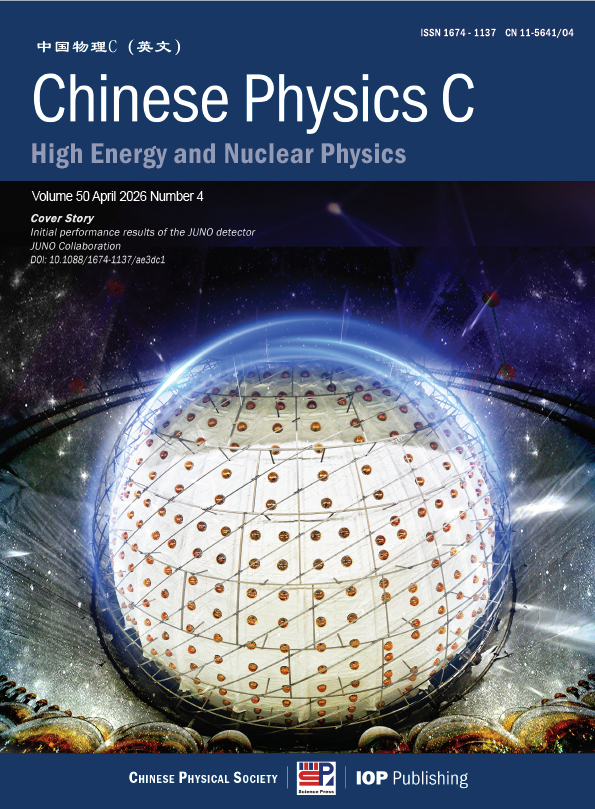
- Cover Story (Issue 4, 2026): Initial performance results of the JUNO detector
- Cover Story (Issue 3, 2026): Comprehensive investigation on baryon number violating nucleon decays involving an axion-like particle
- Cover Story (Issue 2, 2026) |The images of Brans-Dicke-Kerr type naked singularities
- Cover Story (Issue 1, 2026) A focused review of quintom cosmology: from quintom dark energy to quintom bounce
- Cover Story (Issue 11, 2025) The Earth-Magnet Assists DAMPE in Studying Cosmic Anti-Electrons
Advertising